


One-Year Deadline: How Colorado’s Dram Shop Law Blocks Claims
Yes, Colorado has a dram shop law, but it’s narrow by design. Colo. Rev. Stat. § 44-3-801 lets you sue a bar, restaurant, or social host only if you can prove they willfully and knowingly served alcohol to someone under 21 or someone visibly intoxicated. Three things matter immediately: the proof bar is high, you have one year to file, and damages are capped. If you’re in this situation, preserve evidence now and talk to an attorney before that clock runs out.
Table of Contents
- What Colorado’s Dram Shop Statute Actually Says
- Who Can Be Sued: Licensees, Social Hosts, and Who’s Left Out
- The Three Elements That Make or Break a Dram Shop Claim
- The One-Year Deadline and What You Can Actually Recover
- Evidence That Wins (or Loses) a Dram Shop Case
- How an Attorney Strengthens a Dram Shop Claim
- Why the Causation Fight Matters More Than People Think
- How Stubbornattorney Helps After an Alcohol-Related Injury
- Sources
- FAQ
What Colorado’s Dram Shop Statute Actually Says
Colorado starts from the opposite premise most people assume. The default rule under state law is that the person who drank the alcohol, not the business that sold it, caused whatever happened next. Colo. Rev. Stat. § 44-3-801 builds in only a couple of narrow carve outs to that rule, and dram shop lawsuits live entirely inside those carve outs.
The public-law text of § 44-3-801 spells out the legislative reasoning directly: consumption of alcohol, rather than its sale, is generally treated as the “proximate cause” of any resulting injury. That single sentence explains why so many dram shop claims fail before they get anywhere near a jury. Unless a victim can slot their facts into one of the statute’s specific exceptions, there’s no case.
The two paths to liability are:
- Service to a minor. A licensee willfully and knowingly sold or served alcohol to someone under 21.
- Service to a visibly intoxicated adult. A licensee willfully and knowingly sold or served alcohol to a person who was visibly intoxicated at the time of service.
Notice the word doing all the work here: “willfully and knowingly.” Colorado doesn’t punish a bartender for missing subtle signs of intoxication. It punishes a business for serving someone when the intoxication, or the person’s age, was obvious enough that continuing to pour was a conscious choice.
Who Can Be Sued: Licensees, Social Hosts, and Who’s Left Out
Colorado draws a firm line between businesses that hold a liquor license and private individuals who serve drinks at a party. That line changes both what you have to prove and how far your claim can reach.
Licensees are the primary target of dram shop claims. This category covers:
- Bars, taverns, and nightclubs
- Restaurants with a liquor license
- Liquor stores and package retailers
- Hotels, event venues, and caterers operating under Colorado liquor licensing rules
Because licensees are regulated, trained, and legally accountable for how they serve alcohol, the statute treats them as the main class of defendants when the willful and knowing standard is met.
Social host liability covers private individuals, typically someone who threw a party and served alcohol to a minor. The reach here is much narrower than what most people expect from “social host” laws in other states. Colorado’s version generally limits liability to situations involving underage guests. A host isn’t automatically on the hook for every intoxicated adult who leaves their party and causes a crash.
There’s also a limit on who can sue in the first place. Colorado’s statute restricts certain claims by the intoxicated person themselves against the vendor who served them, which is why most successful dram shop cases come from third parties injured by someone else’s drinking, not from the drinker suing the bar that served them.
The Three Elements That Make or Break a Dram Shop Claim
Winning a Colorado dram shop case comes down to proving three things, and each one carries its own evidentiary headache.
- Willful and knowing service. This is the highest bar in the statute. You need more than a bartender’s bad judgment call, you need evidence the server or vendor consciously ignored obvious signs. Server training records, prior citations, and internal bar policies on cutting off patrons often become central exhibits here.
- Visible intoxication (or underage status). Courts look at objective, observable signs: slurred speech, stumbling, glassy eyes, slowed reactions, or a tab showing an unusually large number of drinks in a short window. A receipt showing six cocktails in ninety minutes tells a very different story than one showing a beer with dinner.
- Causation. You must connect the specific alcohol that vendor sold to the intoxication that caused your injury. This is where a lot of otherwise strong cases collapse.
That third element got a lot sharper after Mitton v. Danimaxx of Colorado (2023COA18). The Colorado Court of Appeals made clear that plaintiffs have to draw a real line between the defendant’s service and the intoxication behind the injury, not just show the person had been drinking somewhere that night. If someone drank at one bar, then kept drinking at a second location before causing a crash, the first bar’s service can become legally disconnected from what happened later. Defense attorneys now lean on this ruling constantly, arguing that post-sale drinking, a stop at another venue, or even time elapsed between last call and the incident broke the causal chain.
Pro Tip: If your case involves someone who visited more than one bar or party before the incident, timeline evidence, receipts, timestamps, and witness accounts of exactly when and where drinking happened, can be the difference between a viable claim and one that gets dismissed on causation grounds.
The One-Year Deadline and What You Can Actually Recover
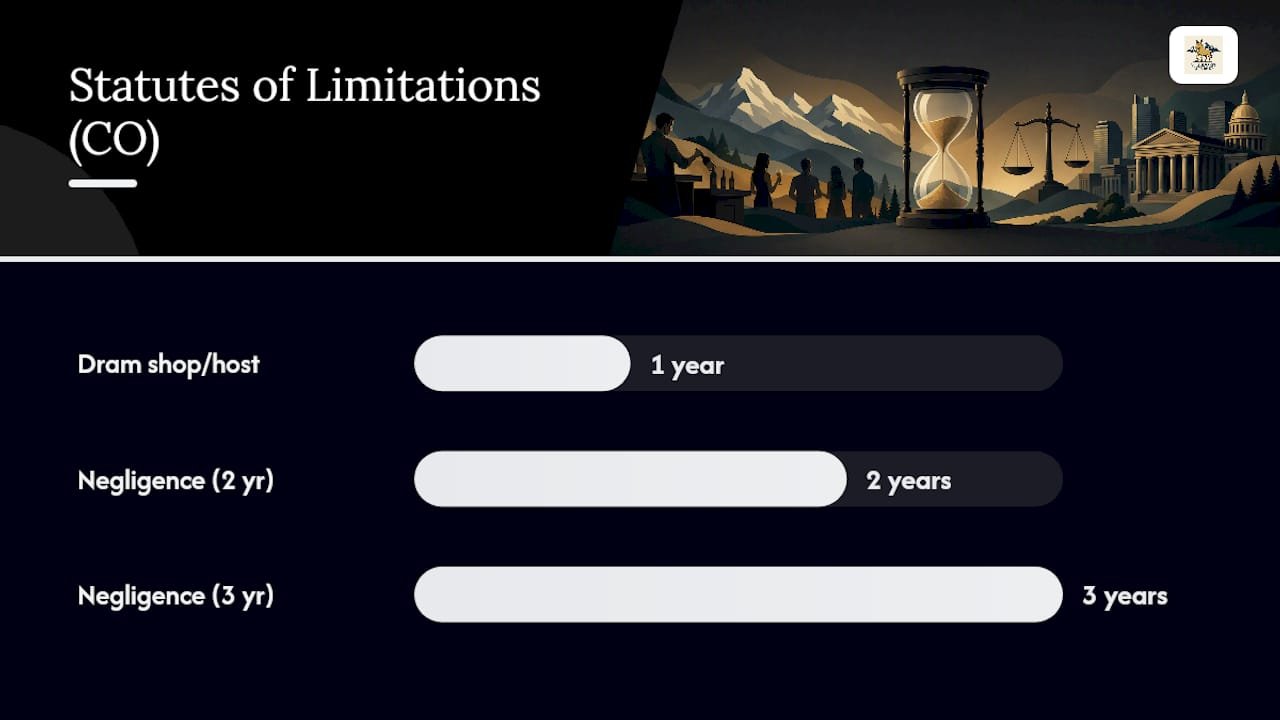
Colorado gives dram shop and social host victims far less time than most personal injury claims allow. Standard negligence cases in Colorado typically run on a two or three-year statute of limitations depending on the type of claim. Dram shop and social host claims get one year, full stop.
- File within one year of the incident, or the claim is almost always barred permanently, regardless of how strong the underlying evidence is.
- Damages are capped under the statute, with the cap periodically adjusted for inflation rather than fixed forever at one number.
- Missing the deadline doesn’t just weaken your case, it typically ends it. Courts treat this window as close to jurisdictional, meaning late filing usually results in dismissal with prejudice rather than a second chance.
Nolo’s breakdown of Colorado’s dram shop and social host statute confirms that the legislature revisits these caps periodically to account for inflation, so the exact ceiling on recoverable damages shifts over time. That’s one more reason to get a current read on the numbers from an attorney rather than relying on an old article or a number a friend mentioned.
One year sounds like plenty of time until you’re dealing with hospital bills, insurance calls, and grief. It isn’t. Evidence that matters most in these cases, like surveillance footage and POS logs, often gets deleted or overwritten in a matter of weeks, long before most people even think about consulting a lawyer.
Evidence That Wins (or Loses) a Dram Shop Case
Because the willful and knowing standard is so demanding, dram shop cases live or die on documentation. The kind of proof that actually moves these cases forward includes surveillance video, itemized tabs and receipts, point-of-sale timestamps, server training logs, and statements from bartenders, servers, and other patrons who were present.
- Request surveillance footage immediately. Most bars and restaurants overwrite security video on a 30 to 90-day cycle. If you wait even a few weeks to ask, the footage showing how much someone drank and how staff reacted may already be gone.
- Send a preservation letter. A formal written request, ideally through an attorney, puts the business on legal notice that it must retain video, POS data, and staff schedules or risk sanctions for destroying evidence.
- Photograph everything you can access. The scene, receipts left behind, and even the state of the establishment matter more than most people realize.
- Collect witness names and contact information on the spot. Other patrons, staff members, and even the designated driver who wasn’t drinking often disappear from memory within days.
- Get medical records early. Blood alcohol readings taken shortly after the incident can become critical corroborating evidence for the intoxication element.
Pro Tip: Chain of custody matters as much as the evidence itself. A surveillance clip that changes hands informally, through texted phone videos or unofficial copies, can be challenged in court. Getting evidence preserved and documented through a formal request protects its value later.
Reviewing steps that strengthen an injury claim after any alcohol-related crash can help you understand what adjusters and defense attorneys will scrutinize first.
How an Attorney Strengthens a Dram Shop Claim
A one-year deadline paired with a “willful and knowing” standard is not a do-it-yourself project. An experienced attorney typically moves on several fronts at once:
- Sending preservation letters and subpoenas before surveillance footage or POS data disappears
- Tracking down and interviewing witnesses while memories are still fresh
- Evaluating whether the causation chain, especially under the Mitton standard, actually holds up
- Filing suit well ahead of the one-year cutoff, not against it
- Negotiating with the vendor’s insurer or litigating if a fair settlement isn’t on the table
At intake, bring whatever you have: incident reports, medical records, photos, receipts, and names of anyone who witnessed the events. Most Colorado personal injury firms, including Stubbornattorney, handle these cases on contingency, meaning you owe nothing upfront and nothing at all unless the case results in a recovery. Timelines vary, but expect months rather than weeks, particularly when a case involves appellate-sensitive causation issues like the ones raised in Mitton.
Why the Causation Fight Matters More Than People Think
Most articles on dram shop law spend all their energy on the “willful and knowing” standard and barely mention causation. That’s backwards. In practice, causation is where I’ve seen these cases actually get won or lost, especially now that Mitton v. Danimaxx gave defense attorneys a clean, citable argument for breaking the chain between a bar’s pour and a plaintiff’s injury.
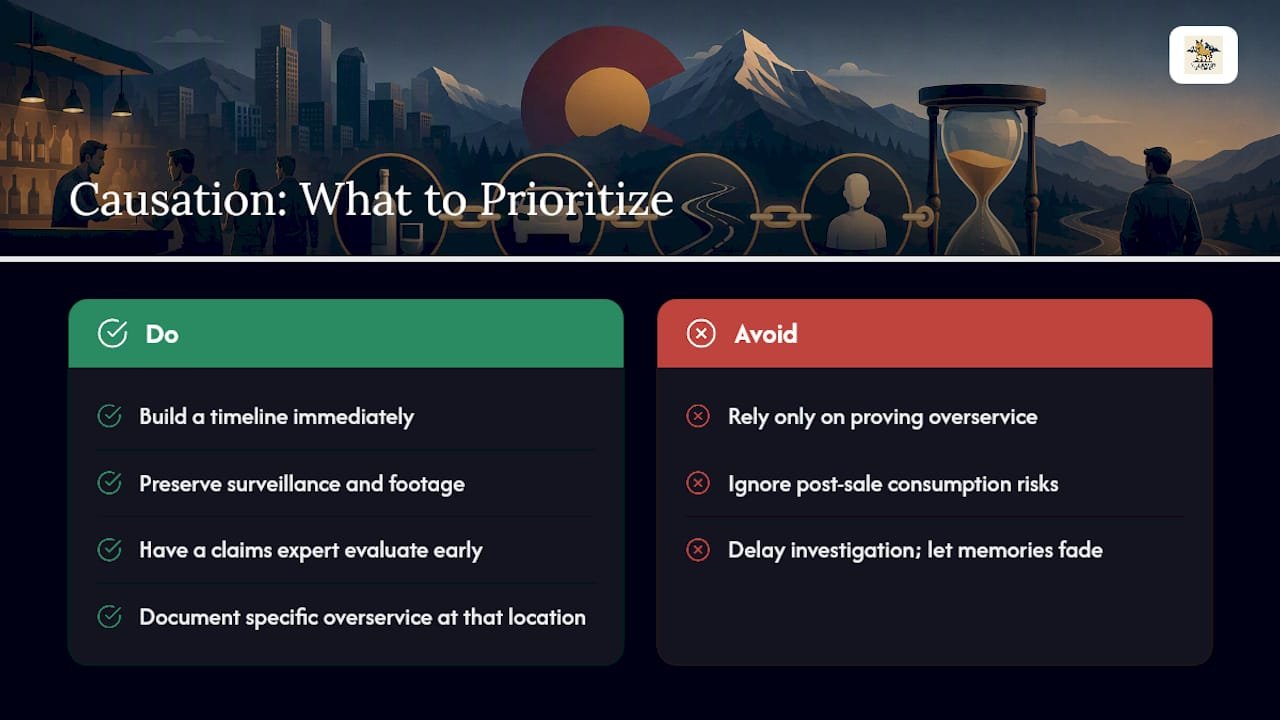
Here’s what that means for real people: it’s not enough to prove a bar overserved someone. You have to prove that specific overservice, at that specific location, is what caused the intoxication behind your injury. If your case involves someone who bar-hopped, or if there’s a gap of an hour or two between last call and the incident, expect the defense to make post-sale consumption their entire strategy. That’s not a reason to give up on a claim. It’s a reason to build a timeline before memories fade and footage gets erased, and to have someone who understands claims evaluation, on both the plaintiff and insurer side, looking at the case from day one.
I spent years as a federal claims adjudicator before I started representing injury victims, which means I’ve sat on the other side of this exact kind of fact pattern. Insurers and defense teams look for gaps in causation first, not last. Malnar Injury Law has handled hundreds of injury cases and recovered millions in settlements by treating that gap as the priority, not an afterthought.
— Ryan
How Stubbornattorney Helps After an Alcohol-Related Injury
Dram shop cases move fast and punish delay, which is exactly where Stubbornattorney’s approach pays off for Colorado families. Instead of getting handed off to a case manager, your claim gets direct attorney attention from day one, which matters enormously when preservation letters and witness interviews need to happen within days, not weeks. The firm’s lead attorney has experience as a federal claims adjudicator and understands how insurers evaluate causation disputes, which helps in building cases to close evidence gaps early.
Stubbornattorney represents injury victims and families across wrongful death and impaired-driving crash cases on contingency, so you pay nothing unless there’s a recovery. If someone you love was hurt or killed because a bar or host kept serving an obviously intoxicated person, get a free case evaluation now and start the evidence-preservation clock running in your favor, not the defense’s.
Sources
- Justia — Colorado Revised Statutes § 44-3-801
- Colorado Public Law — C.R.S. § 44-3-801
- Clark Hill — Colorado Dram Shop Liability: connection between alcohol sold and intoxication required
- Nolo — Colorado dram shop and social host liability
Damages caps under the statute are periodically revised, so confirm the current figures with an attorney rather than relying on a fixed number from an older source.
This article is general information, not a substitute for advice from a qualified lawyer. Consult a qualified legal professional about your own circumstances before acting on anything here.
FAQ
Which States Have Dram Shop Laws?
Most states, including Colorado, have some form of dram shop law, though the standards vary widely. Some states allow claims for ordinary negligence in overserving a patron, while Colorado requires proof of willful and knowing service under § 44-3-801, making it one of the stricter versions in the country.
Can I Still Buy Hard Liquor in Grocery Stores in Colorado?
Yes. Colorado changed its liquor licensing rules to allow full-strength beer, wine, and spirits in grocery and convenience stores that hold the proper license, a shift from the state’s older three-tier restrictions. That licensing expansion doesn’t change dram shop liability rules; any licensed retailer that willfully and knowingly sells to a minor or a visibly intoxicated person can still face a claim under the same statute.
What Is a Dram Shop Lawsuit?
A dram shop lawsuit is a civil claim against a licensed alcohol vendor, or in narrower cases a private social host, for injuries caused by someone the vendor served while underage or visibly intoxicated. In Colorado, these claims require proving willful and knowing service and must be filed within one year, both stricter requirements than a typical personal injury case.
Where Can You Purchase Liquor in Colorado?
Liquor stores, licensed grocery and convenience stores, bars, restaurants, and licensed event venues can all sell alcohol under Colorado’s liquor licensing system. Every one of those licensees is subject to the same dram shop liability rules if they knowingly serve a minor or someone visibly intoxicated.
How Is a Dram Shop Claim Different From a Regular Negligence Claim?
A standard negligence claim only requires showing a business failed to act reasonably, while a Colorado dram shop claim requires the tougher “willful and knowing” standard plus proof of direct causation between the sale and the injury. The filing deadline is shorter too, one year instead of the two or three years typically allowed for general negligence claims.