


Act Within 72 Hours: Spoliation Letter Templates for Car Accidents
Send a spoliation letter, also called an evidence preservation letter, the moment you know a crash caused real injury or damage. Notify the other driver, the vehicle owner, any trucking carrier involved, all insurers, and any business or vendor with camera or telematics systems nearby. Dashcam footage, 911 call recordings, and event data recorder logs get overwritten or auto-deleted within days, so waiting even a week can cost you the case’s best proof.
Table of Contents
- What a Spoliation Letter for a Car Accident Actually Does
- Why Timing Wrecks More Cases Than Bad Facts
- The Order to Preserve Evidence After a Crash
- Who Gets the Letter and How to Address It
- How to Write a Spoliation Letter (With Two Templates)
- When a Preservation Letter Changes the Outcome of a Case
- Why Most People Send These Letters Too Late, or Not at All
- If You Need Help Preserving Evidence After a Crash
- Where to Verify Preservation and Retention Rules
- Sources
- FAQ
What a Spoliation Letter for a Car Accident Actually Does
A spoliation letter, sometimes called an evidence preservation notice, is a written demand telling a person or company to stop destroying anything related to a crash. It doesn’t ask for documents yet. It just freezes the evidence in place so nothing disappears before a claim gets filed.
Once a party receives that notice, they’re on legal footing they can’t easily walk away from. Courts weigh the timing of notice heavily in spoliation disputes. Under Federal Rule of Civil Procedure 37(e), a party that loses electronically stored information after being put on notice faces a two-tiered set of consequences: milder curative measures if the loss was negligent, and harsher sanctions like an adverse-inference instruction if a court finds intent to deprive. A well-timed letter is often the difference between those two outcomes.
A spoliation letter isn’t a subpoena and carries no independent enforcement power on its own. What it does is create a documented record that the recipient knew preservation mattered, which is exactly the record you need if evidence later goes missing. Effective letters tend to include:
- A clear statement that litigation is anticipated
- The exact incident date, time, and location
- Named systems, devices, or accounts believed to hold evidence
- A request to suspend routine deletion or backup rotation
Why Timing Wrecks More Cases Than Bad Facts
Most crash evidence has a shelf life measured in days, not months. Commercial dashcams and store security systems commonly loop and overwrite footage within a short window, sometimes in as little as 72 hours if no one flags it for retention. Event data recorders, the “black box” units in modern vehicles, only capture a set number of trigger events before older data gets pushed out by new activity, especially if the vehicle keeps being driven.
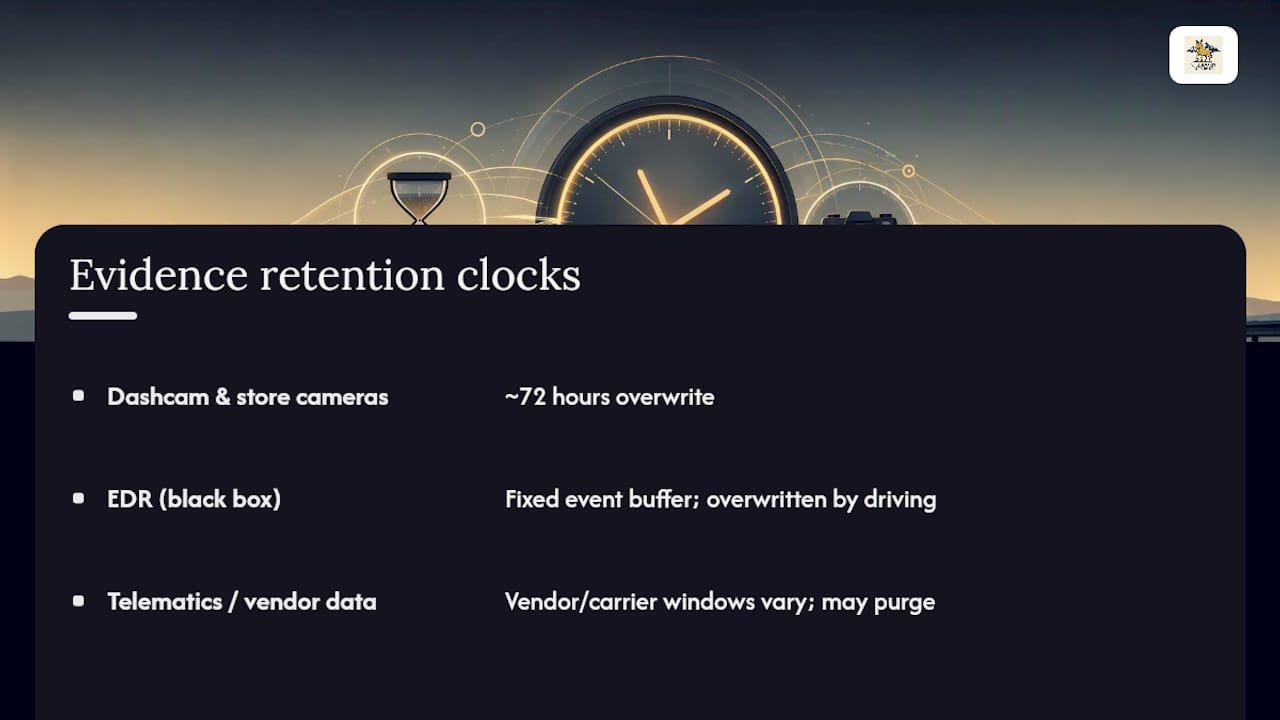
Trucking cases carry their own retention clock. FMCSA rules require motor carriers to retain electronic logging device data and supporting documents for specific periods, but those windows still close, and some telematics vendors purge raw GPS and camera data on their own separate schedule regardless of what the carrier keeps. That mismatch is exactly where evidence quietly vanishes.
Timing also shapes the legal remedy available later. Evidence lost before anyone sent notice usually gets treated as ordinary negligence, if it’s treated as spoliation at all. Evidence lost after a documented preservation letter went out looks very different to a judge. That gap is why the letter needs to go out in days, not weeks.
The Order to Preserve Evidence After a Crash
Not every piece of evidence is equally fragile. Send your letter and requests in this order, starting with what disappears fastest:
- Dashcam and nearby surveillance video. Identify every camera that could have captured the crash, including the other drivers’, nearby businesses, and traffic cameras, and request exports within 48 hours of the crash if possible.
- Event data recorder (EDR) downloads. Ask the vehicle owner or carrier to stop driving or repairing the vehicle until the black box data is imaged by a qualified technician.
- ELD and telematics logs. For truck crashes, request the driver’s electronic logging device data, GPS pings, and hours-of-service records before the retention window closes.
- Maintenance and inspection records. These show whether mechanical failure or deferred maintenance played a role, and shops routinely purge older work orders.
- Driver qualification files and dispatch records. Relevant mainly in commercial cases, these show hiring history, training, and whether the carrier knew about prior violations.
When you send any request, ask specifically for native file formats and embedded metadata, not a screenshot or a converted PDF. A re-encoded video file loses timestamp data that can matter enormously if footage authenticity gets challenged later. Also ask the recipient to state their normal retention schedule for that system, since it tells you exactly how much runway you actually have.
Pro Tip: Always send your preservation letter by certified mail and email simultaneously, then calendar a follow-up call some days before you expect the recipient’s shortest retention window to close. That single habit catches more lost footage than any other step in this process.
For a broader rundown of what qualifies as usable evidence in an injury claim, see this practical evidence checklist, which pairs well with the preservation steps above.
Who Gets the Letter and How to Address It
Send separate, targeted letters rather than one generic notice blasted to everyone. Recipients typically include:
- The other driver and, separately, the registered vehicle owner if different
- The trucking company or carrier, plus any leasing or brokerage entity involved
- Every insurer with potential exposure, including the driver’s and any commercial policy
- Dashcam, telematics, or GPS vendors that store data outside the carrier’s own systems
- Property or business owners whose exterior cameras may have captured the scene
- Hospitals or EMS providers, when medical records or incident reports matter to the claim
Address the letter to a company’s registered agent or records custodian, not a generic info@ inbox, unless you already know litigation counsel has been retained. Once a lawyer appears on the other side, route all further preservation correspondence through them instead. For nonparty vendors and small businesses, addressing a manager or owner directly usually works fine.
Whatever method you use, keep proof of delivery. Certified mail with a return receipt, plus a same-day email with read confirmation, gives you two independent records that notice actually landed. Save both.
How to Write a Spoliation Letter (With Two Templates)
A strong preservation letter follows the same skeleton every time, regardless of who receives it. Each clause exists to close off a specific excuse the recipient could otherwise raise later.
- Incident identification: date, time, location, and any police report or claim number.
- Litigation-notice statement: a sentence putting the recipient on formal notice that litigation is anticipated.
- Specific evidence list: named systems, devices, or file types, never a vague “all relevant records.”
- Suspension request: an explicit instruction to pause auto-deletion, backup rotation, or routine purging tied to those systems.
- Native format and metadata demand: a request for original files, not converted copies.
- Retention schedule request: ask the recipient to disclose how long the system normally holds data.
- Acknowledgment deadline: a short window, typically 5 to 10 business days, for written confirmation.
- Proof-of-service note: state the letter was sent by certified mail and email, and request a signed acknowledgment back.
Model preservation language along these lines, drawn from litigation-hold templates used in civil practice, has held up well in court because it names systems instead of speaking in generalities, according to drafting guidance from LegalClarity.
Template A: Short Nonparty Notice (for a witness, nearby business, or homeowner with a camera)
“On [date], a motor vehicle collision occurred near [location/address]. We represent or are assisting [name] in connection with this incident. We request that you preserve any video, audio, or electronic recordings from your security or camera systems covering the period [start time] to [end time] on [date], including native export files and any available metadata. Please do not delete, overwrite, or archive this footage in the ordinary course of business. Kindly confirm receipt of this request within 5 business days.”
Template B: Full Preservation Letter for Carriers and Insurers
“This letter serves as formal notice that litigation is anticipated arising from the motor vehicle collision on [date] at [location], involving [vehicle description/plate] operated by [driver name]. You are hereby directed to preserve all electronically stored information and physical evidence related to this incident, including but not limited to: event data recorder (EDR) downloads, electronic logging device (ELD) records, telematics and GPS data, dashcam footage, maintenance and inspection records, driver qualification files, and dispatch communications for the period [date range]. Please suspend any automatic deletion, backup rotation, or document destruction policy applicable to these records. We request native-format exports with associated metadata and ask that you identify your standard retention schedule for each system listed. Please confirm receipt and compliance in writing within 10 business days.”
Keep every request narrow. Naming the exact vehicle, date range, and system avoids a recipient later claiming the request was too broad to comply with in good faith, a point litigation-hold drafting guidance makes directly.
When a Preservation Letter Changes the Outcome of a Case
Preservation letters do their real work quietly, long before a case ever sees a courtroom. A carrier that receives a properly worded notice within days of a crash is far less likely to let its telematics vendor purge GPS pings on the standard 30-day cycle, simply because someone internally now has to justify not preserving them. That single letter can be the reason black box data still exists six months later when a case actually gets filed.
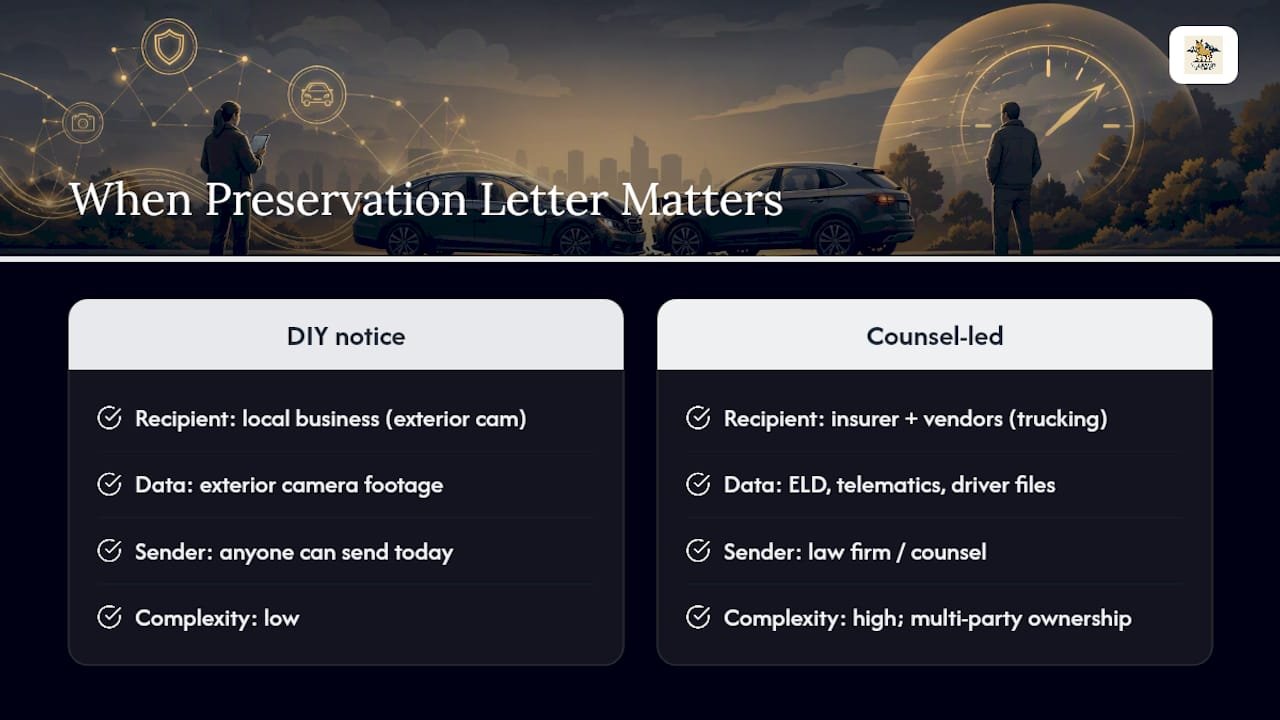
The harder judgment call is knowing when a short DIY notice is enough and when the situation calls for counsel immediately. A notice to a local business asking them to hold onto exterior camera footage is something anyone can send today. A notice to a trucking company’s insurer, involving ELD data, driver qualification files, and multiple layers of corporate ownership, is a different animal entirely. Getting the addressee wrong can mean the letter never reaches anyone with authority to act on it.
That’s the point where firms like Malnar Injury Law step in: identifying every vendor in the chain, issuing formal preservation demands, coordinating EDR imaging with qualified technicians, and moving to subpoenas fast when a party ignores a notice. If you’re unsure whether you’re dealing with a simple case or a multi-party trucking claim, that’s worth figuring out early.
Why Most People Send These Letters Too Late, or Not at All
The biggest failure I see isn’t a badly written letter. It’s the letter that never gets sent because the person assumes their insurance company or the police report will handle evidence preservation automatically. Neither does. Insurers investigate their own exposure, not yours, and police reports rarely capture EDR data or vendor camera footage at all.
The conventional advice tells people to “document everything” after a crash, which is true but useless as a standalone instruction. Documenting the scene with your phone doesn’t preserve the other driver’s dashcam, the gas station’s exterior camera, or the trucking company’s ELD logs. Those require someone actively demanding preservation from a third party, in writing, before the retention clock runs out.
My honest read: the letter matters less for what it demands and more for the date on it. A notice sent on day three protects you in ways a notice sent on day twenty simply cannot, no matter how well written the later one is. Prioritize speed over polish. Send something narrow and specific this week rather than something exhaustive next month.
— Ryan
If You Need Help Preserving Evidence After a Crash
Legal professionals handle the parts of a spoliation claim most people can’t do alone: identifying every vendor and carrier in the chain, issuing formal preservation letters within days of a crash, coordinating EDR and ELD data imaging, and moving to subpoenas the moment a party stalls or refuses. Where a homeowner or witness notice is something you can send yourself, a multi-party trucking case with insurers, brokers, and telematics vendors is where a Colorado Springs personal injury lawyer earns its keep fast.
At your first contact, bring the crash date and time, photos, vehicle information, and any witness contacts you already have. Malnar Injury Law works on contingency, so evaluation costs nothing and preservation outreach can start while intake is still being finalized. Start with a free case evaluation and let the firm chase down evidence before it disappears.
Where to Verify Preservation and Retention Rules
For readers who want the underlying legal framework rather than summaries, the FMCSA’s record retention guidance covers exact ELD and supporting-document timelines. Model litigation-hold language comes from IAALS’s sample preservation letters, and courts applying Rule 37(e) sanctions are summarized in this New York courts spoliation guidance. For immediate post-crash action beyond preservation letters, this partner overview of first steps after a crash is a useful supplement.
Sources
- Sample Litigation Hold Letter and Electronic Data Preservation (IAALS)
- How long must motor carriers retain records, duty status RODS, and supporting documents? | FMCSA
- Spoliation (NY Courts guidance referencing Rule 37(e) and remedies)
- Evidence preservation letter guidance (Addison Law Firm)
- How to Write a Demand for Preservation of Evidence – LegalClarity
FAQ
Can You Provide an Example of a Spoliation Letter?
Yes. A short version for a nonparty (a witness or nearby business) asks them to preserve camera footage from a specific date and time window. A full version for a carrier or insurer names specific systems like EDR, ELD, and dashcam data, states that litigation is anticipated, and demands native files with a written acknowledgment deadline. Both templates appear in full above.
Who Can Send a Spoliation Letter?
Anyone involved in a crash, or their representative, can send a preservation notice. Individuals can send a basic version themselves for straightforward situations, but multi-party or trucking cases usually go further when handled by an attorney who can identify every custodian and follow up with subpoenas if a party ignores the request.
How Long Does It Take to Get a Settlement After a Demand Letter Is Sent?
Timing varies widely by case complexity, insurer responsiveness, and whether the evidence is well documented. Cases with clear, preserved evidence and cooperative insurers tend to move faster than disputed cases involving missing footage or contested fault.
How Much Are Most Car Accident Settlements Worth?
Settlement value depends heavily on injury severity, medical costs, lost income, and available insurance coverage, so there’s no single typical figure. Cases with strong preserved evidence, including EDR data and video, generally settle for amounts that better reflect the actual harm because fault and causation are harder to dispute.