

50% Rule and Special Verdicts in Colorado Comparative Negligence
That rule comes straight from C.R.S. § 13-21-111, which requires juries to return a special verdict listing total damages and a fault percentage for every party.
Table of Contents
- What Colorado Comparative Negligence Law Actually Says
- How Courts Decide Who Was at Fault
- How Fault Percentages Shape Settlement Negotiations
- The Math: What Damages Look Like at Different Fault Percentages
- Caps, Nonparties, and Other Ways Recovery Gets Reduced
- What a Decade of Claims Work Teaches You About Fault Fights
- Why Timing Matters More Than People Realize
- How Stubbornattorney Protects Your Recovery Under Colorado’s Fault Rules
- Where This Information Comes From
- Sources
- FAQ
What Colorado Comparative Negligence Law Actually Says
Colorado runs on a modified comparative negligence system, and the word “modified” is doing a lot of work in that sentence. It means fault has a ceiling. Cross it, and your claim disappears no matter how badly you were hurt or how much the other driver also messed up.
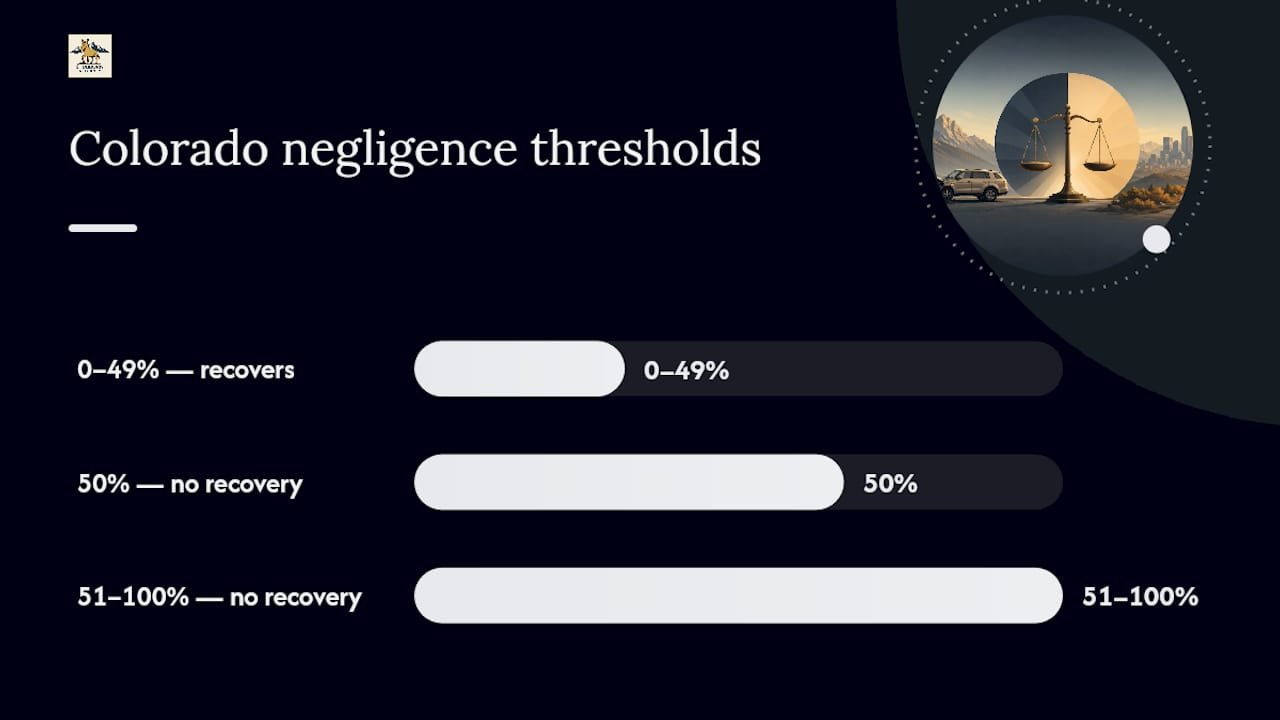
The statute itself reads almost plainly for a piece of legal text. C.R.S. § 13-21-111 states that contributory negligence does not bar a plaintiff’s recovery, but only when the plaintiff’s negligence is “not as great as” the negligence of the person being sued. The moment your share equals or exceeds the defendant’s, the door closes.
Here’s how that plays out procedurally. The jury doesn’t just hand down a dollar figure. Under the statute, they first calculate what the plaintiff’s total damages would be if fault didn’t exist at all. Then they assign a percentage of negligence to each party involved. That’s the special verdict form in action, and it’s the mechanism that makes the whole system work.
Once those numbers exist, the judge does the math:
- If plaintiff fault is under 50%, the court reduces the damage award by that exact percentage and enters judgment for the reduced amount.
- If plaintiff fault is 50% or more, the court enters judgment for the defendant. The case is over, regardless of how large the original damage figure was.
- The reduction is proportional and automatic. There’s no separate hearing to argue about whether the reduction should apply once the jury has set the percentages.
This structure explains why so much of a personal injury case in Colorado ends up being fought over percentages rather than over whether an accident happened. Everyone typically agrees a crash occurred. The battle is over who caused how much of it, and that battle determines the entire payout. Consumer legal guides summarize this same threshold consistently: Nolo’s overview of Colorado injury law confirms that damages shrink in proportion to fault, and hitting 50% wipes out the claim entirely.
How Courts Decide Who Was at Fault
Fault percentages don’t come out of thin air. Juries build them from a specific stack of evidence, and the quality of that evidence often decides the case before anyone sets foot in a courtroom.
- Police reports. Responding officers document initial impressions, citations issued, and sometimes a preliminary fault opinion that shapes early settlement talks.
- Witness statements. Independent bystanders carry more weight than involved parties, since they have no stake in the outcome.
- Accident reconstruction. Engineers and reconstruction experts use skid marks, vehicle damage patterns, and event data recorder downloads to model exactly how a crash unfolded.
- Medical records. These connect the injury to the mechanism of the crash and can undercut arguments that a plaintiff’s own conduct worsened the harm.
- Photos and scene documentation. Timestamped images of vehicle positions, road conditions, and signage often settle disputes that would otherwise turn into a credibility contest.
Once that evidence is assembled, Colorado’s judicial instructions guide the jury through applying it. Chapter 9 of the pattern instructions, specifically Instructions 9:22 through 9:29, walks jurors through comparative negligence, including how to handle designated nonparties and multiple defendants on the verdict form.
Multi-defendant cases add a wrinkle that trips up a lot of claimants. The comparison isn’t simply “plaintiff fault versus everyone else’s fault combined.” In allocation scenarios involving several defendants, the plaintiff’s percentage gets weighed against the negligence attributed to the party or parties actually being pursued, and how that plays out can shift depending on how the case is structured. Practitioners note that this distinction can preserve a claim that would otherwise look hopeless on paper, particularly when one defendant is far more culpable than the others involved.
How Fault Percentages Shape Settlement Negotiations
Long before a jury ever sees a special verdict form, insurance adjusters are already doing this math themselves. That’s the part most people don’t expect.
Adjusters routinely assign a preliminary fault percentage to the claimant early in the process, often within days of the first phone call. That number becomes the anchor for every settlement offer that follows.
The trouble is that early fault assignments are frequently built on incomplete information. Adjusters work fast, and they work from whatever is in front of them, which is sometimes just a police report and a phone statement. Countering that number requires organized pushback, not just an argument over the phone.
Attorneys typically respond with a few specific moves:
- Preserving evidence before it disappears, including vehicle damage, skid marks, and surveillance footage that businesses often overwrite within weeks.
- Building a demand package that reframes the incident with witness statements, medical documentation, and reconstruction analysis the adjuster hasn’t seen.
- Pursuing targeted discovery and expert reports once litigation starts, specifically aimed at the percentage the insurer assigned.
Pro Tip: Get medical care immediately after any accident, even if you feel fine. Insurers use gaps in treatment as evidence that your injuries weren’t serious, and that argument can inflate your assigned fault percentage indirectly by undercutting your damages claim.
If you’re in the early stages of a claim, the fastest way to protect yourself is straightforward: document the scene before it changes, get checked out by a medical provider the same day if possible, and write down witness names and phone numbers while people are still standing there. Our guide on proving liability in a car accident claim walks through what that evidence collection looks like in practice.
The Math: What Damages Look Like at Different Fault Percentages
Numbers make this rule click in a way that statutory language never quite manages. Take a single-defendant crash with $100,000 in total damages, meaning the jury values the injury and losses at that figure before any fault reduction.
- 0% plaintiff fault: Full recovery. The plaintiff collects $100,000.
- 20% plaintiff fault: The award is reduced by that percentage, leaving $80,000, exactly the calculation method the DU Law Review’s explanation of comparative negligence describes.
- 49% plaintiff fault: The plaintiff still recovers, but only 51% of the total, or $51,000. This is the last dollar available under the statute.
- 50% plaintiff fault: Recovery is barred completely. The plaintiff receives nothing, even though the damages were identical to the 49% scenario.
Multi-defendant crashes complicate the picture further. The plaintiff’s fault gets weighed differently depending on how the claim is structured against each defendant, which is why allocation among multiple defendants often becomes its own separate negotiation. A defendant assigned a small share of fault has far less exposure than one assigned the majority, and attorneys build strategy around which defendant carries the bulk of the responsibility.
Caps, Nonparties, and Other Ways Recovery Gets Reduced
The fault percentage isn’t the only lever that shrinks a Colorado injury award. Two other mechanics deserve attention, because they can matter even when your fault percentage looks favorable.
Colorado law caps non-economic damages, the category covering pain and suffering rather than medical bills or lost wages. Practitioner commentary has tracked recent changes to these caps and how they interact with comparative fault math, since a capped non-economic figure gets reduced by fault percentage just like everything else, according to analysis from Berg Hill Greenleaf Ruscitti. Our breakdown of compensation types available to Colorado accident victims covers how economic and non-economic damages are categorized before any reduction applies.
Designated nonparties add another layer. Colorado allows a defendant to name someone who isn’t a party to the lawsuit, maybe a phantom driver, a third party who left the scene, and ask the jury to assign that person a fault percentage too. That percentage still comes out of the total, which can reduce what any actual defendant owes without adding a dime to what the plaintiff can collect.
A few procedural mistakes tend to inflate a plaintiff’s assigned fault more than anything else:
- Giving a recorded statement to an adjuster before consulting an attorney.
- Delaying medical treatment, which creates gaps insurers exploit.
- Failing to preserve physical evidence like vehicle damage or road conditions before they change.
- Missing the deadline to identify or respond to a designated nonparty filing.
What a Decade of Claims Work Teaches You About Fault Fights
Ryan Malnar built Stubbornattorney on more than a decade of personal injury practice, but the sharper edge comes from his earlier work as a federal claims adjudicator and adjuster. That background means he’s evaluated claims from the other side of the table, which changes how a case gets built from day one.
Attorneys who understand adjuster logic move differently. They assemble evidence before the insurer’s version of events hardens into the official story. They pull targeted medical records that isolate injury causation instead of dumping an entire chart that invites nitpicking. They bring in experts specifically to contest a percentage allocation, not just to prove the crash happened.
Insurance adjusters don’t guess at fault percentages. They calculate them using the same frameworks a former adjudicator recognizes immediately, which is exactly why contesting those numbers requires matching that precision rather than just disputing them in general terms.
Why Timing Matters More Than People Realize
I’ve spent enough time on both sides of claims work to know that the biggest damage to a case usually happens in the first two weeks, long before anyone hires an attorney. Evidence disappears, memories fade, and insurers lock in a fault narrative while the claimant is still figuring out how to pay medical bills. My background evaluating claims for the federal government taught me exactly how those early percentages get built, and that’s the insight I bring to every case here.
If you’ve been hurt in Colorado and fault is being disputed, don’t wait to find out where you stand. We offer a free case review, and you don’t pay anything unless we recover money for you.
— Ryan
How Stubbornattorney Protects Your Recovery Under Colorado’s Fault Rules
Legal representation exists for exactly the moment described above: when an insurance company hands you a fault percentage that doesn’t match what actually happened. Some law firms represent car, truck, motorcycle, bicycle, semi-truck, pedestrian, and slip and fall accident victims across Colorado, and some work on contingency, meaning clients pay nothing unless their case is won.
A free case review generally starts with an evaluation of your accident: what evidence already exists, what’s at risk of disappearing, and what the insurer’s early fault assignment gets wrong. From there, many cases move into evidence preservation and a formal demand package built to contest that percentage before litigation ever becomes necessary. Some cases resolve there. Others require discovery and expert work as described earlier in this article.
If you’re dealing with a fault dispute right now, start with a free case evaluation and find out where your claim actually stands.

Where This Information Comes From
This explanation draws directly on C.R.S. § 13-21-111, Colorado Judicial Chapter 9 jury instructions, and legal analysis from DU Law Review and Nolo.
This article is general information, not a substitute for advice from a qualified lawyer. Consult a qualified legal professional about your own circumstances before acting on anything here.
Sources
- Colorado Revised Statutes § 13-21-111 (Justia)
- Colorado Judicial Instructions, Chapter 9 (comparative negligence)
- Comparative negligence explanation (DU Law Review extract)
- Nolo: Colorado personal injury overview
FAQ
What does C.R.S. mean in Colorado law?
C.R.S. stands for Colorado Revised Statutes, the official codified body of state law. Section 13-21-111 is the specific statute governing comparative negligence in personal injury cases.
Is Colorado a no-fault state for auto insurance?
No. Colorado is an at-fault state, meaning the driver who caused the accident is financially responsible for damages, which is why fault percentage determinations under comparative negligence matter so much in Colorado injury claims.
Can I still recover damages if I was partly at fault for my Colorado accident?
Your damages get reduced by your percentage of fault, and a firm like Stubbornattorney can help contest an inflated fault assignment from an insurance adjuster.