
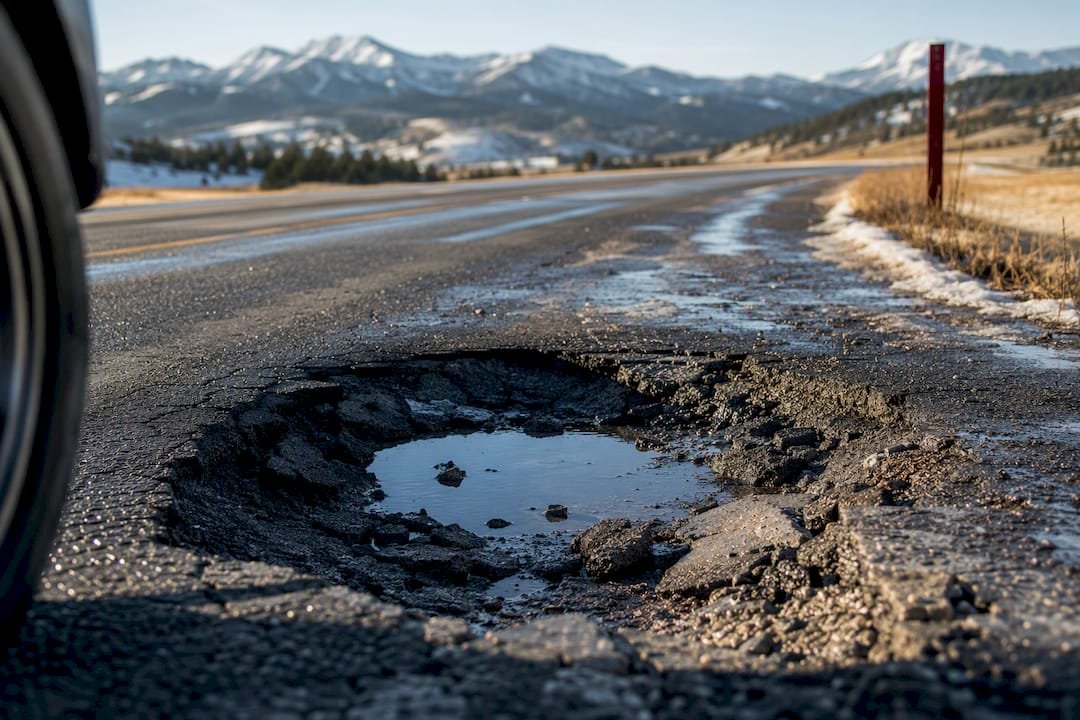
Colorado Pothole Claims: Attorney Vetted, Prove Notice in 182 Days
You can file a pothole damage claim against a Colorado government agency, but you have to move fast and document everything. State law gives you exactly 182 days from the incident to send a written Notice of Claim to the right agency, and the agency will only pay if you can prove it knew about the pothole beforehand and failed to fix it within a reasonable time. Preserve your evidence today, report the pothole, and get that notice in the mail before the clock runs out.
Table of Contents
- How to File a Pothole Damage Claim in Colorado
- What Evidence Do You Need to Document Pothole Damage?
- What Are Colorado’s Deadlines for Pothole Claims?
- How Do Agencies Decide Whether to Pay a Pothole Claim?
- Should You File With Your Insurance Company Too?
- What Should You Do in the First 7 to 14 Days?
- When Does a Lawyer Actually Change the Outcome?
- How Do You Sue a Government Entity for Pothole Damage?
- How Do You Negotiate a Pothole Settlement Before Suing?
- Does Comparative Negligence Affect a Colorado Pothole Claim?
- Where Should You Get a Repair Estimate?
- What Colorado Drivers Get Wrong About Pothole Claims
- Get Help With Your Pothole Damage Claim
- Sources
- FAQ
How to File a Pothole Damage Claim in Colorado
The first decision you have to make is who actually owns the road. That single fact determines which form you fill out, where you send it, and who reviews your claim.
If the pothole sits on a state highway or interstate, your claim goes through the State Office of Risk Management (SORM), which processes claims filed against Colorado state agencies including CDOT. If it’s a city street or county road, you file with that municipality’s clerk or city attorney’s office instead, using their own claim form and delivery instructions.
Here’s what filing actually requires:
- State roads: Complete SORM’s official New Claim Form, print it, sign it in ink, and mail or hand-deliver it to the address SORM specifies. SORM does not accept electronic submissions, so email or online forms won’t count.
- City and county roads: Contact the city attorney’s office or county clerk to get their specific claim form. Colorado Springs, Denver, and most larger municipalities publish their own notice-of-claim procedures separate from the state process.
- State highway reporting: Report the hazard to the Colorado Department of Transportation through its online form or regional maintenance hotlines. This doesn’t replace your formal notice, but it creates a paper trail showing the agency knew about the problem.
- Proof of delivery: Always use certified mail with return receipt requested, or get a signed, dated receipt if you hand-deliver. If your notice is challenged later, that receipt is often the only proof you filed on time.
Keep a photocopy of every form before you mail it. If SORM or the municipality claims they never received your notice, your copy and mailing receipt are what save your case.
What Evidence Do You Need to Document Pothole Damage?
Evidence wins or loses these claims. Adjusters at SORM and municipal risk offices have seen every version of “I hit a pothole” story, so specificity is what separates a credible claim from one that gets tossed.
- Photograph the pothole itself. Take close-up shots showing depth and size, plus wider shots that capture a landmark, street sign, or mile marker so the location is unmistakable.
- Photograph your vehicle damage from multiple angles, including tire sidewalls, rims, and undercarriage if you can safely access it.
- Get a written repair estimate or invoice that specifically ties the damage to a pothole impact, not general wear.
- Collect corroborating evidence: dashcam footage, witness names and phone numbers, and any 311 or CDOT report number you generated.
- Back up everything to cloud storage immediately. Phone photos carry timestamp and location metadata that strengthens your file, and you don’t want to lose it if your phone breaks.
Pro Tip: Use two phones or cameras if you can. One for tight close-ups of the pothole and damage, one for a wide shot that shows the road context and any nearby mile marker or cross street. Drop a pin on your GPS app the moment you stop, before you forget the exact spot.
Documenting your damage well from the start also matters if your claim ever escalates into a dispute over how injury documentation protects your accident claim when a pothole causes more than cosmetic damage.
What Are Colorado’s Deadlines for Pothole Claims?
The 182-day notice deadline is jurisdictional. That means a court has no discretion to excuse a late filing, no matter how good your excuse is or how strong your evidence turns out to be. Miss it, and your claim is permanently barred under the Colorado Governmental Immunity Act.
Once you file on time, the agency has up to 90 days to respond. If it doesn’t respond within that window, the claim is treated as denied, which opens the door to filing a lawsuit under the applicable statute of limitations.
| Deadline or Limit | Detail |
|---|---|
| Notice of Claim deadline | 182 days from the date of damage |
| Agency response window | Up to 90 days after a properly filed notice |
| Recovery cap consideration | Governmental Immunity Act caps apply, more relevant to injury claims than vehicle repair costs |
| Filing proof | Certified mail with return receipt, or signed hand-delivery receipt |
Recovery caps under the Governmental Immunity Act rarely limit a vehicle repair claim since repair costs are usually far below the statutory ceiling. Those caps become far more important once bodily injury enters the picture. For a deeper breakdown of how these windows interact with other injury deadlines, see key deadlines for Colorado injury claims.
How Do Agencies Decide Whether to Pay a Pothole Claim?
Adjusters are looking for one thing above all else: did the agency know about this pothole before your vehicle hit it? That’s the difference between actual notice and constructive notice, and it drives almost every outcome.
Actual notice means someone already reported the exact pothole, through a 311 call, a CDOT report, or a prior claim. Constructive notice means the hazard was so obvious or long-standing that the agency should have known regardless of a formal report. Investigators typically dig into:
- Maintenance logs and prior repair records for that stretch of road
- Existing 311 or CDOT complaint history tied to the location
- Site inspection notes and photos from agency staff
- Internal adjustment file notes from similar past claims
“Reasonable time to repair” is a flexible standard, but recent reporting on paid Colorado pothole claims found investigators cited repair delays exceeding roughly 30 days after notice as evidence the agency waited too long. Most denials come down to three things: no prior report existed, the pothole wasn’t judged severe enough to be a traffic hazard, or the agency argues it repaired the road within a reasonable window once notified.
Should You File With Your Insurance Company Too?
Yes, and you shouldn’t wait to decide between the two. Pothole damage typically falls under your collision coverage, and filing with your insurer usually gets your car repaired far faster than any government claim will.
A few things to weigh before you do:
- Your insurer may classify a pothole impact as a single-vehicle, at-fault collision, which can affect your premium even though no other driver was involved.
- Filing your government notice in parallel doesn’t cost you anything and preserves your right to reimbursement later.
- If the state or city eventually pays your claim, your insurer may pursue subrogation to recover what it already paid out. Keeping detailed records helps that process move smoothly.
- Tell your insurance adjuster you’ve also filed a government notice, and give them the SORM or municipal claim number for their file.
Coordinating both tracks is smart because so few government claims actually pay out. Using insurance to get your car fixed now, while a formal notice sits with SORM or your city, protects you either way.
What Should You Do in the First 7 to 14 Days?
Speed and order matter here. Follow this sequence and you’ll have a filing that holds up if it’s ever questioned.
- Immediately: Photograph the scene and your damage, collect any witness contact information, and drop a GPS pin or note the nearest mile marker.
- Within a few days: Get a written repair estimate, or pay for repairs and keep every invoice. Report the pothole to CDOT or your city’s 311 line and save the confirmation number.
- Within two to three weeks: Fill out the correct Notice of Claim form for the responsible agency, sign it in ink, and send it by certified mail with return receipt, or hand-deliver it and get a signed receipt.
- Follow-up: Request copies of the road’s maintenance and complaint logs, track your SORM or municipal claim number, and reach out to an attorney early if the agency denies your claim or asks for more documentation than seems reasonable.
Pro Tip: Set a calendar reminder for day 150 of the 182-day window, not day 180. That gives you a buffer if your form needs revisions or the mail takes longer than expected. Reporting an accident correctly the first time also helps if you need to reference how to report a car accident in Colorado as part of a broader claim.
When Does a Lawyer Actually Change the Outcome?
A lawyer earns their fee on these claims when the stakes go beyond a routine tire or rim replacement. That includes cases involving bodily injury, repair costs high enough to justify a fight, or a government agency disputing whether your notice was properly filed or timely.
What changes with representation is access. An attorney can draft a notice that’s jurisdictionally airtight, subpoena maintenance and complaint records the agency won’t hand over voluntarily, and negotiate directly with SORM or municipal adjusters who see these claims every week. Ryan Malnar spent years as a claims adjudicator for the federal government before practicing personal injury law in Colorado, which means he’s evaluated claims from the inside of the process these agencies use. That perspective matters most when a claim gets contested on notice grounds or when an insurer and a government agency are pointing fingers at each other over who should pay.
How Do You Sue a Government Entity for Pothole Damage?
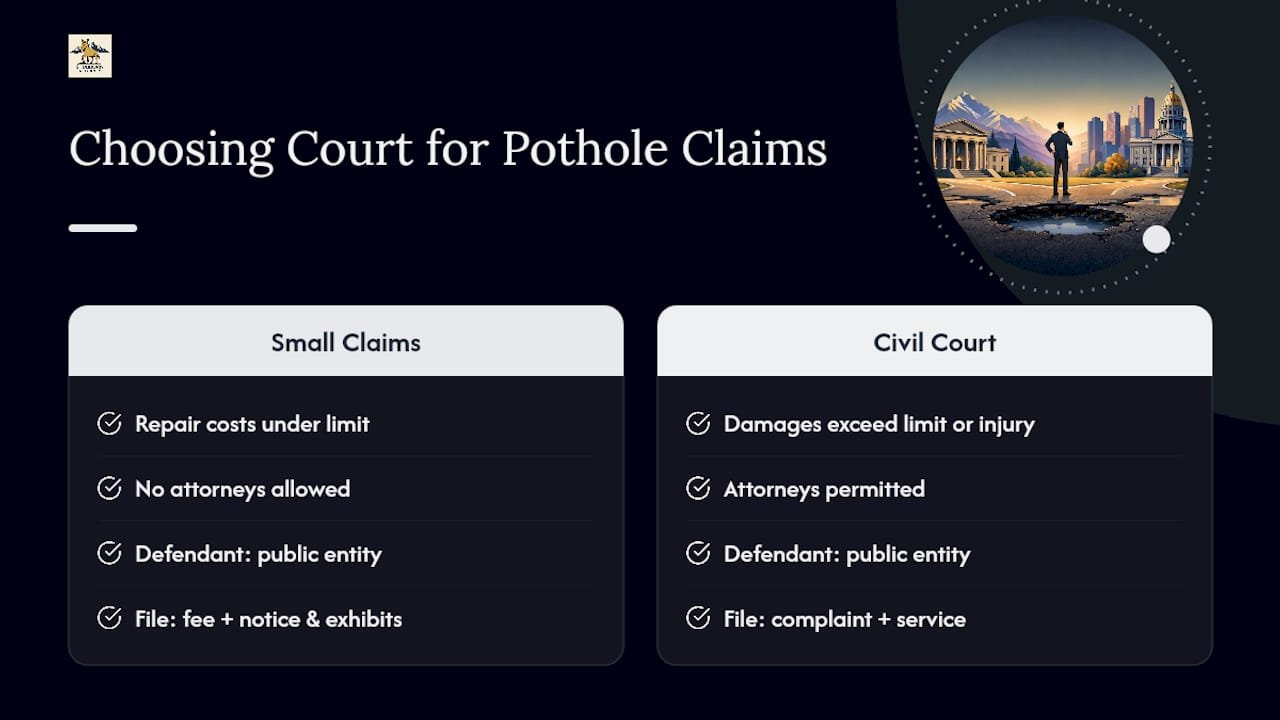
If your notice gets denied, or the agency never responds within 90 days, you have the right to sue. For straightforward vehicle repair costs, small claims court is often the practical route since it’s designed for disputes under a set dollar threshold and doesn’t require an attorney.
Start by confirming your denial is final and noting the date, since your statute of limitations for filing suit starts running from there. Colorado’s Governmental Immunity Act sets a two-year limit for most tort claims against public entities, though the clock and rules can shift depending on the type of claim and entity involved, so confirming your specific deadline matters.
To file in small claims court, you’ll typically need to identify the correct defendant (the state, county, or municipality, not an individual employee), pay a modest filing fee, and submit copies of your notice of claim, denial letter or proof of non-response, repair estimates, and photographs as exhibits. Small claims courts in Colorado generally don’t allow attorneys to represent either side, which keeps the process approachable for a repair-cost dispute.
If your damages exceed small claims limits, or your case involves injury rather than just vehicle repair, you’ll file in county or district civil court instead. That process involves a formal complaint, service on the defendant agency, and discovery, where you or your attorney can request the maintenance logs and prior complaint records that actually prove notice. Civil court moves slower and carries more procedural requirements, but it’s the only path when damages or complexity outgrow the small claims cap. Either way, the notice of claim you filed months earlier becomes the foundation of your entire case file.
How Do You Negotiate a Pothole Settlement Before Suing?
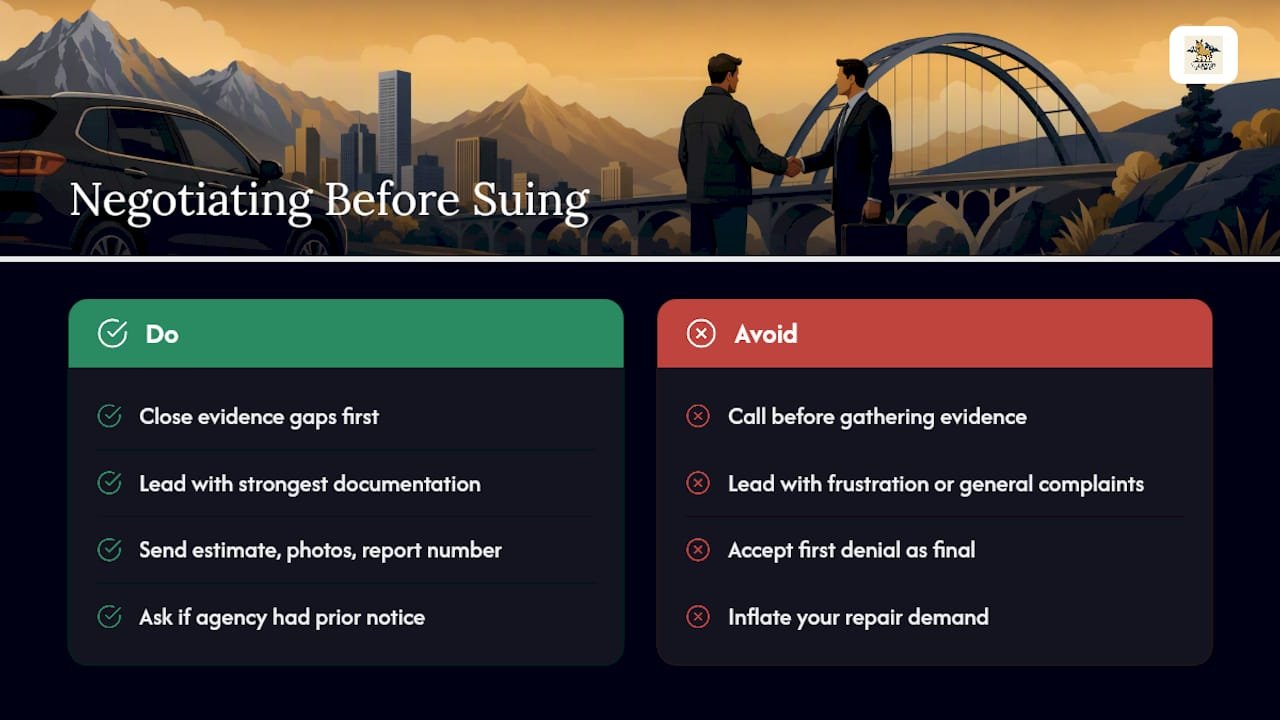
Government adjusters negotiate the same way private insurance adjusters do: they look for gaps in your evidence first. Close those gaps before you ever pick up the phone.
Lead with your strongest documentation, not your frustration. Send your repair estimate, photos, and any CDOT or 311 report number in your initial follow-up correspondence, and reference the exact dates involved. Adjusters respond to specifics, not general complaints about road conditions.
Ask directly whether the agency had prior notice of that particular pothole. If they had a maintenance record or a previous complaint on file, that’s leverage in your favor, and you’re entitled to ask what their records show. If they claim they had no notice, ask what their normal inspection schedule looks like for that stretch of road.
Don’t accept the first “your claim is denied” response as final if you haven’t asked what specific reason drove that decision. Many denials cite boilerplate language about no prior notice or reasonable repair time, but a follow-up request for the specific records behind that denial sometimes reveals the agency’s file is thinner than their letter suggests.
Set a realistic number based on your actual repair costs, not an inflated ask. These are taxpayer-funded settlements, and adjusters have far less room to negotiate upward than a private insurer negotiating a soft-tissue injury claim. If negotiations stall entirely, that’s the point where a lawsuit, or a consultation with an attorney about choosing legal representation that wins, becomes worth considering.
Does Comparative Negligence Affect a Colorado Pothole Claim?
Yes, and it can reduce or eliminate your recovery depending on how you were driving. Colorado follows a modified comparative negligence rule, which means if you’re found more than 50% at fault for the incident, you can’t recover anything at all.
For pothole claims, this usually plays out around speed and attentiveness. If you were driving well above the posted limit, distracted, or driving in conditions where a reasonably careful driver should have spotted and avoided the hazard, the government’s defense team will raise that as a percentage of fault against you. An agency that already has a weak defense on notice will often lean hard on your own driving behavior instead.
This is exactly why the evidence you collect at the scene matters beyond just proving damage. Weather conditions, visibility, whether the pothole was hidden by standing water or shadow, and your speed relative to the limit all factor into how a comparative negligence argument gets built against you. Dashcam footage is particularly valuable here because it can neutralize a fault argument before it ever gets raised.
Practically, if you were driving reasonably and the pothole was the kind of hazard a careful driver couldn’t have anticipated, comparative negligence rarely becomes the deciding factor. It becomes a real problem when your own driving gives the agency an easy argument to shift blame away from their road maintenance failures.
Where Should You Get a Repair Estimate?
Get your estimate from a shop that documents damage thoroughly, not just the cheapest quote you can find. A vague one-line estimate that just says “wheel and tire replacement” gives an adjuster nothing to work with and invites skepticism.
Look for a shop willing to write a detailed assessment connecting the specific damage, bent rim, sidewall bulge, suspension misalignment, to a single impact event rather than general wear. Dealership service departments and specialized alignment or suspension shops tend to produce more detailed, claim-ready paperwork than a quick-lube chain, since they’re used to writing estimates that insurance adjusters actually rely on.
If your damage involves suspension or alignment issues that aren’t visually obvious, ask the shop to note pre-existing wear separately from the new damage. That distinction protects you from an adjuster arguing your damage predates the pothole incident. For anything beyond a simple tire or rim replacement, a second opinion from an independent mechanic can strengthen your file if the first estimate gets challenged.
What Colorado Drivers Get Wrong About Pothole Claims
Most people assume filing a pothole claim is basically a formality, fill out a form, attach a receipt, wait for a check. That assumption is what causes so many claims to fail. The system isn’t built to reimburse you for road neglect. It’s built to protect government agencies from liability unless you can prove, with real documentation, that they already knew about the hazard and sat on it.
The conventional advice online tends to stop at “file within 182 days,” as if the deadline alone gets you paid. It doesn’t. The deadline just keeps your claim alive long enough for an adjuster to look for reasons to deny it. What actually moves the needle is whether you can show prior notice existed, whether repairs took longer than they should have, and whether your documentation is specific enough that denying you would look unreasonable on paper.
If I could get Colorado drivers to prioritize one thing, it’s this: treat the reporting step, the CDOT hotline call or the 311 report, as seriously as the notice form itself. That report is often the only piece of evidence that proves the agency knew. Everything else in your file supports that one fact.
— Ryan
Get Help With Your Pothole Damage Claim
Filing a government claim correctly the first time matters more than most drivers realize, and the team brings a former claims adjudicator’s view of how SORM and municipal adjusters evaluate these files. That inside perspective is the real difference between a notice that gets brushed aside and one an agency has to take seriously.
The firm works on contingency, so there’s no upfront cost and no fee unless you recover compensation. If your pothole claim involves an injury, a contested notice deadline, or an agency dragging its feet on repairs it already knew about, get a free case review with a personal injury lawyer before your 182-day window closes.
This article is general information, not a substitute for advice from a qualified lawyer. Consult a qualified legal professional about your own circumstances before acting on anything here.
Sources
- Submit a Claim | OSC – Office of the State Controller – Colorado
- Does Colorado pay out claims for damage caused by shoddy roads? Yes, but only rarely
- Hundreds of pothole claims made every year in Colorado are rarely paid out – CBS Colorado
- CDOT pothole repairs
- Colorado Revised Statutes (Title 24) — Governmental Immunity Act
FAQ
Can I be reimbursed for pothole damage in Colorado?
Reimbursement is possible if you file a written Notice of Claim within 182 days and can prove the agency had prior notice of the pothole and failed to repair it within a reasonable time, though reporting shows payouts remain rare.
How do I claim compensation for a pothole injury in Colorado?
Follow the same 182-day notice process required for property damage, but expect the recovery caps under the Governmental Immunity Act to play a larger role, and consider consulting an attorney given the higher stakes and documentation involved.
Can you claim from the city for pothole damage?
Yes, if the pothole is on a city street rather than a state highway, you file your notice with that city’s clerk or city attorney’s office using their specific claim form rather than SORM’s.
Can I get money from insurance if I hit a pothole?
Your collision coverage typically covers pothole damage once you file a claim, though your insurer may treat it as an at-fault single-vehicle incident that can affect your premium.
What is the deadline to file a pothole damage claim in Colorado?
You have 182 days from the date of the damage to file a written Notice of Claim with the correct state or municipal agency, and this deadline cannot be extended by a court.