

C.R.S. §42-4-802: Colorado Crosswalk Laws, Who Yields & Next Steps
Colorado law puts the burden on drivers: under C.R.S. §42-4-802, vehicles must yield to pedestrians in both marked and unmarked crosswalks whenever signals aren’t controlling the intersection. That right of way isn’t unconditional, though. Pedestrians must stick to sidewalks where they exist, cross legally, and never step off a curb into a car’s path so suddenly that a crash becomes unavoidable. Get either duty wrong, and Colorado’s traffic code treats it as a real violation, not a technicality.
Table of Contents
- What Colorado Crosswalk Laws Require of Drivers
- Pedestrian Rights and Duties Under Colorado Traffic Law
- Marked vs. Unmarked Crosswalks: What Actually Counts
- Signals, School Buses, and When the Rules Get Specific
- Penalties and Enforcement for Crosswalk Violations
- Speed Is the Variable That Decides Outcomes
- What to Do If You’re Hurt in a Colorado Crosswalk
- Get Help After a Colorado Crosswalk Accident
- Sources
- FAQ
What Colorado Crosswalk Laws Require of Drivers
Drivers carry the heavier legal duty here, and the statute is specific about it. Under C.R.S. §42-4-802, you must yield when a pedestrian is on your half of the roadway or close enough to be in danger, and this applies at intersections even without painted lines, not just where crosswalks are marked. When signals aren’t working or aren’t present, that yield obligation kicks in automatically.
The Colorado DMV adds two rules drivers routinely miss: never stop with any part of your vehicle inside a crosswalk, and never pass a vehicle that has stopped for a pedestrian. That second one causes a disproportionate number of crosswalk injuries, because the passing driver often has no idea someone is crossing until it’s too late.
A few habits keep you on the right side of the law and out of a courtroom:
- Slow down well before you reach a crosswalk, especially where visibility is poor.
- Check your turning path twice. Right-on-red turns are a leading cause of driver-pedestrian conflicts.
- Make eye contact with pedestrians waiting at the curb before proceeding.
- Watch for people using wheelchairs, canes, or guide dogs, who may need more crossing time.
Pro Tip: In rain, snow, or low light, cut your normal crosswalk approach speed further. Reduced visibility is exactly when Colorado’s yield law gets tested hardest, and it’s the scenario where drivers most often claim they “never saw” the pedestrian.
Pedestrian Rights and Duties Under Colorado Traffic Law
Pedestrian right of way in Colorado comes with strings attached. CDOT’s pedestrian guidance requires walking on sidewalks whenever they’re available, and when there’s no sidewalk, you walk on the left side of the road, facing traffic. Crossing outside of a marked or intersection crosswalk means you must yield to vehicles, not the other way around, and stepping off a curb abruptly into a car’s path remains illegal even if you technically had the right to cross there.
Mid-block crossings only count as legal crosswalks if they’re actually marked. Between two signalized intersections, jaywalking penalties in Colorado apply if you cross anywhere else, since state law prohibits crossing outside a marked crosswalk in that stretch.
A simple routine cuts your risk every time you cross:
- Stop at the curb and look left, right, then left again.
- Make eye contact with approaching drivers before stepping off the curb.
- Cross at a marked crosswalk or intersection whenever one is within reasonable reach.
- Keep watching traffic the entire time you’re crossing, don’t just glance once and go.
- Never step out suddenly from between parked cars or other sightline obstructions.
Marked vs. Unmarked Crosswalks: What Actually Counts
Under C.R.S. §42-1-102(21), a legal crosswalk exists at every intersection, whether or not it’s painted, as the area connecting the sidewalks on either side. That surprises a lot of drivers: no paint doesn’t mean no crosswalk and no yield obligation.
Marked crosswalks, the painted lines you see mid-block or at busy intersections, exist because CDOT applies engineering warrants before installing them, weighing traffic volume, speed, road width, and pedestrian counts. That’s not bureaucratic caution for its own sake. Research summarized in FHWA’s crosswalk marking guidance has found that paint alone on a wide, high-speed road can actually increase collisions if it isn’t paired with something else:
- Pedestrian refuge islands on multi-lane roads
- Rectangular rapid-flashing beacons or pedestrian hybrid signals
- Curb extensions that shorten crossing distance and improve sightlines
The legal right to cross doesn’t change based on which category you’re in, but your actual safety margin does.
Signals, School Buses, and When the Rules Get Specific
Pedestrian-control signals carry their own legal weight. A steady “Walk” means you have the right of way to start crossing. A steady “Don’t Walk” means don’t start, period. A flashing “Don’t Walk” means finish crossing if you’re already in the intersection, but don’t step off the curb after it starts flashing. Some intersections run an exclusive pedestrian phase that stops all vehicle traffic in every direction, and drivers must hold completely still until it ends.
School buses add another layer. Colorado law requires drivers to stop at least 20 feet away the moment a bus activates its flashing lights and stop arm, giving children room to cross safely in front of the bus.
- If a signal is broken or stuck, treat the crosswalk like an unmarked one: proceed only when it’s genuinely clear, and don’t assume drivers see you.
- Never assume a driver stopping for you is aware of a second lane of traffic doing the same.
Penalties and Enforcement for Crosswalk Violations
Violating C.R.S. §42-4-802 is a class A traffic infraction, Colorado’s category for serious moving violations that carry fines and points but don’t rise to a criminal charge in most cases. Officers responding to a crosswalk incident typically issue a citation on the spot when fault is clear, and that citation becomes a key piece of evidence in any insurance claim or lawsuit that follows.
Whether you’re the driver or the injured pedestrian, documentation matters more than most people realize. Photos of the scene, the specific signal phase, and contact information for any witness who saw what happened can make or break a claim months later, long after memories fade.
Speed Is the Variable That Decides Outcomes
CDOT’s pedestrian safety data shows that fatality risk climbs sharply as vehicle speed increases, with a pedestrian struck at around 23 mph facing a meaningfully lower chance of death than one struck at 50 mph. That gap is the entire argument for slowing down near crosswalks, even ones you’ve driven through a hundred times without incident.
Engineering guidance backs this up from the infrastructure side: CDOT and FHWA both caution that paint alone doesn’t fix a high-speed corridor. It takes speed reduction, better lighting, and physical crossing aids working together.

Pro Tip: If you regularly walk a route with no marked crossing nearby, treat every vehicle as if the driver hasn’t seen you until you’ve made eye contact. Colorado’s right of way law protects you legally, but it doesn’t stop a car moving at 40 mph.
What to Do If You’re Hurt in a Colorado Crosswalk
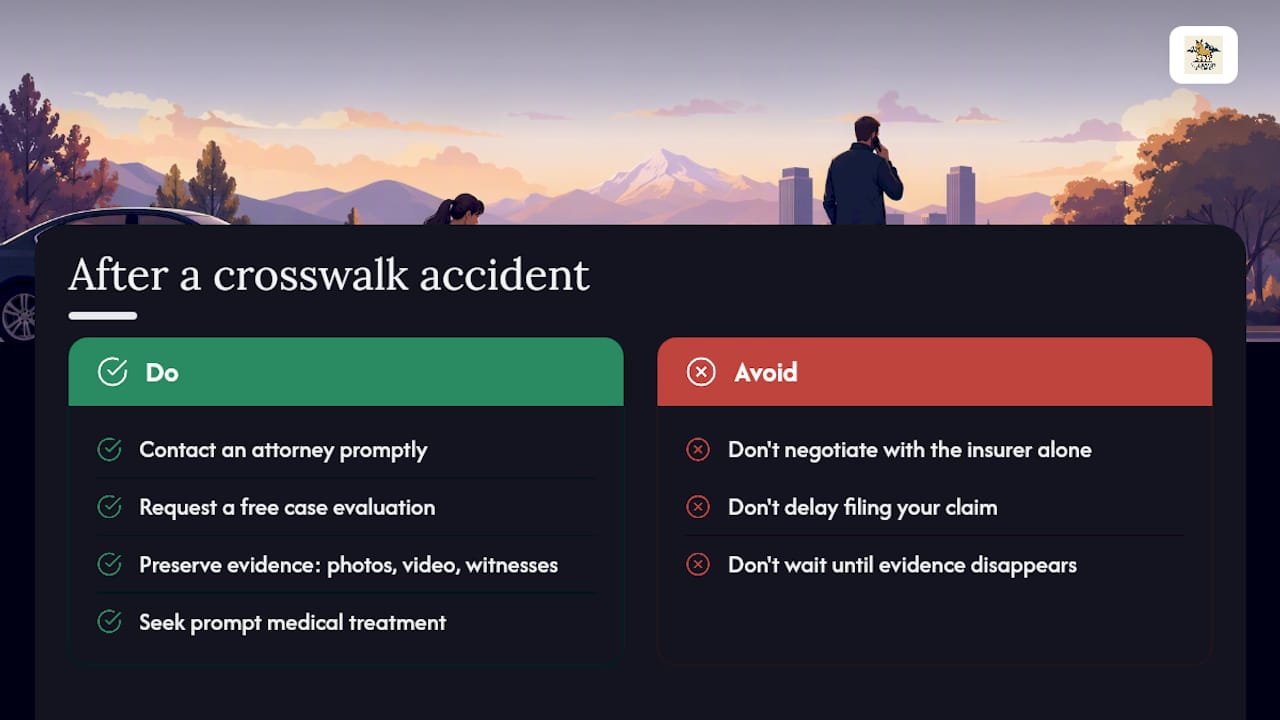
Get medical attention first, even for injuries that feel minor. Then, if you’re able, photograph the scene, the signal, and your injuries, and get names and phone numbers from anyone who saw it happen. Don’t apologize or speculate about fault at the scene; just state what happened. Request the police report and ask whether nearby cameras caught the collision.
An attorney can step in from there to secure that footage before it’s overwritten and manage insurer communication so you’re not negotiating alone.
— Ryan
Get Help After a Colorado Crosswalk Accident
Filing a claim after a crosswalk collision usually means going head-to-head with an insurance adjuster trained to minimize your payout, and doing that alone rarely ends well. An attorney may represent injured pedestrians on a contingency fee basis, meaning you owe nothing unless compensation is recovered for you. A free case evaluation reviews your accident details, medical treatment, and the evidence available, then lays out realistic next steps for your specific situation. Experienced legal teams have handled many injury claims and understand how insurers evaluate crosswalk cases, sometimes drawing on backgrounds in claims adjustment before practicing law. If you were hit in a crosswalk, reach out for a free case review before evidence disappears and deadlines close in.
This article is general information, not a substitute for advice from a qualified lawyer. Consult a qualified legal professional about your own circumstances before acting on anything here.
Sources
- 2025 Colorado Revised Statutes § 42-4-802. Pedestrians’ right-of-way in crosswalks
- Pedestrian Safety Tips | Colorado DMV
- Information for Pedestrians — CDOT
- FHWA crosswalk marking selection guide
FAQ
Do cars have to yield to pedestrians in a crosswalk in Colorado?
Yes. Under C.R.S. §42-4-802, drivers must yield to pedestrians in both marked and unmarked crosswalks whenever the pedestrian is on the driver’s half of the road or close enough to be endangered.
What are the new crosswalk-related traffic laws for 2026 in Colorado?
Colorado’s core crosswalk statute, C.R.S. §42-4-802, hasn’t changed its fundamental yield requirement; drivers still must stop for pedestrians in marked and unmarked crosswalks, and violations remain a class A traffic infraction.
Can you go 10 over the speed limit in Colorado?
No. Colorado law sets a specific limit for each road, and any amount over that limit is a citable violation, though officers use discretion on enforcement; near crosswalks, even small speed increases sharply raise pedestrian fatality risk according to CDOT data.
Do pedestrians have the right of way in every US state?
No. Right-of-way rules vary by state, and while most states require drivers to yield in crosswalks similar to Colorado’s approach, the specific definitions of marked versus unmarked crosswalks and the penalties for violations differ from state to state.
What happens if a pedestrian crosses outside a crosswalk in Colorado?
Crossing outside a marked crosswalk between two signalized intersections is illegal under Colorado law, and the pedestrian must yield to vehicle traffic when crossing at any other unmarked location.