

Settlement vs Trial in Colorado: Ask for a Written Litigation Budget
Most personal injury plaintiffs are better off settling, because settlement guarantees payment, cuts years off the timeline, and removes the risk of walking away with nothing. Trial is the right call only when liability is clear, damages are severe, and the numbers still favor rolling the dice after you account for costs, delay, and the odds of actually collecting.
Table of Contents
- Settlement vs Trial: What Settling Actually Means
- What a Trial Actually Involves
- Settlement vs Trial: Weighing the Real Trade-Offs
- The Money Math: Fees, Expenses, and Expected Value
- Tax Rules, Liens, and How Your Settlement Gets Paid Out
- When Trial Is Genuinely the Better Bet
- When Settlement Is Almost Always the Smarter Call
- Mediation, Arbitration, and Middle-Ground Options
- How to Decide: A Checklist for Your Next Conversation With Your Lawyer
- How Stubbornattorney Evaluates Settle-or-Try Decisions
- A Personal Note on the Emotional Weight of This Decision
- Get a Straight Answer About Your Case, Not a Guess
- Sources
- FAQ
Settlement vs Trial: What Settling Actually Means
A settlement is a private agreement that ends a legal dispute, and it almost always includes a release of claims, meaning you agree not to sue over the same injury again. That release is permanent. Once you sign, you cannot come back later if your injuries turn out worse than expected, which is why timing a settlement offer matters as much as the number attached to it.
Settlements can happen at nearly any stage, from a demand letter sent before a lawsuit is even filed to a number scrawled on a napkin outside the courtroom five minutes before jury selection. The typical path looks like this:
- Your attorney sends a demand letter outlining liability, damages, and a target number.
- The insurance company or defendant responds with a counteroffer, usually lower.
- Both sides negotiate, sometimes over weeks, sometimes over months.
- Once a number is accepted, both sides sign a settlement agreement and release.
Payment doesn’t land in your hands the day you sign. The check goes to your attorney’s trust account first, where fees, case expenses, and any liens get paid out before you see a dime. That process, detailed here, can add weeks to your actual payday even after the case is technically resolved.
Confidentiality is one of the quieter advantages of settling. Court filings are public record, but a settlement negotiated privately usually stays private, protected by a confidentiality clause both sides sign. There are exceptions. Settlements involving minors typically require court approval, and class action settlements go through judicial review regardless of what either side wants kept quiet. For an ordinary car accident or slip and fall case, though, a settlement rarely shows up anywhere a future employer or curious neighbor could find it.
What a Trial Actually Involves
Going to trial means putting your case in front of a judge or jury and letting them decide the outcome instead of negotiating it yourself. The process runs in a fairly fixed sequence:
- Pretrial motions and discovery wrap up, including depositions, expert reports, and any last attempts at mediation.
- Jury selection happens over a day or two, with attorneys questioning potential jurors for bias.
- Both sides present evidence, call witnesses, and cross-examine the other side’s experts, often over several days to a couple of weeks depending on case complexity.
- Closing arguments and jury instructions wrap the evidentiary phase.
- The jury deliberates and returns a verdict, which can take hours or days.
Colorado civil courts, like most state systems, are backed up. A case filed today can take well over a year to reach a trial date once you account for discovery disputes, expert scheduling, and court calendars. Our litigation process overview walks through what drives those delays in Colorado specifically.
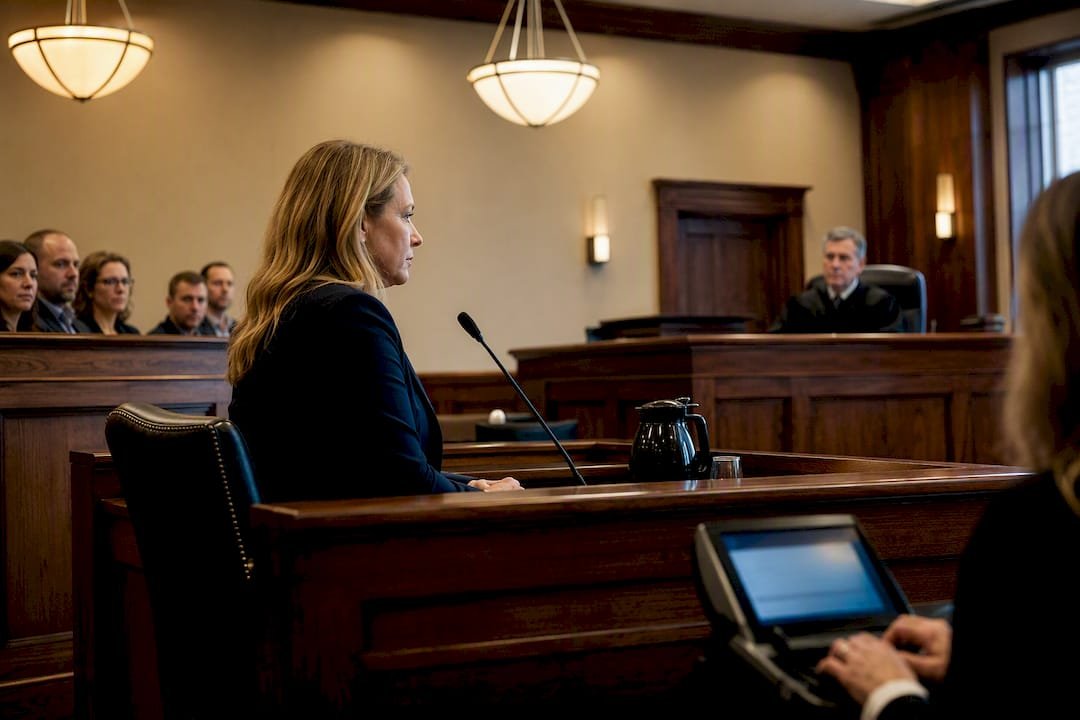
Trials are public. Anyone can walk into the courtroom, and the transcript becomes part of the public record permanently. That includes your medical history, your testimony under cross-examination, and any embarrassing details the defense manages to introduce. Testifying is also emotionally grueling in a way most people don’t anticipate until they’re sitting in the witness chair.
A verdict isn’t necessarily the end. The losing side can appeal, which adds months or years, and even a final judgment is only worth something if the defendant actually has the money or insurance coverage to pay it.
Settlement vs Trial: Weighing the Real Trade-Offs
Every case involves the basic trade-off between certainty and potential upside. Here’s how that plays out in practice.
Settlement advantages:
- You know exactly what you’re getting and when, instead of gambling on twelve strangers.
- Cases resolve in months rather than years.
- Terms usually stay private, away from public court records.
- Legal costs are lower because you skip the expense of a full trial.
Settlement disadvantages:
- You cap your recovery at the negotiated number, even if a jury might have awarded more.
- There’s no appeal if you later feel the number was too low.
- Confidentiality clauses can shield a defendant’s conduct from public scrutiny, which matters if the case involves a repeat safety violation or corporate negligence.
Trial advantages:
- Juries can award more than any settlement offer on the table, including punitive damages in cases involving reckless or intentional conduct.
- A public verdict creates accountability and a paper trail other victims can point to.
- You get your day in court, which matters to some plaintiffs regardless of the financial calculation.
Trial disadvantages:
- Verdicts are unpredictable. Juries can and do surprise both sides.
- Trial costs run higher, from expert witness fees to the extra hours your attorney invests.
- The process takes longer, and appeals can stretch a “win” out for years before you see a check.
- A jury verdict against a defendant with no assets or inadequate insurance can be worthless on paper.
Pro Tip: *Ask your attorney what percentage of similar cases in your practice area settle before trial.
Our guide on settling out of court breaks down the situational factors that tend to tip this balance one way or the other.
The Money Math: Fees, Expenses, and Expected Value
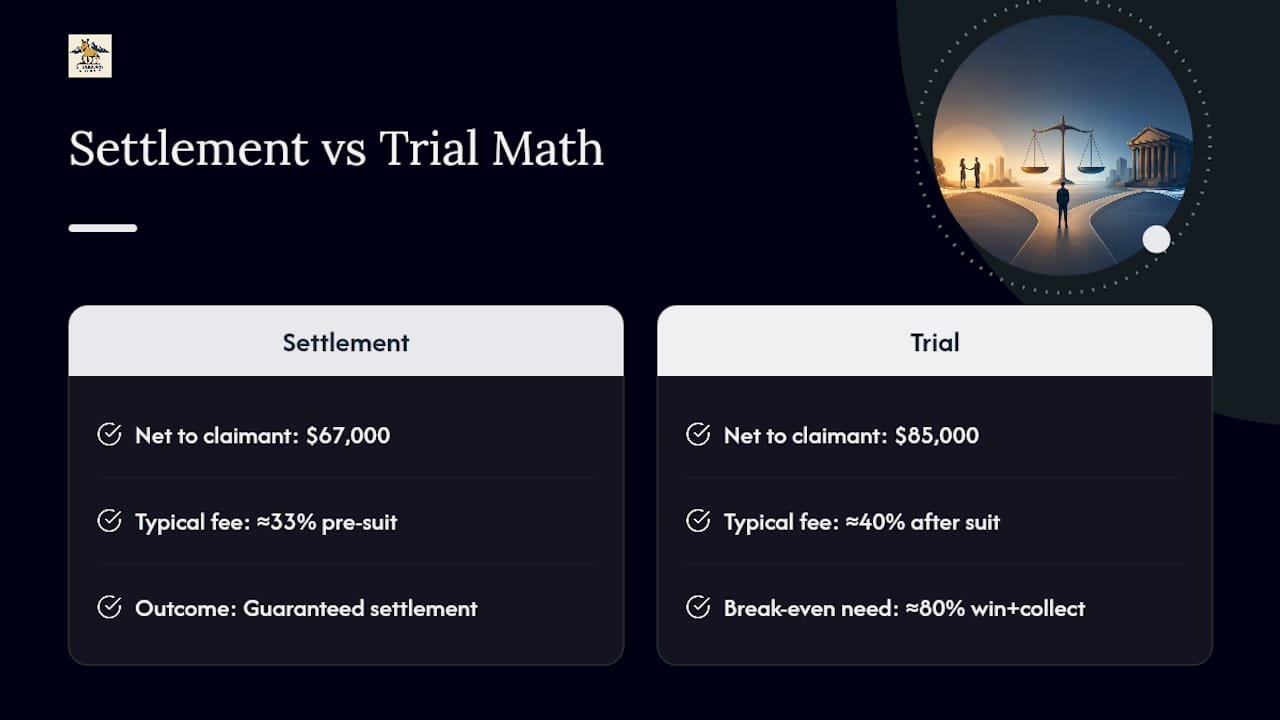
Contingency fees aren’t flat. Most personal injury attorneys charge around a third of the recovery if a case settles before a lawsuit is filed, but that percentage often jumps closer to 40% once litigation actually starts, according to LegalClarity’s breakdown of settlement and trial fee structures. That single fact changes the math on almost every offer you’ll receive.
Run the numbers on a hypothetical substantial pre-trial settlement offer versus the possibility of a larger jury verdict. After contingency fees and expenses, a trial verdict might net you somewhat more than settlement, assuming you win and the defendant can actually pay. Assuming is the operative word.
Trial expenses stack up quickly and may include expert witness fees, court reporter and transcript costs, deposition costs for multiple witnesses, and trial exhibit preparation, among others.
The way to compare a guaranteed settlement against a trial gamble honestly is expected value. An expected-value calculator combines the potential award, your odds of winning, the odds of actually collecting from the defendant, and your added trial costs into one number, then tells you the break-even probability trial needs to beat the settlement on the table.
Here’s a simplified version: if a settlement offer nets you $67,000 guaranteed, and a trial win would net $85,000 after the higher fee and expenses, you need roughly an 80% chance of winning and collecting for trial to make mathematical sense. Most cases don’t clear that bar with confidence.
The reality most plaintiffs underestimate: fewer than 2 to 3 percent of civil lawsuits ever reach a verdict. The other 97 to 98 percent resolve through settlement, often specifically because the expected-value math favors it once both sides run these numbers honestly.
Collection risk deserves its own mention. A verdict against an uninsured driver or an undercapitalized company is a piece of paper, not a paycheck. Before you push for trial, ask your attorney to assess whether the defendant has insurance coverage or assets sufficient to actually pay a judgment. Our page on factors that affect settlement value covers how insurance limits shape realistic recovery expectations from the start.
Tax Rules, Liens, and How Your Settlement Gets Paid Out
Settlement money doesn’t go straight to you. It routes through your attorney’s trust account first, where a specific payment order applies before anything reaches your pocket.
- Attorney fees come out per the contingency agreement.
- Case expenses your attorney advanced (medical record fees, filing costs, expert bills) get reimbursed.
- Liens get satisfied, which can include Medicare, Medicaid, private health insurers, hospital liens, and in some cases outstanding child support obligations.
- What’s left is your net recovery.
Lien resolution is frequently the slowest part of this process. Medicare and Medicaid in particular can take weeks to calculate their final lien amount, and disputed fee or lien amounts must sit in trust until resolved rather than being disbursed early. That delay frustrates clients who assume a signed settlement means an immediate check.
Tax treatment depends heavily on what the settlement compensates. Damages for physical injuries or physical sickness are generally not taxable income under federal law. Compensation for lost wages, punitive damages, and interest on a judgment usually is taxable, and how a settlement agreement allocates money across these categories affects your tax bill directly.
To keep disbursement moving, ask your attorney upfront how lien negotiations will be handled and get a written estimate of the timeline. If a lienholder or insurer misses a payment deadline they’ve agreed to, your attorney can typically send a formal demand letter, and in persistent cases, involve the court that approved the settlement to enforce it.
When Trial Is Genuinely the Better Bet
Trial makes sense when the fundamentals are strong enough to justify the added cost, delay, and risk. A few patterns tend to point that direction.
- Liability is airtight. Dashcam footage, a police report with an admission of fault, or a defendant with a documented history of the same violation removes most of the jury unpredictability that scares plaintiffs away from trial.
- Damages are severe and long-term. Catastrophic injuries with lifetime care costs sometimes justify pursuing structured verdicts or punitive damages a settlement simply can’t match.
- The case has public importance. If a company knowingly sold a defective product or a driver has multiple prior DUI convictions, a public verdict creates a record that can deter future harm in a way a sealed settlement never will.
- The evidence is unusually strong. Video evidence, a defendant’s own admissions, expert testimony that holds up under cross-examination, and a documented pattern of similar conduct all increase leverage at trial specifically.
Historical jury research shows plaintiffs have won slightly more than half of jury verdicts in past studies, though win rates swing significantly by case type and jurisdiction. That’s a coin flip with real money attached, which is exactly why the strength-of-evidence checklist above matters more than optimism. Our evidence checklist for injury cases is a useful starting point for gauging where your case actually stands before you commit to that path.
When Settlement Is Almost Always the Smarter Call
Certain red flags should push you toward the settlement table regardless of how strong your case feels emotionally.
- The defendant has limited insurance or assets. Winning a verdict against someone who can’t pay it is a moral victory, not a financial one.
- Liability is genuinely disputed. If witness credibility is shaky or fault could reasonably be split, a jury’s unpredictability works against you as easily as for you.
- You need money now. Medical bills and lost income don’t wait for a trial date eighteen months out.
- Privacy matters to you. If you’d rather your medical history and testimony stay out of public court records, settlement is the only path that reliably keeps it that way, a point worth weighing seriously before you turn down a reasonable offer.
Mediation, Arbitration, and Middle-Ground Options
You don’t have to choose purely between a private settlement and a full public trial. Mediation puts a neutral third party in the room to help both sides find common ground, with costs typically split between the parties. Many Colorado courts now require mediation before a trial date gets set, which is a major reason mediation resolves so many disputes before they ever reach a jury.
Arbitration works differently. A private arbitrator hears the case and issues a decision, which can be binding or non-binding depending on what both sides agreed to beforehand. Binding arbitration is faster than trial but gives up your right to appeal almost entirely.
High-low agreements are a clever hybrid: both sides agree in advance to a floor and a ceiling for the verdict, regardless of what the jury actually decides. That lets you go to trial while capping your downside risk, a useful tool when both sides want the accountability of a public verdict without the full exposure of an unpredictable number.
How to Decide: A Checklist for Your Next Conversation With Your Lawyer
Before you accept an offer or greenlight a trial, get these answers in writing.
- Request a detailed litigation budget. Ask exactly how much it will cost if the case goes to trial, and how that changes your net recovery given the higher contingency percentage.
- Ask for a break-even probability. Your lawyer should be able to explain what odds of winning, and collecting, trial would need to beat the offer on the table.
- Get a written gross-versus-net comparison. See the settlement number and the potential verdict number side by side, after fees, expenses, and liens are subtracted from each.
- Ask about trial experience and realistic timeline. Some attorneys settle almost everything because they rarely go to trial, not because it’s always the best call for you.
Pro Tip: If your attorney can’t produce a written litigation budget within a few days of asking, that’s a signal worth taking seriously. A firm that regularly tries cases should have this ready quickly, because they’ve built it before.
Our step-by-step negotiation playbook covers how to push back on a lowball offer before you even get to the trial question.
How Stubbornattorney Evaluates Settle-or-Try Decisions
Ryan Malnar built this firm’s approach around a simple discipline: run the numbers before you run your mouth. Before founding Stubbornattorney, Ryan worked as a claims adjudicator for the federal government, which means he’s evaluated cases from the insurance company’s side of the table, not just the plaintiff’s.
That background shapes how the firm handles every settle-or-trial decision. We build a litigation budget and an honest probability estimate before recommending either path, then walk clients through exactly what a trial fee structure would do to their net recovery. We’ve settled hundreds of injury cases and litigated others when the math and the facts genuinely supported it. The decision is always yours. Our job is making sure you’re deciding with real numbers in front of you, not a guess.
A Personal Note on the Emotional Weight of This Decision
Being stubborn in advocacy and being pushy with a client are two different things, and mixing them up does real damage. We prepare every client who’s heading toward trial for what the witness chair actually feels like, not the sanitized version. Some clients want their day in court no matter what the numbers say, and that’s a legitimate choice. We support it either way, because it’s your case and your recovery, not ours.
— Ryan
Get a Straight Answer About Your Case, Not a Guess
If you’re staring down a settlement offer and wondering whether trial would net you more, Stubbornattorney gives you what most firms skip: a written litigation budget and an honest probability estimate before you decide anything. We work on contingency, so there’s no upfront cost, and we serve injury victims across Colorado and Colorado Springs with the same direct, numbers-first approach whether your case settles in three months or heads to trial in two years.
Our personal injury services page outlines how we handle everything from evaluation through trial representation. If you want a real number instead of a feeling, start with a free case evaluation and we’ll tell you exactly where your case stands.
This article is general information, not a substitute for advice from a qualified lawyer. Consult a qualified legal professional about your own circumstances before acting on anything here.
Sources
- Legal Information Institute — Settlement
- LegalClarity — Payment settlement process: liens, taxes, and delays
- Calcol — Settle-or-litigate expected value calculator
FAQ
Is it better to take a settlement or go to trial?
For most plaintiffs, settlement is the rational choice because it guarantees payment and avoids the cost and delay of trial. Trial only makes sense when liability is clear, damages are severe, and the expected-value math still favors the gamble after accounting for higher fees and collection risk.
How much will I get from a $100,000 settlement?
It depends on your contingency fee percentage, case expenses, and any liens like Medicare or hospital claims that get paid before you do. At a typical 33% pre-litigation fee with modest expenses, your net recovery varies depending on contingency fees, expenses, and liens, which can reduce the amount you actually receive.
Why do people choose to settle instead of trial?
Settlement offers certainty, speed, and privacy that a trial can’t match, along with lower legal costs since you skip expert witness fees and extended court costs. Most people also want to avoid the emotional toll of testifying and the unpredictability of letting strangers decide their case.
Do most lawsuits settle before trial?
Yes. Fewer than 2 to 3 percent of civil lawsuits ever reach a verdict, with the vast majority resolving through negotiated settlements well before a trial date arrives.