

Can a Car Accident Cause a Concussion Without a Head Hit?
Yes, a car crash can cause a concussion even if your head never touches the steering wheel, window, or airbag. The sudden acceleration and deceleration snaps your brain against the inside of your skull, and that alone is enough to cause injury. If you notice confusion, severe headache, repeated vomiting, or any red-flag symptom after a crash, get emergency care first. Otherwise, schedule a clinical evaluation within a day or two and start a written symptom log even if you feel mostly fine.
Table of Contents
- Why Concussion Symptoms Get Missed After a Crash
- What Symptoms Should You Watch for After a Crash?
- When Do Delayed Symptoms Signal an Emergency?
- How Do Doctors Diagnose a Concussion?
- What Does Concussion Treatment and Recovery Actually Involve?
- How Do You Document Symptoms for Health and Insurance Purposes?
- How Long Does Concussion Recovery Typically Take?
- What the Evidence Actually Tells Us About Crash Concussions
- Get Legal Help After a Concussion From a Car Accident
- Sources
- FAQ
Why Concussion Symptoms Get Missed After a Crash
A concussion is a functional injury, not a structural one. CT and MRI scans look for bleeding, swelling, or fractures. Concussion doesn’t show up that way, which is why so many people walk out of the emergency room with a “normal” scan and a head injury that’s very real.

Adrenaline compounds the problem. In the hours after a collision, your body floods with stress hormones that mask pain and dull cognitive symptoms. Add whiplash, seatbelt bruising, or a sore neck, and it’s easy for both patients and providers to chalk everything up to soft-tissue trauma.
The CDC notes that concussion symptoms frequently don’t peak until hours or even days after the initial trauma. That delay is exactly why so many people skip the ER, feel “fine enough” the next morning, and never connect the dots when brain fog or headaches show up on day three.
What this means practically:
- Don’t rule out a concussion because your scan came back clean.
- Write down what time symptoms started, not just that they happened.
- Tell your doctor specifically what changed, not just that you “don’t feel right.”
- Assume adrenaline is hiding something in the first 24 hours, especially if the crash involved any jolt to the head or torso.
What Symptoms Should You Watch for After a Crash?
Concussion symptoms fall into three buckets: physical, cognitive, and emotional. Most people only recognize the physical ones, which is exactly why the other two categories get missed for weeks.
Physical symptoms tend to show up first:
- Headache that feels different from a typical tension headache, often described as pressure or throbbing
- Dizziness or a sense of imbalance when standing or turning your head
- Blurred vision, light sensitivity, or trouble focusing on screens
- Nausea, especially when reading or looking at moving objects
- Sensitivity to noise, including normal conversation volume
- Sleep disruption, either sleeping far more or far less than usual
Cognitive symptoms are subtler and often dismissed as stress:
- Thinking that feels slower than normal, like wading through mud
- Trouble concentrating on tasks that used to be easy
- Short-term memory lapses, like forgetting why you walked into a room
- General confusion or a sense of mental fog that doesn’t lift with rest
Emotional and behavioral symptoms are the ones people almost never connect to a car accident:
- Irritability that feels out of character
- New or heightened anxiety
- Sadness or flat mood with no obvious trigger
- Mood swings that surprise even you
Research comparing concussions from motor vehicle crashes to sports injuries found that crash-related concussions carry a heavier overall symptom load and notably higher affective symptom severity. In plain terms: car accident concussions hit your mood harder than the concussions doctors usually study on the sidelines of a football field.
Pro Tip: Describe symptoms with specifics, not adjectives. Instead of telling your doctor “I feel off,” say “I forgot my coworker’s name twice yesterday” or “the headache gets worse when I look at my phone for more than ten minutes.” Specific examples get documented; vague feelings get ignored.
When Do Delayed Symptoms Signal an Emergency?
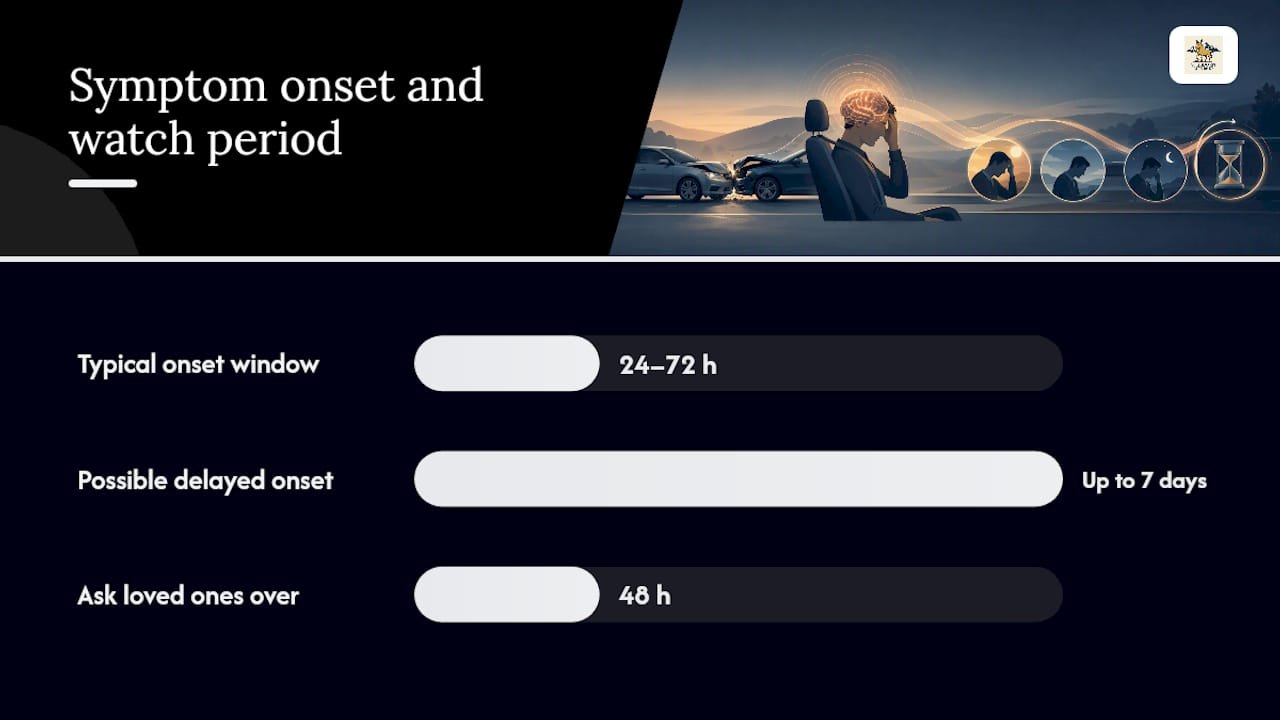
Most concussion symptoms surface within 24 to 72 hours of the crash, though some people don’t notice anything unusual until a week later. That delay is normal for mild concussion. What’s not normal is a symptom that keeps getting worse instead of better.
Certain signs mean you should stop reading this article and call 911 or get to an emergency department immediately:
- A headache that keeps intensifying rather than easing
- Repeated vomiting, not just a single episode of nausea
- Seizures of any kind
- Weakness, numbness, or drooping on one side of the body
- Slurred speech or sudden trouble finding words
- Pupils that are unequal in size or unusually slow to react to light
- Extreme drowsiness or inability to stay awake
An observational cohort of motor vehicle crash patients found that loss of consciousness, alteration of consciousness, and post-traumatic amnesia at the moment of impact all predict more severe traumatic brain injury and a higher chance of returning to the ED within days. If any of those happened at the scene, even briefly, say so explicitly during your evaluation.
If you weren’t in the car, but someone you love was, don’t rely on them to self-report. Ask direct questions over the next 48 hours: Do you know what day it is? Does light bother your eyes? Have you thrown up? A “no” that later becomes a “yes” is worth another trip to urgent care.
How Do Doctors Diagnose a Concussion?
Diagnosis starts with a clinical exam, not a scanner. A physician asks about the mechanism of injury, checks your neurological responses, and evaluates balance, memory, and reaction time in the office. That hands-on exam remains the diagnostic core of concussion care.
CT and MRI still matter. They rule out the things that can kill you: a brain bleed, a skull fracture, swelling that needs surgical intervention. But a normal scan doesn’t mean a normal brain. As the NINDS explains, concussion is diagnosed clinically, and imaging is one tool among several rather than the final word.
That’s where functional testing earns its keep. Balance assessments, neurocognitive batteries, and eye-tracking exams can flag dysfunction that a scan simply isn’t built to detect.
A normal CT or MRI rules out a bleed or fracture. It does not rule out a concussion. Functional testing exists precisely because imaging has blind spots that clinical exams and neurocognitive assessments can catch.
Because most people never take a baseline cognitive test before a crash, these post-injury assessments become the only objective reference point available, which matters both for tracking your recovery through a neurologist and for building a record that stands up later.
What Does Concussion Treatment and Recovery Actually Involve?
Treatment starts simple and gets more specific if symptoms stick around. The first phase is protective, not medical: your brain needs rest to heal, the same way a sprained ankle needs to stay off the pavement.
- Take 24 to 48 hours of relative physical and cognitive rest, avoiding driving, working, or heavy screen time.
- Reintroduce light activity gradually once initial symptoms ease, watching for any flare-up.
- Return to work or school in stages, starting with shorter days or reduced workloads if symptoms allow.
- Resume exercise last, working back up to full intensity only once you’re symptom-free at each preceding stage.
- Get medical clearance before returning to contact sports, heavy lifting, or anything with a fall risk.
If symptoms don’t follow that arc, specific referrals come into play. Vestibular physical therapy addresses balance and vision problems that linger past the first two weeks. Headache specialists manage post-traumatic migraines that don’t respond to over-the-counter medication.
Pro Tip: If you’re still dizzy or getting headaches from screen time after two weeks, don’t wait for your follow-up appointment to mention it. Call and ask for a referral to vestibular therapy or a concussion specialist. Early intervention shortens recovery; waiting it out usually doesn’t.
Escalate care any time symptoms plateau instead of improving, or if new symptoms appear weeks after the crash. That pattern often signals post-concussion syndrome, which needs a different treatment approach than acute concussion care.
How Do You Document Symptoms for Health and Insurance Purposes?
Start a dated log the same day you notice symptoms. Write down what happened, how severe it felt on a simple 1 to 10 scale, and what triggered it, whether that’s screen time, driving, or noise.
Beyond your own notes, collect the paper trail your care team generates:
- Written notes from every medical visit related to the crash
- Copies of imaging reports, even the “normal” ones
- Referral letters to specialists like neurologists or physical therapists
- Therapy notes from vestibular PT, counseling, or cognitive rehab
- Itemized medical bills tied to concussion treatment
This record matters for a reason beyond your own peace of mind. Insurance adjusters routinely argue that delayed-onset symptoms aren’t connected to the crash, precisely because concussion symptoms often surface days later. A contemporaneous symptom log undercuts that argument before it starts, because it shows the timeline in your own words, written when it happened rather than reconstructed later from memory.
Keep copies of everything for yourself, request full records from every provider you see, and if an insurer disputes your diagnosis or symptoms drag on, talk to an injury attorney before you sign anything or accept a settlement offer.
How Long Does Concussion Recovery Typically Take?
Most people recover within a few weeks to about three months. Some don’t, and land in a category clinicians call post-concussion syndrome, where symptoms persist well beyond the typical window.
A few factors reliably predict a longer, harder recovery. A JAMA Network Open cohort study found that a history of prior concussion significantly raises the risk of long-term disability after a subsequent motor vehicle crash. Separately, predictors identified in crash-injury research show that loss of consciousness, alteration of consciousness, post-traumatic amnesia, lack of seatbelt use, and alcohol involvement all correlate with more severe outcomes.
If you’ve had a prior head injury, tell every provider you see, even if it happened years ago and seemed minor at the time. Prolonged recovery usually calls for coordinated care across neurology, physical therapy, and mental health rather than a single follow-up visit.
What the Evidence Actually Tells Us About Crash Concussions
The data here points somewhere most advice on this topic doesn’t go: crash concussions aren’t a smaller version of the sports concussions that dominate public awareness. They come with heavier mood symptoms, a documented higher overall burden, and patients who rarely get baseline cognitive testing the way athletes sometimes do. Treating a crash concussion like a sideline injury undersells what’s actually happening.
The conventional advice, “rest and see if it gets better,” isn’t wrong, but it’s incomplete. It skips the part where delayed onset routinely gets used against injured people, both by their own assumption that no symptoms on day one means no injury, and by insurers who lean on that same gap later. A normal CT scan gets treated as proof of nothing wrong, when it’s proof of nothing else.
If there’s one priority I’d put above the rest, it’s this: document before you feel like you need to. Not after the headaches won’t quit, not after an adjuster asks why there’s no record from the week of the crash. The people who recover fastest and get treated fairly by insurers are usually the ones who started writing things down before they were sure it mattered.
— Ryan
Get Legal Help After a Concussion From a Car Accident
Most people focus entirely on getting better after a crash, which is exactly right, but it leaves the insurance side of things unmanaged while symptoms are actively developing. Stubbornattorney exists for that gap. Ryan Malnar spent years as a federal claims adjudicator before becoming an attorney, so he’s evaluated injury claims from the inside of the system that’s now evaluating yours.
That background means the firm knows exactly which documentation gaps insurers exploit on delayed-onset concussion cases, and how to build a record that closes them before a dispute starts. If you’re in Colorado and dealing with concussion symptoms after a crash, especially if an insurer is already questioning your diagnosis or timeline, get a free case evaluation to find out where your claim actually stands before you accept any settlement offer.
This article is general information, not a substitute for advice from a qualified doctor. Consult a qualified healthcare professional about your own circumstances before acting on anything here.
Sources
- CDC: Traumatic brain injury — signs and symptoms
- PubMed: concussion symptom burden study
- JAMA Network Open: Prior concussions and long-term disability after MVC
- PMC: predictors of TBI severity in motor vehicle collisions
FAQ
How Long Does a Concussion Last After a Car Accident?
Most concussions resolve within a few weeks to about three months, though symptoms can persist longer in cases of post-concussion syndrome, particularly for people with a prior concussion history.
What Is the 4-Hour Rule for Concussion?
There’s no universally recognized medical “4-hour rule” for concussion. If you mean how soon to seek care, get emergency evaluation immediately for red flags like repeated vomiting, seizures, or worsening headache, and see a doctor within a day or two even without those signs.
What Is the Average Settlement for a Car Accident With Concussion?
Settlement amounts vary widely based on symptom severity, treatment costs, lost income, and how well the injury is documented, so there’s no single average figure that applies across cases. An injury case evaluation can assess the specifics of your situation.
What Are Five Signs of a Late Concussion?
Delayed concussion signs include worsening headaches, new dizziness or balance problems, growing sensitivity to light or noise, memory or concentration trouble that appears days later, and mood changes like irritability or anxiety, as outlined in CDC guidance.
Recommended
- Concussion Symptoms After a Car Accident in Colorado: Why Seeing a Neurologist Matters – Malnar Injury Law
- Auto accident lawyer Colorado: why is whiplash so serious, anyway? – Malnar Injury Law
- Auto accident law firms: how to claim and win – Malnar Injury Law
- How Pre-Existing Injuries Impact Car Accident Claims – Malnar Injury Law