

Colorado Motorcycle Lane Splitting Rules: What’s Legal Now
Lane filtering is legal in Colorado under a specific set of conditions, but lane splitting is not, and mixing up the two can turn a routine ride into a citation or a liability nightmare. As of August 7, 2024, Colorado Department of Transportation (CDOT) confirms motorcyclists can pass stopped vehicles in the same lane, but only if every one of five conditions is met at once.
The rule that trips people up most: the vehicles you’re passing must be completely stopped, not slowing, not creeping, stopped. You also can’t exceed 15 mph, and you have to reenter normal traffic flow the instant vehicles start moving again.
- Vehicles being passed must be at a full stop
- The lane must be wide enough to pass safely
- You may only pass on the left side of the lane.
- Speed cannot exceed a low speed legally set for filtering maneuvers.
- You must stop filtering the moment traffic starts moving
For the full legal text, see SB24-079 from the Colorado General Assembly. For enforcement guidance, Colorado State Patrol (CSP) publishes plain-language explanations riders should bookmark.
Table of Contents
- What SB24-079 Actually Requires Before You Filter
- Filtering vs. Splitting: The Line That Actually Matters
- How to Filter Legally and Safely
- What Happens Legally If Filtering Goes Wrong
- Helmet Rules and When Filtering Isn’t Worth the Risk
- The Law Has an Expiration Date
- What the Evidence You Collect Actually Determines
- Why This Law Deserves More Scrutiny Than Most Riders Give It
- Get Help After a Colorado Motorcycle Filtering Crash
- Sources
- FAQ
What SB24-079 Actually Requires Before You Filter
Colorado’s lane filtering law didn’t happen by accident. Lawmakers built SB24-079 around five specific conditions, and CDOT and CSP have both echoed the same list in their public guidance. Skip one, and you’re no longer filtering legally. You’re lane splitting, which remains illegal in Colorado.
Here’s the breakdown, condition by condition:
- All vehicles being passed must be at a complete stop. Rolling traffic, even at 2 or 3 mph, doesn’t count. CSP is explicit on this point.
- The lane must be wide enough for safe passage. There’s no fixed inch measurement in the statute. It’s a judgment call, and a bad one shifts liability onto you.
- You may only pass on the left side of the lane. Passing on the right, or weaving between lanes, falls outside the law entirely.
- Speed cannot exceed a low speed legally set for filtering maneuvers. This cap applies for the entire maneuver, not just the moment of passing.
- You must stop the moment vehicles begin moving. Filtering ends the instant traffic starts to flow, according to CSP’s own guidance.
Only about five conditions separate legal filtering from a citation and, worse, a liability problem after a crash. CDOT frames filtering as optional rather than mandatory, and riders remain fully responsible for judging when conditions are actually safe.
Filtering vs. Splitting: The Line That Actually Matters
Lane filtering means passing stopped vehicles at low speed within a single lane. Lane splitting means riding between two lanes of moving traffic, and Colorado has never legalized that. CSP’s own comparison page draws the line at one factor: is traffic moving or stopped?
If cars are rolling forward, even slowly, you’re splitting, not filtering, and you’re breaking the law. Common illegal scenarios include:
- Passing vehicles moving at 5 to 10 mph in stop-and-go traffic
- Riding between two moving lanes on the highway at any speed
- Continuing to filter after traffic starts moving, even briefly
The distinction sounds simple on paper. On a clogged I-25 on-ramp, it’s a lot harder to judge in real time.
How to Filter Legally and Safely
Before you commit to filtering, run a fast mental checklist. Rushing this decision is how riders end up in a crash they can’t clearly explain to an insurance adjuster.
- Check lane width first. If your handlebars won’t clear both mirrors of the vehicles beside you with room to spare, don’t attempt it.
- Confirm every vehicle is fully stopped, not creeping, before you begin.
- Drop to 15 mph or below and hold that speed for the entire pass.
- Stay within the same lane. Don’t drift toward the shoulder or an adjacent lane to gain space.
- Watch brake lights constantly. The moment they release, stop filtering and merge back into position.
- Reenter traffic flow immediately once vehicles start moving, per CSP guidance.
Pro Tip: Scan two cars ahead, not just the one you’re passing. A driver three cars up who suddenly hits the gas can start a chain reaction that closes your gap before you can react.
What Happens Legally If Filtering Goes Wrong
Here’s the part most riders don’t think about until it’s too late: if you’re filtering and a crash happens, you were the only vehicle in motion. That single fact shapes how insurers and investigators approach fault from the first phone call.
CSP has been direct about this. Riders who filter and get into a collision face a real risk of being found at fault by default, simply because everyone else was stationary.
A stopped driver who opens a door or shifts lanes unexpectedly can create a dangerous, sudden hazard for a filtering motorcyclist, and proving that hazard existed after the fact often comes down to physical evidence at the scene.
Enforcement outcomes vary, but careless driving citations are common when an officer determines the five conditions weren’t fully met. If you’re involved in a crash while filtering, take these steps immediately:
- Get medical attention first, even for injuries that feel minor
- Photograph lane width, vehicle positions, and any skid marks before traffic clears the scene
- Collect names and contact information from witnesses
- File a police report and request the report number
- Contact a Colorado motorcycle accident attorney before giving a recorded statement to any insurer
Helmet Rules and When Filtering Isn’t Worth the Risk
Colorado’s helmet law hasn’t changed alongside the filtering statute. Riders over 18 aren’t legally required to wear a helmet, but CSP’s own safety messaging continues to link helmet use with lower fatality rates in motorcycle crash data. Eye protection is required if your bike lacks a windshield.
Legal filtering doesn’t mean safe filtering. Skip it when:
- The lane is too narrow for comfortable clearance
- Roads are wet, icy, or covered in loose gravel
- Visibility is poor, whether from weather, glare, or darkness
- Nearby drivers show aggressive or unpredictable behavior
Formal rider training through the Motorcycle Operator Safety Training (MOST) program builds the low-speed control filtering actually demands. Helmets remain one of the most consistently cited factors in reducing fatal injury severity, according to state safety messaging, regardless of what the filtering law allows.
The Law Has an Expiration Date
SB24-079 isn’t permanent. The authorization to filter repeals effective September 1, 2027, unless the General Assembly acts to extend it. Before that happens, CDOT has to deliver a data-driven report by January 1, 2027.
- CDOT must analyze rear-end and side-swipe collision rates before and after the law took effect
- The report will examine crash severity, not just frequency
- Lawmakers relied partly on filtering studies from California and other jurisdictions when drafting the bill
- Riders should watch CDOT, CSP, and General Assembly updates as the review deadline approaches
Whether filtering becomes a permanent fixture of Colorado motorcycle laws or quietly disappears will depend heavily on what that report shows.
What the Evidence You Collect Actually Determines
Fault in a filtering crash rarely comes down to one person’s word against another’s. It comes down to what can be proven. A timestamped photo showing brake lights illuminated, wheels turned, and your bike’s exact position relative to lane markings can be the difference between a denied claim and a fair settlement. A short video, taken safely after the scene is secure, is even stronger.
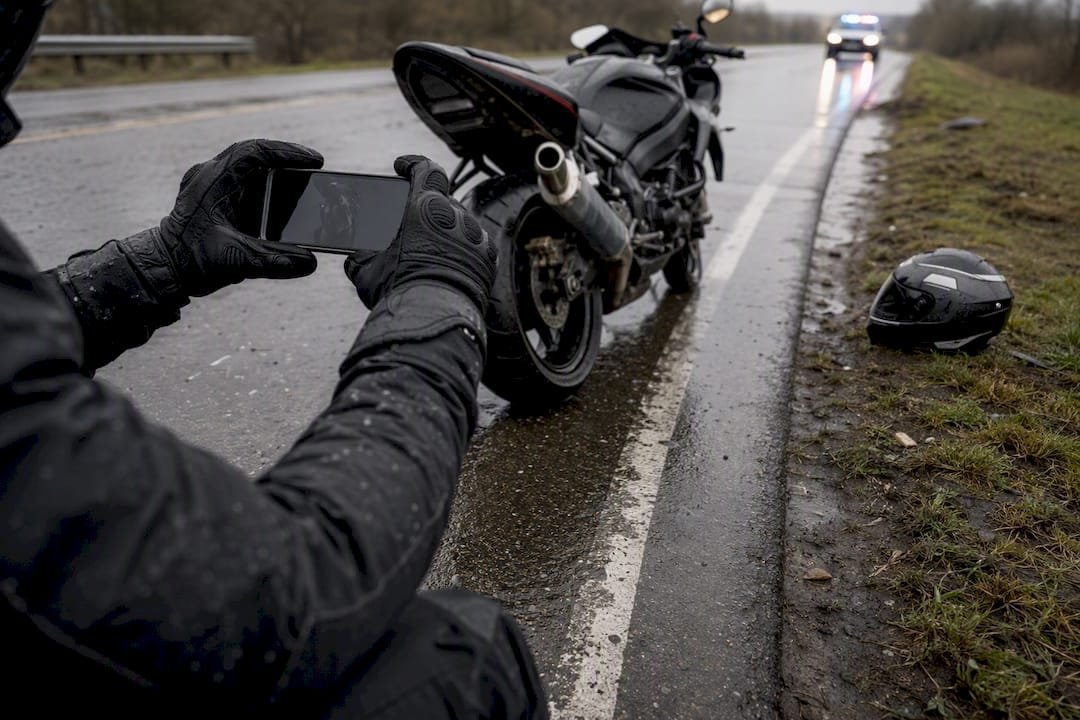
Insurers tend to scrutinize filtering claims more heavily than standard rear-end cases, precisely because the rider was the only thing moving. An early recorded statement given without counsel can lock you into wording that gets used against you later.
Pro Tip: Say only what you’re certain happened when you first speak to any insurer, and hold off on a recorded statement until you’ve talked to an attorney if the injuries are serious or fault is disputed.
Contact a Colorado personal injury attorney when injuries require ongoing treatment, when fault is contested, or when a claim gets denied outright.
Why This Law Deserves More Scrutiny Than Most Riders Give It
Most coverage of Colorado’s filtering law stops at “it’s legal now, here are the rules.” That’s not wrong, but it misses the part that actually matters to someone on a bike: the law was written with a built-in expiration precisely because lawmakers weren’t fully confident it would hold up. That’s not a knock on the statute. It’s a signal that riders should treat every filtering decision as a judgment call, not a blanket permission slip.
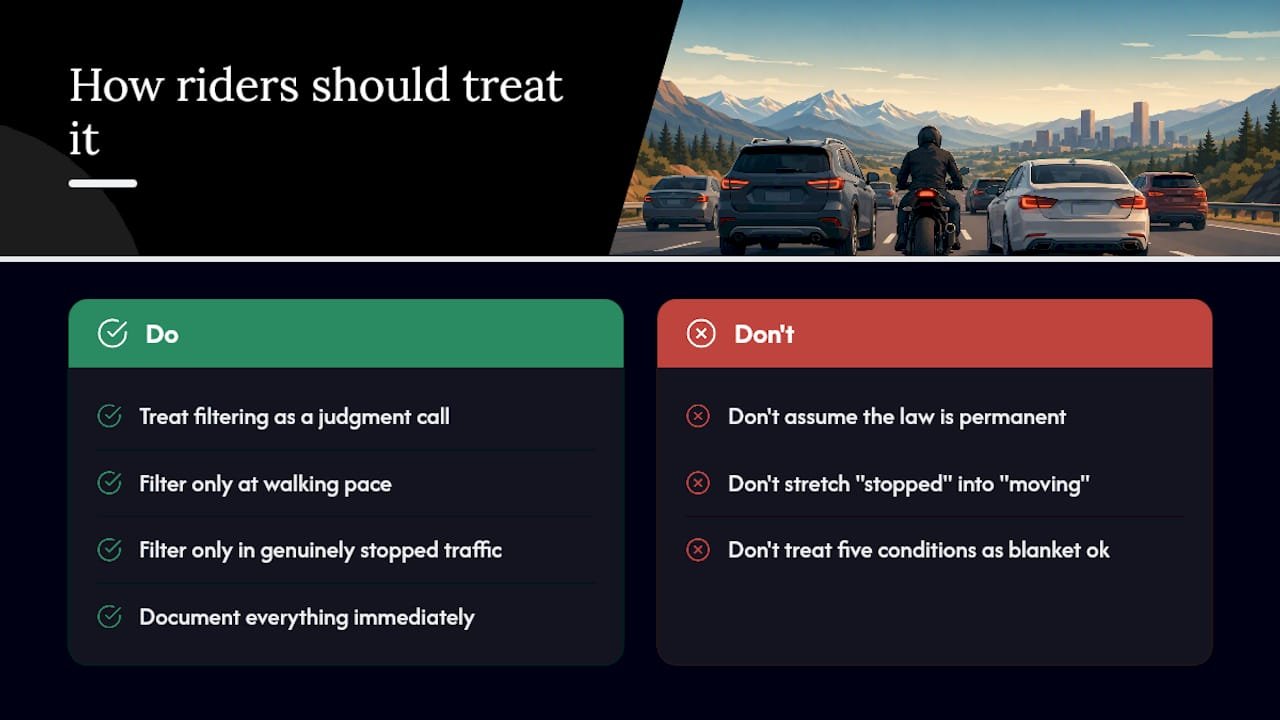
The conventional advice, “follow the five conditions and you’re fine,” undersells how much the width and stopped-vehicle rules depend on split-second reading of a scene that changes by the second. What the research actually supports is narrower: filtering reduces rear-end risk for the rider only when practiced conservatively, at real walking pace, in genuinely stopped traffic. The riders who get hurt tend to be the ones who stretch “stopped” into “barely moving.”
If you take one thing from this law, take this: document everything the moment something goes wrong. The five conditions protect you legally only if you can prove you met them.
— Ryan
Get Help After a Colorado Motorcycle Filtering Crash
If a filtering maneuver ended in a collision, you’re not stuck arguing with an insurance adjuster alone. Stubbornattorney handles Colorado motorcycle crash claims on contingency, meaning you pay nothing unless we recover compensation for you, and every initial consultation is free.
Bring what you have: photos of lane width and vehicle positions, the police report number, and any medical records from treatment so far. Even a partial file helps us start building your case faster.
Whether the crash happened during a legal filtering maneuver or a driver caused the collision outright, our motorcycle accident representation is built to handle exactly these disputes. Start with a free case evaluation and find out where you actually stand.
This article is general information, not a substitute for advice from a qualified lawyer. Consult a qualified legal professional about your own circumstances before acting on anything here.
Sources
- Motorcycle Lane Filtering | Colorado Department of Transportation
- Lane Filtering in Colorado | Colorado State Patrol
- SB24-079 Motorcycle Lane Filtering & Passing | Colorado General Assembly
FAQ
Is lane splitting legal in Colorado?
No. Lane splitting, riding between lanes of moving traffic, remains illegal statewide. Only lane filtering past fully stopped vehicles is permitted under SB24-079.
Which states allow lane splitting for motorcycles?
California is the only state that broadly permits lane splitting. Colorado, along with Arizona, Montana, and Utah, allows only limited lane filtering under stopped-traffic conditions, according to CSP’s comparison of state laws.
What is the 12 second rule for motorcycles?
The 12 second rule is a scanning technique where riders identify potential hazards well ahead on the road, giving enough time to react before reaching that point. It’s commonly taught in motorcycle safety training programs, though it isn’t part of Colorado’s statutory filtering requirements.
Is Colorado a no-chase state for motorcycles?
That question refers to police pursuit policy, not lane filtering law, and isn’t addressed in Colorado’s motorcycle statutes covered here. Pursuit policies vary by individual law enforcement agency.
What happens if I get in a crash while filtering in Colorado?
You may face a higher risk of being found at fault since you were the only vehicle in motion, according to CSP guidance. Document the scene immediately and consider contacting a personal injury attorney before speaking with insurers.
Recommended
- Motorcycle Lane Filtering and Passing – Malnar Injury Law
- Colorado Springs Motorcycle lawyer: how to avoid accidents while riding – Malnar Injury Law
- Colorado Springs Motorcycle accident attorneys: what can you claim? – Malnar Injury Law
- How Colorado’s New Driver Safety Laws Have Impacted Car-Crash-Related Fatalities – Malnar Injury Law