

Cost of a Traffic Lawyer in Colorado: Contingency Fees Explained
Colorado personal-injury attorneys who represent crash victims typically charge a contingency fee of 33%–40% of the recovery, with no upfront payment required. That percentage is the attorney’s fee, but it is not the only number that matters. Case expenses — medical records, expert witnesses, filing fees, and lien repayments — come out of the recovery too, and under Colorado Judicial Branch Rule Change 2020-31, every one of those terms must be disclosed in a written agreement before you sign. Malnar Injury Law, now operating as Stubbornattorney, handles Colorado injury cases on exactly this basis.
Table of Contents
- How does a contingency fee actually work?
- What case expenses will come out of your recovery?
- What must a Colorado contingency agreement include?
- What does your net recovery actually look like?
- What to ask before signing a contingency agreement
- How to choose the right Colorado injury lawyer
- What I’ve seen after years of handling these cases
- Stubbornattorney handles Colorado injury cases on contingency
- Sources
- FAQ
How does a contingency fee actually work?
A contingency fee means the attorney earns nothing unless you recover money. No settlement, no fee. The fee is a percentage of whatever the case resolves for, and that percentage is set in the written agreement before any work begins.
Most Colorado personal-injury firms use one of two models:
- Single flat percentage: One rate applies regardless of when the case resolves, often around 33%.
- Staged percentages: The rate increases if the case advances. A common structure is 33% if settled before a lawsuit is filed, 40% after filing, and sometimes higher if the case goes to trial.
The math shifts noticeably between those two models. On a recovery amount, a flat fee rate leaves a higher net before expenses than a higher percentage fee applied post-suit, showing a noticeable difference on the same gross recovery amount. Fee percentages and how case costs are treated vary by firm and by stage, so confirming the staged structure in writing matters.
Pro Tip: Before signing, ask the attorney to walk through a staged-fee example using your estimated case value. If the agreement only states one percentage, ask whether that rate changes after a lawsuit is filed.
What case expenses will come out of your recovery?
Attorney fees and case expenses are two separate deductions. Most firms advance the costs while the case is active and then recover them from the settlement or verdict. A few require clients to pay as costs arise — the agreement must say which approach applies.
Common expense categories include records retrieval from hospitals and treating providers, expert-witness fees for medical or liability opinions, filing and service fees for court documents, deposition transcripts, accident reconstruction analysis, and investigator costs. On a moderately complex crash case, these can include a variety of expenses that vary significantly with case complexity.
Medical liens and subrogation claims add another layer. If your health insurer, Medicare, Medicaid, or a PIP carrier paid for treatment, they typically have a right to reimbursement from your settlement. Those claims reduce what you actually take home. Lien negotiation — pushing back on the amount the insurer demands — is a standard part of case resolution and can meaningfully increase your net recovery.

One more thing worth knowing: most contingency agreements state that no attorney fee is owed if there is no recovery. But some agreements still hold the client responsible for costs that were advanced, even when the case produces nothing. Colorado rules require that outcome to be disclosed in writing, so read that clause carefully.
What must a Colorado contingency agreement include?
Colorado’s Rule Change 2020-31 sets out specific disclosures every written contingency agreement must contain. Before you sign, confirm the agreement addresses all of the following:
- Fee percentage(s): The exact rate, and whether it changes by stage (pre-suit, post-filing, trial).
- Gross vs. net recovery: Whether the fee is calculated on the total settlement or on what remains after expenses are deducted. This choice changes your math materially.
- Expense estimate: A written estimate of anticipated costs to handle the matter.
- Who advances costs: Whether the firm pays costs upfront or the client pays as they arise, and how repayment works.
- Associated counsel: Whether another attorney will assist and how their fees will be handled.
- Adverse-cost awards: Who is responsible if a court orders your side to pay the opposing party’s costs.
If the agreement is vague on any of these points, ask for a revised draft. A firm that does not provide expense estimates in writing may warrant caution.
What does your net recovery actually look like?
The numbers below show how gross recovery converts to client net across three scenarios. Expenses are illustrative estimates; actual costs vary by case complexity.
Examples show how gross recovery converts to client net across three scenarios, illustrating that the attorney fee percentage and case expenses significantly affect the net recovery amount.
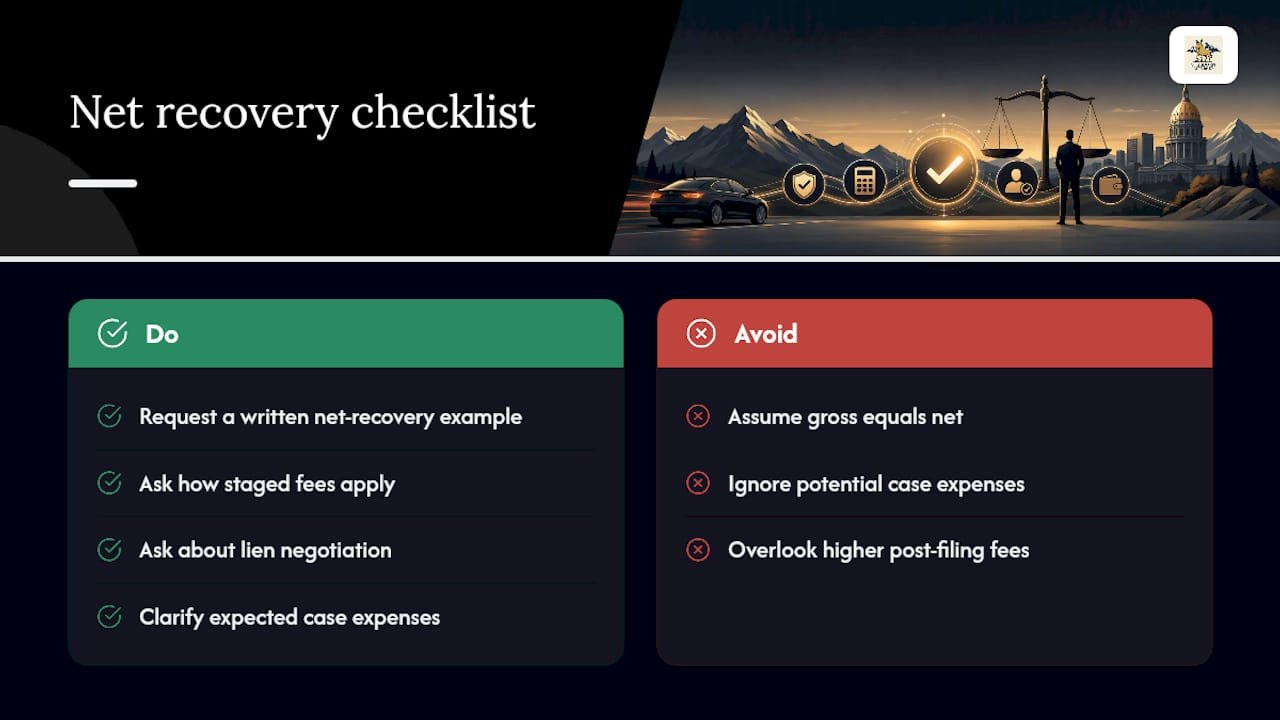
Higher staged-fee percentages after filing a lawsuit increase the attorney fee substantially compared to a lower percentage on the same gross recovery, which highlights the importance of understanding staged fees. Lien negotiation in that scenario could recover additional thousands for the client. Requesting a written net-recovery example before signing is the single most effective way to understand what you are actually agreeing to.
What to ask before signing a contingency agreement
Walk into any consultation with these questions ready:
- What is your fee percentage at settlement, and does it increase after a lawsuit is filed or at trial?
- Is your fee calculated on the gross recovery or on the net after expenses?
- Does your firm advance case costs, or am I responsible for paying them as they arise?
- What is your estimated total for case expenses on a case like mine?
- How will you handle medical liens and subrogation claims?
- Can you show me a written net-recovery example for my estimated case value?
- If associated counsel is involved, how are their fees handled?
- Who will be my primary contact, and how often will I receive case updates?
Pro Tip: Ask the attorney to put the net-recovery example in writing, not just explain it verbally. A free case evaluation is the right moment to get that document.
On communication, ask specifically: will you hear from the firm proactively, or only when you call? The answer tells you a lot about how the relationship will actually work.
How to choose the right Colorado injury lawyer
A few criteria separate firms that handle these cases well from those that don’t:
- Written contingency agreement with staged-fee language and an expense estimate
- Willingness to provide a sample net-recovery calculation before you sign
- Demonstrated track record in Colorado personal-injury claims
- Clear plan for lien and subrogation negotiation
- Local courtroom experience in Colorado courts
Watch for these red flags: vague fee language with no staged-percentage breakdown, refusal to estimate expenses in writing, pressure to sign the same day, no discussion of lien handling, or any promise of a guaranteed outcome. Guaranteed results are ethically prohibited and a reliable signal that something is off.
A free case evaluation lets you compare net-recovery figures across firms before committing. Malnar Injury Law offers free consultations and will walk through the numbers with you before any agreement is signed.
What I’ve seen after years of handling these cases
Most injured people come to a first consultation focused on the wrong number. They want to know the attorney’s percentage. That matters, but the number that actually determines what you take home is the client net after fees, expenses, and liens. A firm charging 33% that does nothing to negotiate your medical liens can leave you with less than a firm charging 40% that fights those lien claims down aggressively.
The gross-versus-net fee calculation affects how much the attorney fee costs. With expenses deducted first, the fee is calculated on a smaller amount, increasing the client’s net recovery. Colorado rules require this to be disclosed in writing. Read that line in your agreement.
My background as a former federal claims adjudicator means I’ve seen how insurers evaluate claims from the inside. That perspective shapes how I build cases and how I negotiate. When I take a case, I don’t let go — that’s not a slogan, it’s how the work actually gets done.
Stubbornattorney handles Colorado injury cases on contingency
If you were injured in a car, truck, motorcycle, or pedestrian accident in Colorado, Stubbornattorney’s personal injury team represents you on a contingency basis — no fee unless you recover. The firm typically advances case costs and will explain every expense and lien-handling step before you sign anything. Ryan Malnar, a Colorado personal-injury attorney and former federal claims adjudicator, leads the team. Request a free case evaluation to get a written net-recovery example for your specific situation.
Sources
- Colorado Judicial Branch — Rule change 2020-31 (contingent fee agreement guidance, PDF)
- Contingency Fee Explained: What Car Accident Lawyers Charge in Colorado | CrashStory
This article is general information, not a substitute for advice from a qualified lawyer. Consult a qualified legal professional about your own circumstances before acting on anything here.
FAQ
What percentage do Colorado personal-injury lawyers typically charge?
Does a contingency fee cover case expenses too?
No. The contingency fee covers attorney compensation only. Case expenses — records, expert fees, filing costs, and lien repayments — are separate deductions from the recovery and must be disclosed in the written agreement under Colorado Rule Change 2020-31.
What happens if my case settles for nothing?
Most contingency agreements waive the attorney fee if there is no recovery. However, some agreements still require the client to repay advanced costs even when the case produces nothing — check that clause before signing.
How does the gross-vs-net fee calculation affect my payout?
A fee calculated on the gross recovery applies to the full settlement amount. A fee on the net applies after expenses are deducted first, which lowers the attorney’s fee and increases your share. Colorado rules require the agreement to specify which method applies.
Can Stubbornattorney help with lien negotiation?
Yes. Stubbornattorney handles lien and subrogation negotiation as part of case resolution, which can reduce third-party reimbursement claims and increase the client’s net recovery.