

Why Settle Out of Court: A Practical Decision Guide
For most civil disputes, settling out of court is the smarter move. You get a guaranteed outcome, you get paid faster, and you avoid the financial and emotional grind of trial. Mediation resolves a large majority of disputes before they reach a courtroom, and in jurisdictions like Texas, civil trials commonly take several years while negotiated settlements can close in weeks. That gap alone changes the math for most people.
Three factors should drive your decision right now:
- Net recovery: What you actually keep after attorney fees, litigation costs, and liens, not the headline number on a verdict.
- Time-to-payment: A guaranteed check in three months versus a possible larger check in three years is a real financial trade-off.
- Non-monetary goals: If public accountability, a legal precedent, or punitive damages are central to your case, trial may be worth the risk.
This guide walks through every dimension of that decision, from how settlements are structured to when you should push back and demand more.
Table of Contents
- What “settle out of court” means and how it actually works
- Why settle out of court: the core advantages
- Downsides and risks you need to know before you sign
- How settlements are reached, step by step
- How to evaluate a settlement offer: a practical checklist
- Timeline and cost: settlement versus trial
- When you should think twice: red flags that favor trial
- What your attorney does in settlement negotiations and how contingency fees work
- What the research shows about mediation, timelines, and privacy
- A lawyer’s perspective: when settling is smart
- Weighing a settlement offer? Here is how Stubbornattorney can help
- Sources and further reading
- FAQ
What “settle out of court” means and how it actually works
An out-of-court settlement is a legally binding agreement between disputing parties that resolves a claim without a judge or jury deciding the outcome. Instead of a verdict, both sides negotiate terms, sign a settlement agreement, and the case ends. No trial, no public record of the final terms, and no waiting on an appeals court to weigh in.
The phrase covers several distinct mechanisms:
- Direct negotiation: One side sends a demand letter; the other responds with a counteroffer. Most personal injury cases start here.
- Mediation: A neutral third party facilitates structured negotiation. Neither side is forced to accept anything, but mediation frequently resolves disputes before trial.
- Arbitration: A neutral arbitrator hears both sides and issues a decision, which can be binding or non-binding depending on the agreement.
- Structured settlement: Instead of a lump sum, payments are made over time, often through an annuity. Common in large personal injury cases.
- Tolling agreement: Pauses the statute of limitations while parties negotiate, buying time without filing suit.
- Conditional settlement: Payment or performance is tied to a future event or contingency.
A simple example: you’re injured in a car accident and file a claim. The insurer offers $40,000. Your attorney sends a demand letter for $90,000. After two rounds of counteroffers and a half-day mediation session, you agree on $72,000 with a confidentiality clause. That is a settlement. A court never sees it.
Why settle out of court: the core advantages
The benefits of settling are not abstract. They show up in your bank account, your calendar, and your stress level.

Cost savings are real and compounding. Litigation is expensive. Expert witnesses, deposition transcripts, court filing fees, and trial preparation costs add up fast. Every month a case stays in litigation, those costs grow. Under a contingency-fee arrangement, your attorney absorbs those costs upfront, but they are recovered from your settlement or verdict. A higher gross verdict that costs $40,000 more to reach may net you less than a lower settlement reached in month four.
Speed matters more than most people expect. Settlements frequently close in weeks or a few months. Trials in some U.S. jurisdictions commonly take one to three years from filing to verdict. That is years of uncertainty, medical bills potentially going unpaid, and your life organized around a lawsuit.
Privacy is a genuine advantage. Trial judgments and court filings are public record. Settlement agreements can include confidentiality clauses that keep the financial terms, the facts of the dispute, and the identities of the parties out of the public eye. For cases involving medical history, business disputes, or family matters, that confidentiality has real value.
Certainty eliminates the binary risk of trial. A jury can award more than the settlement offer. A jury can also award nothing. Settlements provide certainty of outcome and payment timing that trials simply cannot. You also eliminate appeal risk: a defendant who loses at trial can appeal, potentially delaying payment by another year or two.
Control over the outcome. Courts are limited in what they can order. A settlement can include non-monetary terms: an apology, a policy change, a corrective action, or a specific payment schedule. California Courts’ self-help resources specifically note that ADR gives parties more control and can produce mutually acceptable solutions that a judge simply cannot impose.
Statistic callout: Mediation, one of the most common paths to settlement, successfully resolves a large majority of disputes brought to it, making it a highly reliable alternative to the courtroom.
Pro Tip: If your case involves sensitive medical records or business information, push for a confidentiality clause as a standard term, not an afterthought. Once a trial record is public, that information cannot be sealed retroactively.
Downsides and risks you need to know before you sign
Settling is usually the right call, but not always. There are real trade-offs, and some of them are easy to miss until it’s too late.
You may leave money on the table. A strong case with clear liability and documented damages could produce a larger verdict at trial. If the defendant’s insurer is offering $50,000 and a jury would likely award $150,000, the gap is significant. The question is whether the probability of winning, the timeline, and the additional costs justify the gamble.

Release language is permanent. Almost every settlement agreement includes a release of all claims, known and unknown, related to the incident. Once you sign, you cannot come back for more money if your injuries turn out to be worse than expected. This is especially dangerous in cases involving traumatic brain injuries, spinal damage, or other conditions with delayed symptoms.
Enforcement can be a problem. If the paying party is uninsured, underinsured, or financially unstable, collecting on a settlement can be as difficult as collecting on a judgment. A settlement agreement is only as good as the payer’s ability to pay.
You lose the public record. For cases involving corporate misconduct, dangerous products, or institutional negligence, a confidential settlement means the public never learns what happened. Other potential victims may not be warned.
The math can turn ugly fast. Consider a $100,000 settlement offer. After a 33% contingency fee ($33,000), $8,000 in litigation costs, and a $12,000 medical lien, you net $47,000. If the same case goes to trial and produces a $160,000 verdict, your net after the same fee structure and higher trial costs might be $85,000. That $38,000 difference is real, and it is why settlement factors affecting your net recovery deserve careful analysis before you accept any offer.
How settlements are reached, step by step
Knowing the process helps you spot where you have leverage and where delays are normal.
- Initial demand letter. Your attorney sends a formal demand to the opposing party or their insurer, stating the facts, the injuries, and the amount sought. This opens the negotiation.
- Investigation and documentation. Both sides gather evidence: medical records, police reports, expert opinions, and financial records. This phase can take weeks to months.
- Offers and counteroffers. The defendant responds with an offer, typically lower than the demand. Your attorney counters. This back-and-forth continues until the gap narrows or stalls.
- Mediation or neutral evaluation. If direct negotiation stalls, parties often bring in a mediator. Mediation in Colorado personal injury cases typically involves a structured session where the mediator shuttles between parties, helping each side understand the other’s position and risk. Arbitration is different: the arbitrator hears evidence and issues a decision.
- Execution of the settlement agreement. Once terms are agreed, attorneys draft a formal agreement covering payment amount, payment schedule, release language, confidentiality terms, and tax allocation. Both parties sign.
- Closing and payment logistics. Funds are typically held in an attorney’s trust account, liens are paid, fees are deducted, and the net amount is disbursed to the client. Structured settlements involve additional steps to set up the annuity.
Key terms you will see in any settlement agreement:
- Release of claims: Extinguishes your right to sue again over the same incident.
- Confidentiality clause: Restricts what either party can say publicly about the case or its terms.
- Tax allocation: Specifies which portions of the payment are for physical injury (generally not taxable) versus other damages.
- Indemnification clause: Protects the paying party if third parties bring related claims.
- Contingency for nonpayment: Specifies remedies if the defendant fails to pay on schedule.
How to evaluate a settlement offer: a practical checklist
Never evaluate a settlement offer by the gross number alone. The only figure that matters is what you actually keep.
Checklist before you respond to any offer:
- Gross offer amount
- Attorney contingency fee (typically 33%–40%, depending on stage of litigation)
- Estimated costs to trial if you reject the offer
- Medical liens and subrogation claims from insurers or Medicare/Medicaid
- Tax treatment of each damage category
- Structured payment vs. lump sum (and the present value of structured payments)
- Payment security: is the defendant insured, and is the insurer solvent?
- Non-monetary terms: confidentiality, apology, corrective action
Simple net-recovery calculation:
| Item | Example Amount |
|---|---|
| Gross settlement offer | $100,000 |
| Attorney contingency fee (33%) | ($33,000) |
| Medical lien (hospital/insurer) | ($12,000) |
| Net recovery to client | $50,000 |
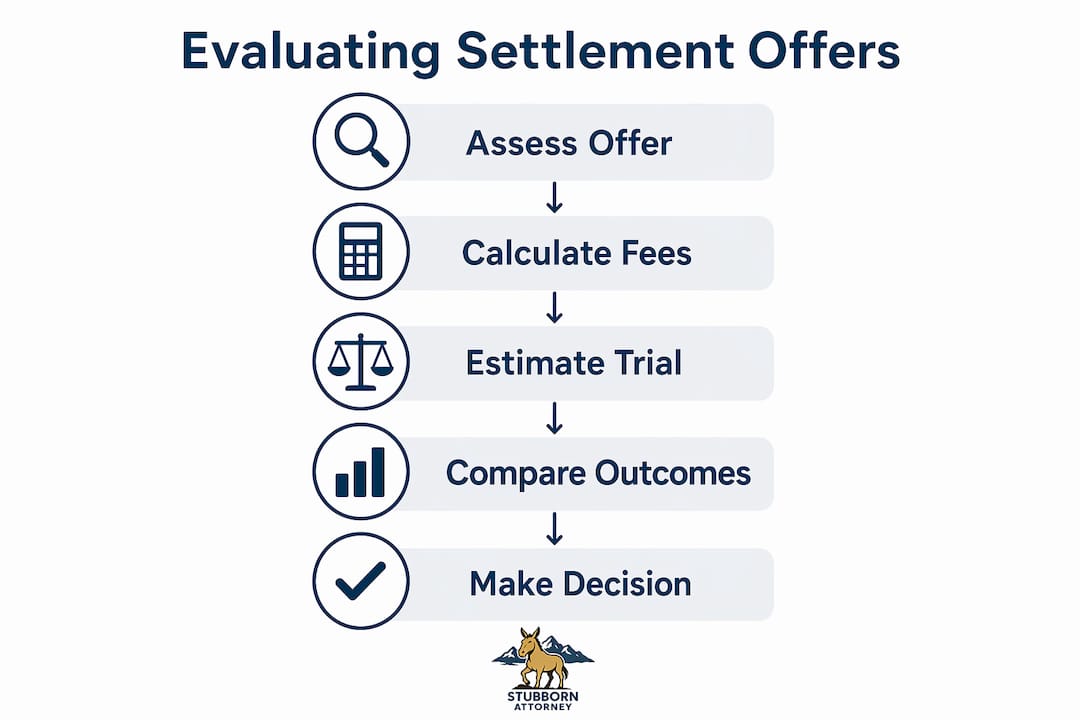
Now compare that $50,000 to the expected value of going to trial. If you estimate a 60% chance of winning a $150,000 verdict, your expected gross at trial is $90,000. After a 40% contingency fee (trial rates are often higher), $15,000 in additional trial costs, and the same $12,000 lien, your expected net is roughly $27,000. In that scenario, the settlement wins on expected value, even though the potential verdict is higher.
Understanding what drives your settlement value is the foundation of this calculation. Liability strength, damages documentation, and the defendant’s insurance limits all shift the numbers.
Pro Tip: If the defendant is paying in installments, ask for a security instrument, a promissory note or a consent judgment held in escrow, so you have immediate legal recourse if they default. Also consider a reopener clause for cases involving ongoing medical treatment, which allows you to return for additional compensation if specific future conditions arise.
Timeline and cost: settlement versus trial
The time and money comparison between settling and going to trial is stark, and it consistently favors settlement for most claimants.
Timeline comparison:
- Settlement: Weeks to a few months for straightforward cases; longer for complex ones with significant injuries.
- Trial: Civil trials in some U.S. jurisdictions commonly take one to three years from filing to verdict, and that does not include post-trial motions or appeals.
Cost categories that grow with litigation:
- Attorney fees (contingency percentage often increases at the litigation stage)
- Expert witness fees (medical experts, accident reconstructionists, economists)
- Deposition costs (court reporter fees, transcript costs)
- Discovery expenses, which can be used strategically to increase pressure on both sides
- Trial preparation and exhibit costs
- Opportunity cost: time away from work, ongoing medical uncertainty, and emotional bandwidth
The pre-litigation phase is almost always the cheapest time to resolve a case. Costs escalate sharply once formal discovery begins, and again once trial preparation starts.
Statistic callout: Mediation resolves a large majority of disputes brought to it. For claimants, that means most cases that enter mediation never reach trial, and the associated cost savings are substantial.
Minnesota Courts’ ADR resources echo what practitioners see every day: savings in time and stress are among the most cited reasons parties choose to resolve disputes outside the courtroom.
When you should think twice: red flags that favor trial
Settlement is the right default, but there are situations where going to trial is the better call.
Scenarios where trial may be worth it:
- Clear liability with strong evidence. If fault is unambiguous and damages are well-documented, a jury may award significantly more than the insurer is offering.
- Punitive damages are realistic. When the defendant’s conduct was egregious, reckless, or intentional, juries can award punitive damages that no insurer will voluntarily put on the table.
- Public accountability matters. Some cases, particularly those involving dangerous products, institutional negligence, or repeat offenders, serve a public interest that a confidential settlement would eliminate.
- The opposing party refuses to negotiate reasonably. If the defendant’s offers are consistently far below any reasonable range and they show no willingness to move, trial may be the only path to fair compensation.
Red flags in a settlement offer:
- The offer is far below the documented damages with no credible justification.
- The defendant refuses to provide payment security or is judgment-proof.
- Release language is so broad it could extinguish unrelated future claims.
- The timeline pressure feels artificial, suggesting a statute-of-limitations strategy.
- The confidentiality terms are one-sided or unusually restrictive.
A litigator’s framework for settlement decisions consistently emphasizes evaluating collectability and non-monetary outcomes alongside the dollar figure. A large verdict against a defendant who cannot pay is worth less than a smaller settlement that clears in thirty days.
One more thing worth knowing: strong trial preparation often produces better settlement terms before trial starts. When the other side sees that you are genuinely ready to go, their calculus changes.
What your attorney does in settlement negotiations and how contingency fees work
Your attorney’s job in a settlement negotiation is not just to send letters and wait. A good attorney shapes the entire process.
What an experienced attorney does:
- Evaluates the realistic value range of your case based on liability, damages, and comparable verdicts
- Drafts and sends the initial demand letter with supporting documentation
- Manages offers and counteroffers, advising when to hold and when to move
- Selects and prepares for mediation, including choosing a mediator with relevant experience
- Vets the financial security of any proposed payment arrangement
- Reviews and negotiates every clause in the settlement agreement, including release language, tax allocation, and confidentiality terms
- Coordinates lien resolution with medical providers and insurers
How contingency fees affect your net recovery. Under a contingency-fee arrangement, you pay nothing upfront. The attorney receives a percentage of the recovery, typically 33% if the case settles before trial and 40% or more if it goes to trial. Litigation costs (filing fees, expert fees, deposition costs) are usually advanced by the firm and recovered from the settlement. If there is no recovery, you owe nothing. That structure aligns your attorney’s incentives with yours: a faster, larger settlement is better for both of you.
The role of your attorney in settlement negotiations extends beyond negotiation tactics. An attorney who has handled hundreds of similar cases knows what insurers are likely to pay, what a jury in your jurisdiction is likely to award, and where the real leverage points are.
Pro Tip: If you are unsure whether an offer is fair, ask your attorney to walk you through the expected-value calculation in writing. A good attorney will show you the math, not just give you a recommendation. If they cannot or will not, that is a signal to get a second opinion.
Ryan Malnar at Stubbornattorney brings a specific advantage here: before practicing law, he worked as a claims adjudicator and adjuster for the federal government. He knows exactly how insurers evaluate claims from the inside, which changes how he builds a demand and where he applies pressure.
What the research shows about mediation, timelines, and privacy
The case for settling out of court is not just practitioner opinion. It is backed by court guidance, empirical analysis, and the documented experience of firms that handle these cases every day.
Mediation success. Wolters Kluwer’s analysis of mediation versus litigation confirms that mediation resolves a large majority of disputes brought to it. For a claimant weighing whether to pursue ADR, that success rate means mediation is not a long shot; it is the most likely outcome.
Timeline data. The one to three year trial timeline in jurisdictions like Texas is not an outlier. It reflects the structural reality of civil court dockets across the country. The Colorado injury lawsuit timeline follows a similar pattern: from filing to trial, Colorado claimants typically face a one to three year process, while settlements can resolve at any point along that path.
Privacy in practice. Trial judgments, pleadings, and exhibits become part of the public court record. Settlement agreements, by contrast, can include enforceable confidentiality clauses. For cases involving medical history, employment disputes, or family matters, that distinction is not minor.
Court guidance on ADR. Both California Courts and Minnesota Courts explicitly recommend ADR to self-represented litigants, citing time savings, cost savings, and greater control over outcomes. When the courts themselves are directing people toward settlement, that is a meaningful signal.
“Settlements let parties craft remedies a court cannot order, which often creates better practical outcomes for ongoing relationships.” — California Courts Self-Help Guide
Stubbornattorney has settled hundreds of injury cases and recovered millions of dollars for Colorado clients. That volume of real-world outcomes is its own form of data: the firm knows what insurers pay, what juries award, and where the gap between the two creates opportunity.
A lawyer’s perspective: when settling is smart
Settlement is not a concession. It is a strategic decision based on a clear-eyed analysis of risk, cost, and what your client actually needs.
The cases I see where people regret settling almost always share one feature: they focused on the gross number and ignored the net. A $200,000 verdict sounds better than a $120,000 settlement until you factor in two more years of litigation costs, a higher contingency percentage at trial, an unchanged lien, and the real possibility that the defendant appeals and you wait another eighteen months for payment. The settlement was the better financial outcome, and nobody ran the numbers.
The cases where trial was clearly right also share a pattern: the defendant’s conduct was egregious, the evidence was overwhelming, and the insurer was making lowball offers that bore no relationship to the documented damages. In those situations, being genuinely ready for trial is itself a negotiating tool. The moment the other side believes you will actually try the case, the settlement math changes for them too.
My practical rule: prioritize net recovery first, timeline second, and non-monetary goals third. Reassess after discovery, because what you learn in discovery often shifts all three. A case that looked like a strong trial candidate at filing sometimes looks very different after depositions.
Weighing a settlement offer? Here is how Stubbornattorney can help
Stubbornattorney handles personal injury cases across Colorado on a pure contingency basis. You pay nothing unless there is a recovery. That means the firm’s interest and yours are identical: the best possible outcome, reached as efficiently as possible.
The services most relevant to someone weighing a settlement offer include a free case evaluation, demand letter drafting, full settlement negotiation, mediation representation, and a detailed net-recovery analysis that shows exactly what you would keep under different scenarios. Ryan Malnar’s background as a former federal claims adjudicator means he approaches every negotiation knowing how the other side thinks.
Stubbornattorney has settled hundreds of injury cases and recovered millions of dollars for Colorado clients, covering car accidents, truck collisions, slip and fall injuries, and wrongful death claims. If you want to see the types of cases the firm handles, the common personal injury case examples page is a good starting point.
For a free case review and a straight answer on whether your offer is fair, visit the Colorado personal injury services page or call directly. No obligation, no fee unless you recover.
Sources and further reading
- Mediation vs. litigation: the advantages of settling out of court — Wolters Kluwer. Supports mediation success rate claims and the predictability advantage of settlement.
- Out-of-court settlements — Sutliff & Stout. Source for the 1–3 year trial timeline comparison in Texas.
- Resolve your dispute out of court — California Courts Self-Help Guide. Official court guidance on ADR benefits: time, cost, control, and tailored remedies.
- Settle out of court — Minnesota Courts. Court-endorsed overview of ADR types and the stress/time savings of settling.
- Settlement vs. Trial: Choosing the Best Path for Your Case — CaseValue.law. Supports certainty-of-outcome and payment-timing claims.
- Negotiating in the shadow of the law — Program on Negotiation, Harvard. Discovery cost strategy and early targeted exchange as a leverage point.
- Settle or Go to Trial — Richard D. Schibell. Practitioner framing of settlement as rational, evidence-based strategy.
- When To Settle And When To Fight: A Litigator’s Framework — Mondaq. Business priorities, collectability, and non-monetary outcomes in the settlement decision.
- Settling vs. Going to Trial — VictimsLawyer blog. Net-recovery calculation and expected-value reasoning for claimants.
- Alternative Dispute Resolution (ADR) Explained — Kloqk. Third-party procedural overview of ADR options and mediator roles.
- Stubbornattorney.com — Malnar Injury Law. Firm settlement experience, contingency-fee model, and Colorado-specific case handling.
FAQ
Is it better to settle out of court or go to trial?
For most people, settling out of court is the better choice because it delivers a guaranteed outcome faster and at lower cost. Trial is worth considering when liability is clear, the offer is far below documented damages, or punitive damages are realistic.
What are the main benefits of settling out of court?
The core benefits are speed (weeks versus years), lower costs, certainty of payment, privacy through confidentiality clauses, and control over the outcome. Court-endorsed ADR guidance consistently cites these same advantages.
Do you get more money if you settle out of court?
Not always on a gross basis, but often on a net basis. A lower settlement offer can produce a higher net recovery than a larger verdict once you subtract additional litigation costs, a higher contingency fee at trial, and the time-value of waiting one to three more years for payment.
What is a settlement agreement?
A settlement agreement is a legally binding contract that resolves a dispute without a trial. It typically includes the payment amount, a release of all related claims, confidentiality terms, and a payment schedule.
When should you not settle a case?
Think twice about settling when the offer is far below documented damages with no credible basis, when the defendant’s conduct warrants punitive damages, when public accountability is a core goal, or when the payer cannot demonstrate the financial ability to pay.
This article provides general legal information, not legal advice. Laws and procedures vary by jurisdiction and case type. Consult a qualified attorney to evaluate your specific situation.