
What Is Accident Reconstruction? A Guide for Claimants
Accident reconstruction is defined as a forensic discipline that applies physics and engineering to determine exactly how and why a vehicle collision occurred. Courts, insurance companies, and legal teams rely on it when injuries are severe, a fatality is involved, or liability is genuinely disputed. The process goes far beyond what a police report captures. It uses Newton’s Laws of Motion, energy conservation principles, and technologies like 3D laser scanning and Event Data Recorders (EDRs) to produce a scientifically defensible account of the crash. If you are dealing with an injury claim or a legal dispute after an accident, understanding this process can directly affect your outcome.
What is the accident reconstruction process?
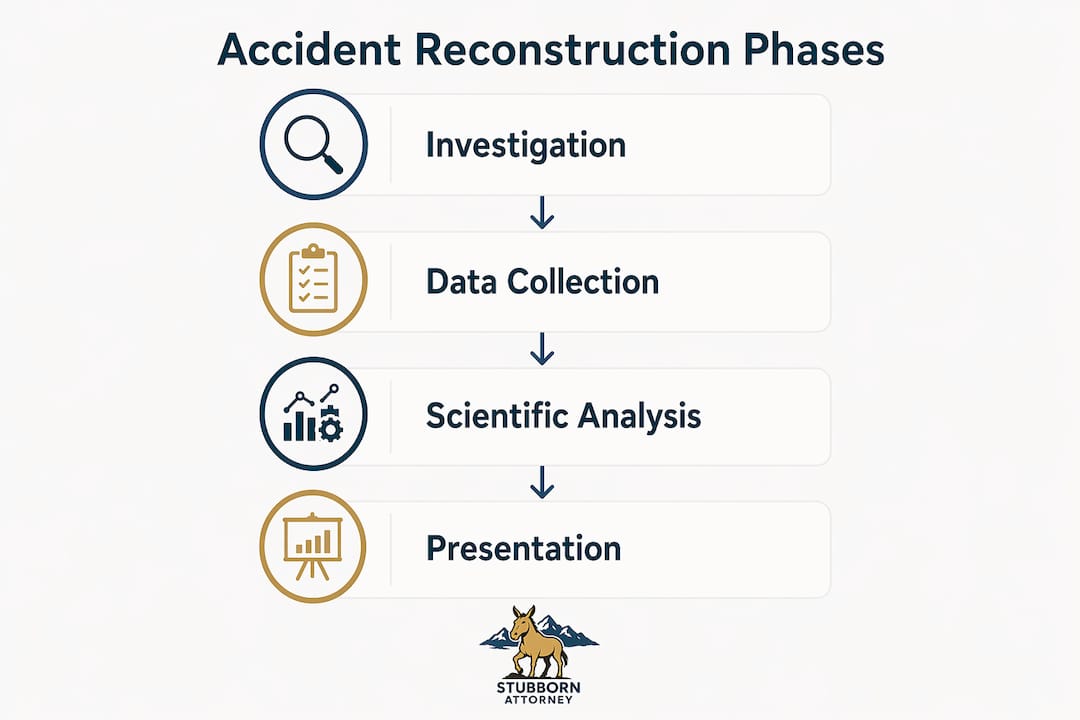
Accident reconstruction is a structured, multi-phase process that transforms physical and digital crash evidence into a clear scientific narrative. Most reconstructions follow three core phases: investigation, analysis, and presentation. Each phase builds on the last, and skipping steps weakens the final findings in court or during insurance negotiations.
Phase 1: Investigation and data collection
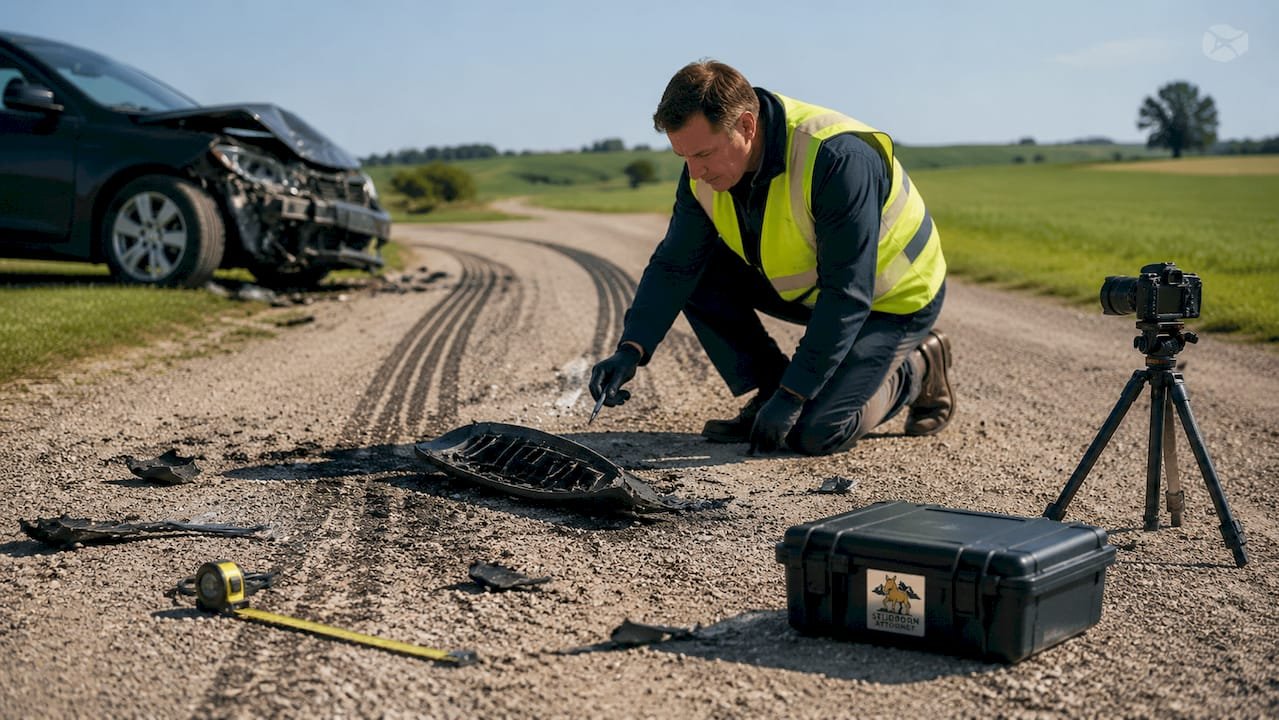
The investigation phase is where experts gather every piece of usable evidence from the scene and the vehicles involved. Specialists use 3D laser scanning to capture precise spatial measurements of the crash site, drone imaging to document large or complex scenes from above, and EDR extraction to pull pre-crash data directly from a vehicle’s onboard computer. EDRs record speed, throttle position, brake application, and seatbelt status in the seconds before impact. That data is objective and time-stamped, making it far more reliable than memory.
Phase 2: Scientific analysis
The analysis phase applies physics to the collected data. Experts use Newton’s Laws of Motion and energy transfer principles to calculate pre-impact speed, direction of travel, and collision dynamics. Skid marks reveal braking force and vehicle speed. Yaw marks show whether a vehicle was rotating before impact. Crush damage patterns indicate the direction and magnitude of the collision force. Computer simulation software then models the crash sequence, allowing experts to test multiple scenarios against the physical evidence.

| Evidence type | What it reveals |
|---|---|
| Skid marks | Pre-braking speed and stopping distance |
| Yaw marks | Vehicle rotation and loss of control |
| Crush damage | Impact direction and force magnitude |
| EDR data | Speed, braking, and throttle at time of crash |
| Drone imagery | Full scene geometry and vehicle positions |
Phase 3: Presentation
The presentation phase translates technical findings into clear testimony or written reports that judges, juries, and insurance adjusters can understand. This is where the science becomes legally useful. Experts produce diagrams, animations, and written opinions that explain what the physical evidence proves. A reconstruction without clear presentation is wasted analysis.
Pro Tip: Ask your attorney whether the reconstruction expert has courtroom testimony experience specifically. Analysis skills and communication skills are separate, and you need both.
Who are accident reconstruction experts and what qualifications do they have?
Accident reconstruction experts are engineers, former law enforcement officers, or scientists with specialized training in crash physics and forensic evidence analysis. Their qualifications determine whether their testimony is admissible and credible in court.

The training requirements are demanding. For example, the New Hampshire State Police CAR Unit mandates 240 hours of advanced crash reconstruction training before an officer qualifies as a reconstructionist. That standard reflects the depth of knowledge required to perform defensible analysis. Private experts typically meet or exceed similar benchmarks.
The most recognized professional credential in the field is certification by the Accreditation Commission for Traffic Accident Reconstruction, known as ACTAR. ACTAR certification requires passing a rigorous written examination and demonstrating field experience. Courts treat ACTAR-certified experts as significantly more credible than uncertified analysts.
Key qualifications to look for in a reconstruction expert include:
- ACTAR certification as the recognized industry standard for courtroom credibility
- Engineering or physical science degree, providing the mathematical foundation for analysis
- Specialized training hours in crash reconstruction, EDR data extraction, and simulation software
- Prior expert witness experience, meaning the expert has testified and withstood cross-examination
- Familiarity with SAE International standards, which govern technical methodology in reconstruction
- Experience with the Daubert or Frye admissibility standards that courts use to evaluate expert testimony
Pro Tip: Request the expert’s curriculum vitae before retaining them. Look specifically for prior cases where their testimony was challenged and upheld. That track record matters more than credentials alone.
The role of accident reconstruction experts extends beyond analysis. They serve as translators between complex science and the legal system. An expert who cannot explain momentum conservation to a jury in plain language is far less valuable than one who can. Communication skill is a professional qualification, not a bonus.
How does accident reconstruction work in legal and insurance claims?
Reconstruction translates directly into claim outcomes. Insurance adjusters and attorneys use reconstruction findings to assign fault, calculate damages, and decide whether to settle or litigate. The science either supports or dismantles the narrative each side presents.
One of the most powerful applications is resolving conflicts between witness accounts and physical evidence. Witness testimony is often unreliable because human perception under stress is imperfect. A witness may report that a car ran a red light, but if the EDR shows the vehicle was traveling at a speed inconsistent with that account, the physical evidence controls. Reconstruction provides the objective, physics-based data that insurance adjusters and legal teams need to evaluate claims accurately.
Reconstruction also identifies what police reports miss. Police officers document the scene as they find it, but they are not forensic engineers. Police reports serve as scene documentation but are not definitive for liability. A reconstructionist correlates the police report with EDR data, crush measurements, and debris patterns to reveal contradictions that can fundamentally change a claim’s outcome.
The practical impact of reconstruction on claims and litigation includes:
- Establishing pre-impact speed when a driver denies speeding
- Proving or disproving brake application using EDR records
- Confirming or refuting seatbelt use at the moment of impact
- Identifying mechanical failure as a contributing cause separate from driver error
- Quantifying the force of impact to support or challenge injury severity claims
- Exposing staged accidents where physical evidence contradicts the reported sequence of events
Timing is the factor most people underestimate. Key evidence degrades quickly after a crash. Tire marks fade within days. Fluid stains are washed away. Debris is cleared from the roadway. Engaging a reconstruction expert early preserves legally admissible evidence before it disappears. Courts apply admissibility standards like Daubert and Frye to reconstruction testimony, and those standards require that the analysis be based on sufficient facts and reliable methodology. Evidence that no longer exists cannot be analyzed.
To understand how reconstruction fits into your broader legal strategy, the guide on proving liability in a claim explains how physics-based findings interact with other forms of fault evidence.
What evidence is critical for accurate accident reconstruction?
The quality of a reconstruction depends entirely on the quality and completeness of the evidence collected. Missing evidence produces incomplete analysis. Incomplete analysis produces findings that opposing experts can challenge.
The most critical evidence categories are:
- Tire marks: Skid marks, yaw marks, and acceleration scuffs reveal speed, direction, and driver inputs before impact
- Vehicle positions: Final resting positions and gouge marks in the pavement establish the geometry of the collision
- Crush damage: The depth and direction of deformation on each vehicle indicate the angle and energy of impact
- Debris patterns: Glass, plastic, and fluid deposits mark the primary point of impact and the post-impact path of each vehicle
- EDR and telematics data: Onboard computers record speed, braking, steering input, and airbag deployment timing in the seconds before a crash
- Drone imagery and 3D scans: These technologies capture the full scene geometry with millimeter accuracy before anything is moved or cleaned
Accident reconstruction is a race against time because physical evidence like skid marks and fluid stains degrade or are cleaned quickly. The window to capture usable evidence is often measured in hours, not days. Reconstruction is also engaged strategically before trial to preserve evidence and guide investigation to meet legal admissibility standards.
Police reports have real limitations in this context. Officers photograph and measure what they can, but they rarely extract EDR data at the scene or perform 3D scanning. That gap is exactly where forensic reconstruction adds value. The guide on gathering accident evidence covers the practical steps you can take immediately after a crash to protect the evidence that experts will later need.
Pro Tip: If you are physically able after an accident, photograph everything before vehicles are moved. Your phone photos can document tire marks, debris, and vehicle positions that may disappear within hours.
What I have learned about reconstruction after a decade of injury cases
After more than a decade representing injured clients in Colorado, I have watched reconstruction evidence change the outcome of cases that looked unwinnable on paper. I have also watched clients lose recoverable claims because they waited too long to involve an expert.
The most common mistake I see is treating the police report as the final word on what happened. Officers do a difficult job under pressure, but their reports are scene documentation, not forensic analysis. I have had cases where the police report listed my client as the at-fault driver, and reconstruction evidence proved the opposite. That reversal only happened because we acted fast and got an expert on the scene before the evidence was gone.
The second mistake is underestimating how much communication matters. The best reconstructionist in the country cannot help your case if a jury cannot follow their testimony. I always ask potential experts to explain their methodology in plain language before I retain them. If they cannot do that in a conversation with me, they will not do it effectively on the witness stand.
The uncomfortable truth about reconstruction is that it is not just a trial tool. It is a strategic asset that shapes how insurance companies evaluate your claim from the very beginning. Adjusters know when a credible expert is behind a claim. That knowledge changes the settlement math before anyone sets foot in a courtroom. If your case involves disputed liability, serious injury, or a fatality, reconstruction is not optional. It is the foundation everything else is built on.
— Ryan
How Stubbornattorney approaches cases involving accident reconstruction
Accident reconstruction evidence is most powerful when legal strategy and technical analysis work together from the start. At Stubbornattorney, we work directly with qualified reconstruction experts on cases involving disputed liability, serious injury, and complex crash dynamics. Ryan Malnar’s background as a former federal claims adjudicator means he understands exactly how insurance companies evaluate technical evidence, and he uses that knowledge to build claims that hold up under scrutiny. If your accident involves questions about fault, speed, or injury causation, the time to act is now. Review common personal injury case examples to see where reconstruction typically plays a role, or contact Stubbornattorney for a free case evaluation to discuss your specific situation.
FAQ
What is accident reconstruction in simple terms?
Accident reconstruction is the forensic process of applying physics and engineering to determine how and why a vehicle collision happened. Experts analyze physical evidence, vehicle data, and scene measurements to produce a scientifically supported account of the crash.
Who performs accident reconstruction?
Reconstruction is performed by engineers, former law enforcement officers, or scientists with specialized crash analysis training. The most recognized credential is ACTAR certification, which requires passing a rigorous examination and demonstrating field experience.
How much does an accident reconstruction expert cost?
Expert hourly rates typically range from $300 to $600, depending on expertise, case complexity, and geographic market. Courtroom testimony commands higher rates than analysis work alone.
Why is accident reconstruction needed if there is already a police report?
Police reports document the scene but do not constitute forensic analysis. Reconstructionists correlate police reports with EDR data and physical evidence to reveal contradictions that can change the outcome of an insurance claim or lawsuit.
When should reconstruction experts be brought in?
Experts should be engaged as early as possible after a crash. Physical evidence degrades quickly, and delays can prevent recovery of legally admissible findings required under Daubert or Frye admissibility standards.