

How to Prove Liability in a Car Accident Claim
Proving liability in a car accident means demonstrating, through legally recognized evidence, that another party’s negligence caused your injuries and losses. The formal legal term is negligence, and it requires satisfying four cumulative elements: duty of care, breach of duty, causation, and damages. Miss any one of them and your claim fails, regardless of how badly you were hurt. With roughly 95% of personal injury claims settling before trial, the strength of your evidence does not just matter in court. It determines your settlement value from day one.
How to prove liability: the four elements you must establish
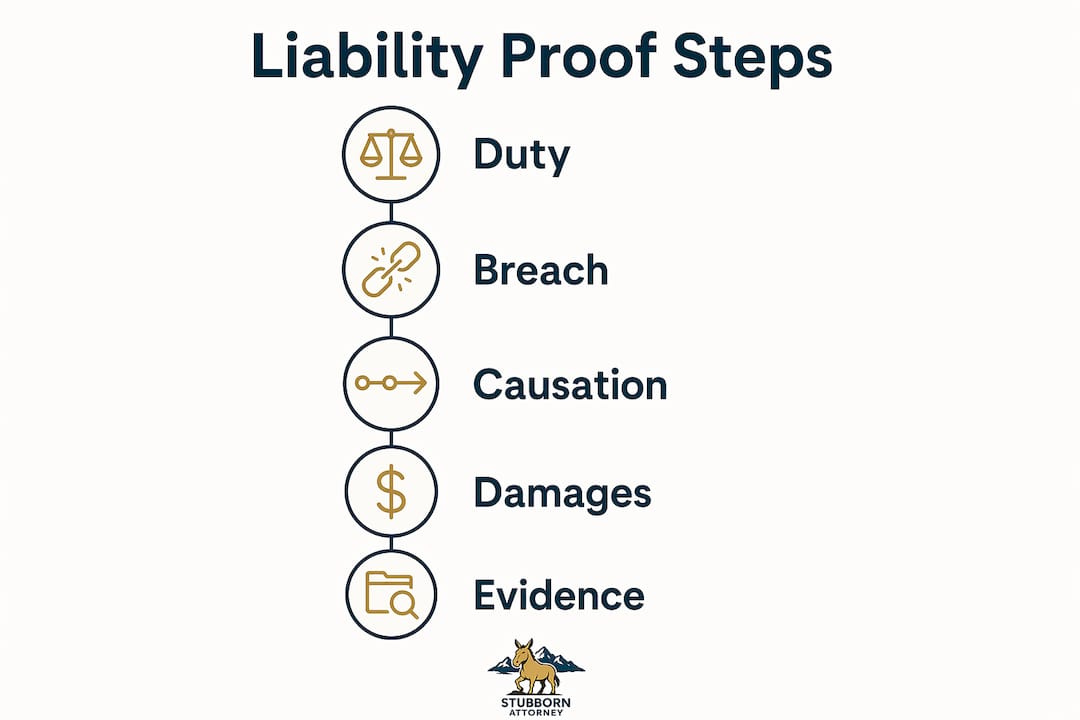
The four elements of negligence are duty of care, breach of duty, causation, and damages. Every car accident claim in the United States depends on proving all four. Think of them as links in a chain. One weak link breaks the entire case.
Duty of care
Duty of care is the legal obligation every driver carries the moment they get behind the wheel. Colorado law, like every other state, requires drivers to operate their vehicles in a reasonably safe manner and follow traffic laws. This element is almost never disputed in car accident cases. The duty exists automatically.
Breach of duty
Breach is where most liability fights actually happen. A breach occurs when a driver’s conduct falls below what a reasonable person would do under the same circumstances. Courts do not ask what the defendant intended. They ask what a hypothetical reasonable driver would have done instead. Running a red light, texting while driving, or following too closely all qualify as breaches because a reasonable driver would not do those things.
Causation
Causation splits into two parts, and both must be proven. Actual cause uses the “but-for” test: but for the defendant’s breach, would your injury have occurred? Proximate cause asks whether your harm was a foreseeable consequence of the breach. If a driver rear-ends you and you suffer whiplash, both tests are satisfied. If you later trip on a curb at the hospital and break your wrist, that second injury likely fails the proximate cause test because it is too remote from the original breach.
Damages
Damages are the measurable losses you suffered: medical bills, lost wages, property damage, and pain and suffering. All four elements are cumulative, meaning even airtight proof of fault cannot save a claim without documented damages. This is why medical treatment records and financial documentation are not optional. They are the backbone of your recovery.
Pro Tip: Document every out-of-pocket expense from the day of the accident forward. Prescription receipts, rideshare costs to medical appointments, and even over-the-counter pain medication add up and all qualify as compensable damages.
What types of evidence establish fault in a car accident case
Multiple evidence categories are required to support all four negligence elements simultaneously. No single piece of evidence does the whole job. Here is how to collect each type effectively.
-
Police accident report. Call law enforcement to the scene every time, even for minor collisions. The responding officer’s report documents road conditions, vehicle positions, witness names, and often includes a preliminary fault determination. Insurance adjusters treat this report as a foundational document. Request your copy within 24 hours from the Colorado Springs Police Department or the relevant county sheriff’s office.
-
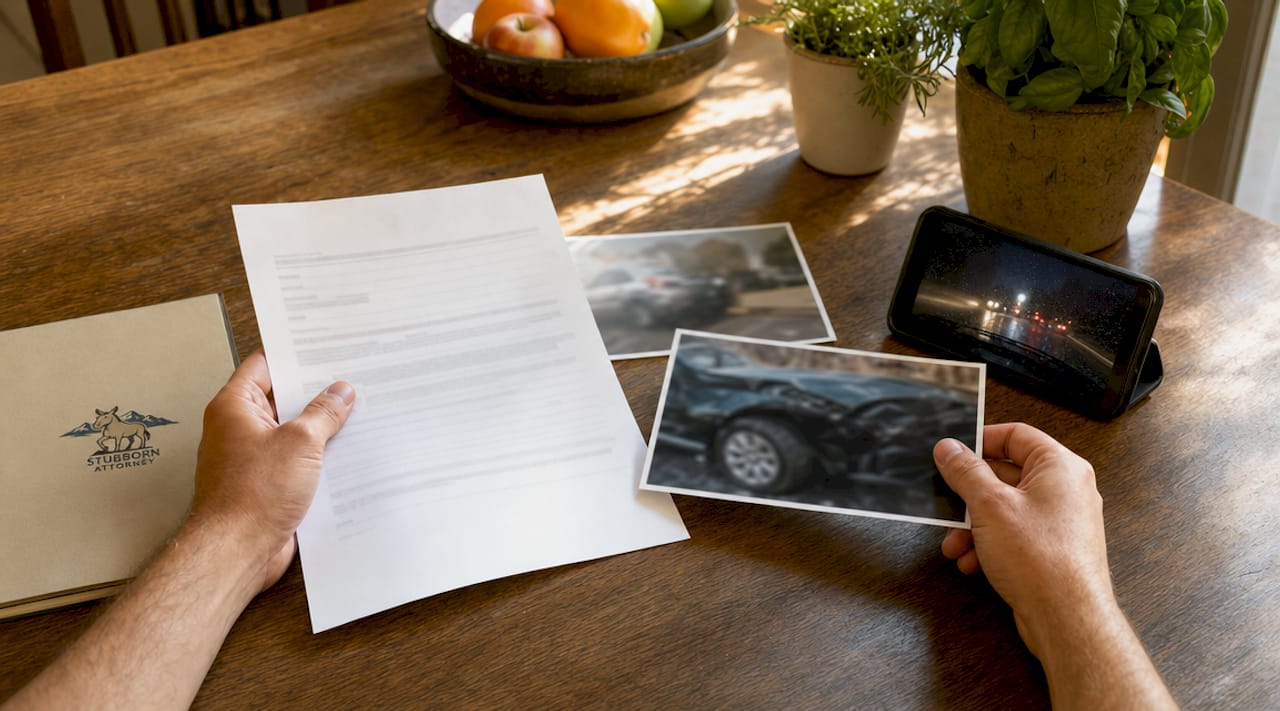
Photographs and video. Photograph vehicle damage, skid marks, traffic signals, road signs, weather conditions, and your visible injuries before anything is moved or cleaned up. Dashcam footage from your vehicle or a nearby driver is particularly powerful because it captures the sequence of events in real time. Surveillance cameras from nearby businesses are time-sensitive. Footage is often overwritten within 24 to 72 hours, so act fast.
-
Eyewitness statements. Independent witnesses carry significant weight because they have no financial stake in the outcome. Get names, phone numbers, and brief written statements at the scene if possible. Courts recognize that eyewitness accounts are subjective, which is why corroborating them with physical evidence strengthens their value considerably.
-
Medical records. Your medical records connect the accident to your injuries, which satisfies both causation and damages. Seek treatment immediately after the crash, even if you feel fine. Delayed treatment gives insurers a reason to argue your injuries were pre-existing or unrelated. Every diagnosis, treatment plan, and follow-up visit creates a documented chain from the collision to your recovery.
-
Expert witnesses. For complex crashes, an accident reconstructionist can analyze vehicle damage, road conditions, and physics to establish exactly how the collision occurred. Medical experts can testify about the nature and permanence of your injuries. These professionals translate technical facts into clear, credible conclusions that juries and adjusters understand.
Pro Tip: If you did not have a dashcam at the time of your accident, install one before your next drive. Dashcam footage has become one of the most decisive pieces of evidence in modern car accident claims.
How insurance companies evaluate liability and what can undermine your claim
The standard of proof in a civil negligence case is preponderance of the evidence, meaning your version of events must be more likely true than not. That is a greater than 50% threshold, not the “beyond a reasonable doubt” standard used in criminal cases. This lower bar sounds favorable, but insurance companies exploit every gap in your evidence to push that percentage down.
Insurance adjusters actively investigate for any sign of contributory fault on your part. Even minimal shared fault can reduce or eliminate your recovery depending on the state. Colorado follows a modified comparative negligence rule: if you are found 50% or more at fault, you recover nothing. If you are 30% at fault, your damages are reduced by 30%. In states like Virginia, the rule is even harsher. Even 1% claimant fault can bar recovery entirely under strict contributory negligence.
Insurance companies are not neutral fact-finders. Their financial interest is in paying you as little as possible. Every statement you make, every gap in your medical treatment, and every inconsistency in your account is potential leverage against you.
Common evidence weaknesses that hurt claims include the following:
- Delayed medical treatment. A gap between the accident and your first doctor visit creates room for the insurer to argue your injuries happened elsewhere.
- Inconsistent statements. Telling the officer one thing and the adjuster another gives the insurer grounds to question your credibility.
- Missing witness contact information. Witnesses who cannot be located later cannot support your account.
- Incomplete documentation of damages. Verbal descriptions of pain are far less persuasive than treatment records, imaging results, and specialist notes.
- Social media activity. Photos or posts showing physical activity after the accident are routinely used to dispute injury severity.
One underused legal doctrine worth knowing is res ipsa loquitur, which translates to “the thing speaks for itself.” When direct evidence is unavailable, this doctrine allows a court to infer negligence from the nature of the accident itself. If an accident is the type that ordinarily does not happen without someone’s fault, the burden shifts to the defendant to explain. It is a powerful tool in cases where physical evidence was lost or never collected.
How to organize and present your evidence for a fair outcome
Gathering evidence is only half the work. How you organize and present it determines whether an adjuster or jury can follow your argument clearly. A well-structured claim file communicates competence and credibility before a single negotiation begins.
| Evidence type | What it proves | When to collect it |
|---|---|---|
| Police report | Breach, initial fault determination | Within 24 hours of accident |
| Photographs and video | Breach, causation, damages | At the scene immediately |
| Medical records | Causation, damages | Ongoing from day of accident |
| Witness statements | Breach, causation | At the scene or within days |
| Expert reconstruction report | Causation, breach | During claim or litigation prep |
| Pay stubs and tax records | Lost income damages | As soon as treatment begins |
Start a dedicated folder, physical or digital, on the day of the accident. Every document goes in: the police report, repair estimates, medical bills, correspondence with the insurer, and your own written timeline of events. Your timeline should record dates, symptoms, appointments, and any communications with the other driver’s insurance company. Consistency across all of these documents is what makes a claim credible.
Attorneys at firms like Malnar Injury Law use this documentation to build a demand package that presents your evidence in a logical sequence. The package typically opens with the liability argument, supported by the police report and photographs, then moves to causation through medical records, and closes with a damages calculation. Adjusters respond to organized, well-supported packages because they signal that the claimant is prepared to litigate if necessary.
Visual aids matter more than most claimants realize. Annotated photographs, accident diagrams, and medical illustrations help adjusters and jurors who are not lawyers or doctors understand complex facts quickly. An attorney’s role in settlement negotiations includes translating your evidence into a narrative that is both accurate and persuasive. Transparency throughout the process, meaning no surprises, no omissions, and no exaggerations, keeps your credibility intact from the first demand letter to the final settlement check.
What I have learned from years of fighting these cases
After more than a decade handling car accident claims in Colorado, and years before that as a federal claims adjudicator, I can tell you the single most common reason strong cases fall apart: people wait too long to take their evidence seriously.
Most people who call me after an accident did the right things at the scene. They called the police, took some photos, exchanged insurance information. What they did not do was follow through in the days immediately after. They skipped the doctor because they felt “okay.” They did not track down the witness who offered a card. They posted a photo from a family event two weeks later without thinking about it. By the time they realize the insurer is disputing their claim, the window to fix those gaps has closed.
The other pattern I see constantly is underestimating the insurer’s preparation. The adjuster assigned to your claim has handled hundreds of cases. They know exactly which questions to ask to get you to say something that reduces your recovery. That is not cynicism. That is the reality of how insurance companies fight payouts in Colorado. The earlier you get legal counsel involved, the less opportunity the insurer has to shape the narrative before you do.
For complicated crashes, particularly those involving multiple vehicles, commercial trucks, or disputed speeds, an accident reconstructionist is not a luxury. It is often the difference between a fair settlement and a denied claim. I have seen cases where the physical evidence told a completely different story than the other driver’s account, and the reconstruction report was the only thing that proved it.
My honest advice: treat your claim like a project from day one. Document everything, see a doctor immediately, and do not give recorded statements to the other driver’s insurer without legal guidance. Persistence and preparation are what win these cases.
— Ryan
How Stubbornattorney can help you build a winning liability case
Proving fault after a car accident requires more than good intentions. It requires the right evidence, collected correctly, presented persuasively. At Stubbornattorney, the legal team behind Malnar Injury Law has settled hundreds of injury cases and recovered millions of dollars for Colorado accident victims. Ryan Malnar’s background as a former federal claims adjudicator means he knows exactly how insurers evaluate your claim and where they look for weaknesses. From gathering police reports and coordinating expert witnesses to negotiating directly with insurance companies, the firm handles every step of the personal injury claims process for you. Your first case evaluation is completely free. If you were injured in a car accident and need to establish fault, explore common personal injury case examples to see how similar claims have been handled, then reach out to start building your case today.
FAQ
What does “proving liability” mean in a car accident case?
Proving liability means demonstrating through evidence that another driver’s negligence caused your accident and resulting injuries. It requires establishing all four elements: duty of care, breach of duty, causation, and damages.
How much evidence do you need to prove fault?
You need enough evidence to show your claim is more likely true than not, which is the preponderance of evidence standard used in civil cases. Police reports, photographs, medical records, and witness statements together typically satisfy this threshold.
Can you still recover damages if you were partly at fault?
In Colorado, yes, as long as you are less than 50% at fault. Your damages are reduced by your percentage of fault under the state’s modified comparative negligence rule. In strict contributory negligence states, even minor fault can bar recovery entirely.
What happens if there is no direct evidence of fault?
When direct evidence is unavailable, the legal doctrine of res ipsa loquitur may allow a court to infer negligence from the circumstances of the accident itself. This shifts the burden to the defendant to provide an explanation, making it a useful tool in cases with limited physical evidence.
How long do you have to file a car accident liability claim in Colorado?
Colorado’s statute of limitations for personal injury claims is generally three years from the date of the accident. Missing this deadline eliminates your right to recover, regardless of how strong your evidence is. Consult an attorney as early as possible to protect your claim.