

Former Insurance Adjuster Lawyer: Colorado Car Accident Claims
If you were hurt in a crash in Colorado, a lawyer who once evaluated claims from the other side knows how the person on the phone is trained to think about your case. That is the practical value of hiring a former adjuster as your attorney. At Malnar Injury Law, now StubbornAttorney.com, Ryan Malnar has practiced for over a decade and is a former claims adjudicator/adjuster for the federal government. He represents only injured people, and we take cases on a contingency basis: you pay nothing unless there is a monetary recovery.
This guide explains what adjusters actually do, how they decide what a claim is worth, what Colorado law gives you in the process, and when a Colorado Springs driver should bring in a lawyer.
Table of Contents
- What a claims adjuster does after a Colorado crash
- Why adjuster experience helps the person on the other side
- How adjusters evaluate a car accident claim
- What Colorado law gives you in the claims process
- What to do when an adjuster calls
- When to bring in a lawyer after a Colorado Springs crash
- Fees: what a contingency arrangement means
- A worked example
- Our perspective
- Talk to us about your Colorado car accident
- FAQ
- Sources
What a claims adjuster does after a Colorado crash
An insurance adjuster is the employee, or contractor, who investigates a claim and recommends how much the insurer should pay. After a car accident you will usually hear from at least two of them: one from your own insurer, and one from the at-fault driver’s insurer.
They are not the same, and the difference matters:
- Your own insurer’s adjuster handles claims under your policy, such as collision coverage, medical payments coverage or uninsured/underinsured motorist coverage. You have a contract with this company.
- The other driver’s adjuster handles what is called a third-party claim. That insurer owes its duties to its own policyholder, not to you. Its job is to resolve your claim for as little as the facts support.
Both work from the same toolkit: the police report, photos, repair estimates, medical records, billing codes and software or internal guidelines that place a value range on injuries. Our page on the role of the insurance adjuster in personal injury claims walks through that process in more detail.
An adjuster is not necessarily dishonest. Most are professionals doing a job with caseloads, authority limits and targets. The problem for an unrepresented person is not bad manners. It is that the adjuster knows what each sentence you say will do to the file, and you do not.
Why adjuster experience helps the person on the other side
A lawyer who has worked on the claims side has seen the file from the inside. That experience shows up in a handful of concrete places.
Knowing what moves a valuation
Adjusters look for reasons to reduce a number: a gap in treatment, a delay before the first doctor visit, a prior injury to the same body part, a recorded statement that sounds uncertain, or a photo of you doing something active. A lawyer who has evaluated claims knows which of these carry weight and which are noise. That lets us prepare the record before the insurer builds its own version of it.
This is the core of Ryan’s background. As he puts it, he knows how large insurance companies and government agencies evaluate your claim. That knowledge is aimed at one goal: presenting your case so the evaluation lands where the evidence says it should.
Presenting the claim the way a reviewer needs to see it
An adjuster must justify every dollar to a supervisor. A demand package that lines up medical records, bills, wage loss and a clear account of how the injury changed your life gives the adjuster something they can approve. A vague one gives them a reason to counter low. Understanding what a reviewer needs to see is a practical advantage, not a trick.
Recognizing a lowball and a stall
Early offers often arrive before you know the full extent of your injuries. A lawyer who has seen how claim files are valued can tell whether an offer reflects your medical course or only the insurer’s reserve for the claim. For more on how we approach this, read why attorneys fight insurance companies in Colorado.
What it does not guarantee
No background guarantees a result. Every claim turns on the evidence, the injuries, the available insurance coverage and who was at fault. What experience gives you is a better-prepared case and fewer surprises, not a promised number. A lawyer who tells you otherwise should make you cautious, and we do not make that promise.
How adjusters evaluate a car accident claim
While each insurer uses its own methods, the building blocks are consistent.
| Factor | What the adjuster looks at | What strengthens your side |
|---|---|---|
| Liability | Police report, witness statements, photos, vehicle damage | Early evidence, scene photos, witness contact details |
| Medical treatment | Diagnosis, treatment length, provider notes, billing | Prompt care, consistent follow-up, complete records |
| Medical costs | Bills and what was paid or adjusted | Itemized bills and records tied to the crash |
| Lost income | Pay records, employer letters | Documentation of missed work and reduced capacity |
| Pain and daily-life impact | Notes in records, sometimes statements | A consistent, honest account of how you are affected |
| Prior conditions | Earlier medical history | Records showing the crash made the problem worse or new |
Whiplash, back and neck injuries are a common example. They often do not show on an X-ray, so the adjuster leans heavily on the treatment timeline and the doctor’s notes. Gaps tend to get read as recovery.
Fault can reduce your claim
Colorado uses a system in which your own share of fault can reduce what you recover, so the insurer has a reason to assign you as much blame as it can. This is why the liability evidence and what you say about the crash matter from day one. We explain the framework on our page about understanding personal injury claims in Colorado.
What Colorado law gives you in the claims process
You are not without tools when dealing with an insurer. A few Colorado rules are worth knowing.
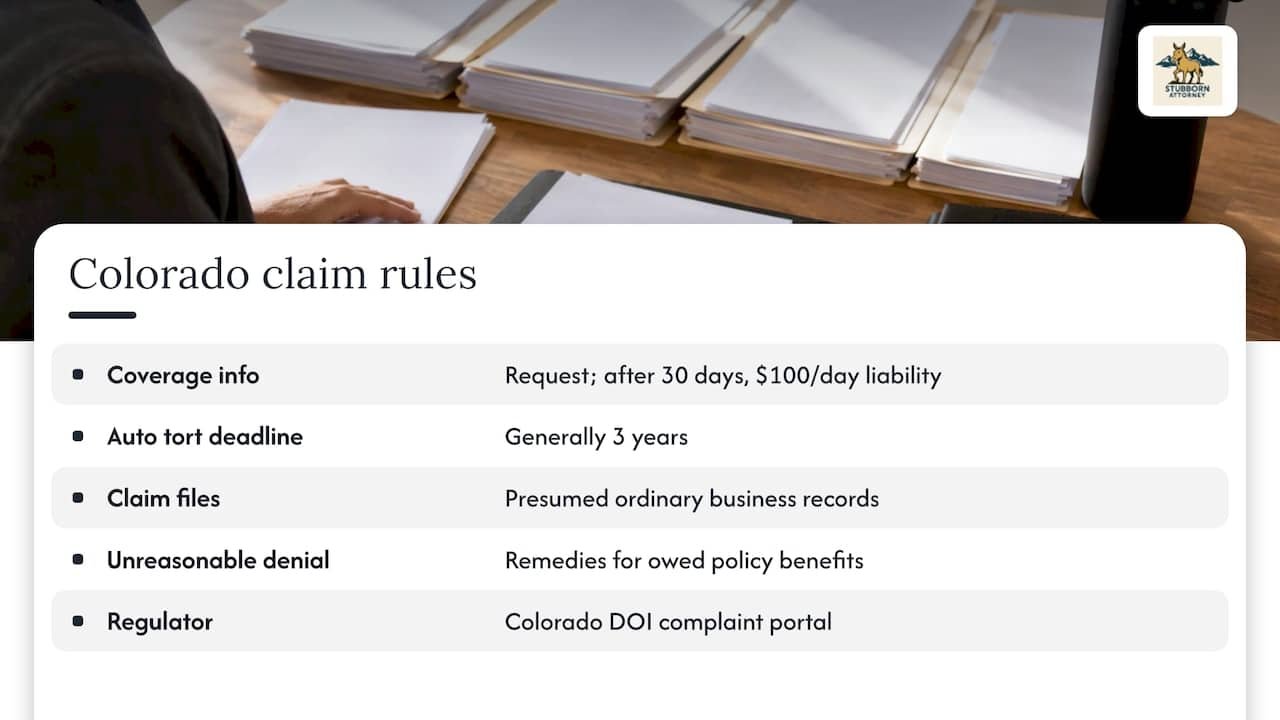
Coverage information. Under C.R.S. § 10-3-1117, a person with a potential automobile-liability claim can request relevant policy-coverage information from the insurer. According to the Colorado General Assembly’s case summary, failing to respond within 30 days can create liability of $100 per day, subject to the statute and current case law. Knowing how much coverage is available shapes the whole strategy of a claim.
Time limits. Colorado generally allows three years to bring a tort action for bodily injury or property damage arising from the use or operation of a motor vehicle, under C.R.S. § 13-80-101(1)(n), as enacted in 1994. Other kinds of claims, including those against government entities or involving a death, can follow different rules, so confirm your own deadline with a lawyer early rather than near the end.
Claim files are generally discoverable. In Lazar v. Riggs (2003), the Colorado Supreme Court affirmed that an insurer’s internal claim files and recorded statements are presumed to be ordinary business records rather than protected trial-preparation materials. In a lawsuit, that means a lawyer can generally ask for how the insurer handled your claim. A lawyer who has worked in claims knows what is in those files and what to ask for.
Unreasonable delay or denial. Colorado also has remedies when an insurer unreasonably delays or denies benefits owed under a policy, set out in C.R.S. § 10-3-1116. These apply to people claiming benefits under their own policy, such as uninsured motorist coverage. Our page on Colorado insurance bad faith claims covers how evidence is built in those cases.
Complaints to the regulator. The Colorado Division of Insurance regulates auto insurance in the state, and consumers can submit questions or complaints through its complaint portal. That is a process the law gives to an authority, and we can help you make sense of when it fits your situation.
What to do when an adjuster calls
The first call usually comes within days of the crash, often while you are still in pain and sorting out a rental car. A few habits protect you.
- Get medical care first. Your health comes before any claim. Tell the provider about every symptom, even mild ones, so the record reflects the crash.
- Give basic facts only. Your name, contact details and the date and place of the accident are fine. Avoid guessing about speed, distances or how you feel. “I’m fine” said at the scene or on a call can be quoted back later.
- Be careful with a recorded statement. The other insurer’s adjuster is not required to be looking out for you. Before you agree to a recorded statement, talk to a lawyer.
- Do not sign a medical release that is broader than needed. A blanket authorization can give an insurer years of unrelated records to comb through for a prior-condition argument.
- Do not accept the first offer to close the claim. Once you sign a release, the claim is over, even if your treatment turns out to be longer than expected.
- Keep a file. Save photos, the police report number, bills, pay stubs, treatment dates and a short daily note on pain and limits.
- Call a lawyer early. The sooner we are in the conversation, the less you have to say to the insurer yourself.
When you have a lawyer, Colorado’s Rule of Professional Conduct 4.2 generally bars a lawyer from communicating about the matter with someone they know is represented, absent consent. In practice, once you hire us, the calls about your case run through our office and the insurer’s lawyers or adjusters deal with us, not with you.
When to bring in a lawyer after a Colorado Springs crash
Plenty of fender benders settle with a property damage check and nothing else. The situations below are different, and they are where a lawyer’s background in claims pays off.
- You were taken for medical care, or you are still treating. Medical bills, lost wages and ongoing symptoms make the claim larger and more contested.
- Fault is disputed. If the other driver blames you, or the police report is unclear, the insurer will push your share of fault up.
- The offer arrives fast. An early payment before your treatment is finished usually undervalues the claim.
- The other driver is uninsured or underinsured. Your claim runs through your own policy, where the unreasonable delay rules above can matter.
- A truck, motorcycle, bicycle or pedestrian is involved. These crashes tend to produce serious injuries and more complicated insurance and liability questions. We handle motorcycle and semi-truck cases as well as car crashes.
- A family member died. Wrongful death claims carry their own deadlines and rules, covered on our wrongful death in a car crash page.
- The adjuster stops returning calls, or the tone changes. That is often when the insurer has decided on its number.
For a step-by-step on timing, see when to hire an automobile accident attorney.
Fees: what a contingency arrangement means
Most injury lawyers, including us, are paid through a contingency fee: the firm receives a percentage of the recovery, and you owe no attorney fee if there is no recovery. Colorado regulates these agreements. Under the Colorado contingent-fee rules, effective January 1, 2021, the agreement must be in writing and state the precise percentage. It must also address expenses, including an estimate, the lawyer’s authority to incur costs and a maximum amount absent further written authorization. The final statement must show the recovery, the expenses and how the fee was computed.
Before you sign with any firm, read the agreement for four things:
- The percentage, and whether it changes if the case goes to a lawsuit.
- How case expenses (records, experts, filing fees) are handled.
- Whether the percentage is applied before or after expenses.
- What you will see on the closing statement.
We explain how this works in our guide to contingency fees in Colorado. Because we take cases on contingency, you can start with a free case review and learn where you stand without paying up front.
A worked example
Here is a simplified, hypothetical illustration, not a past case or a prediction.
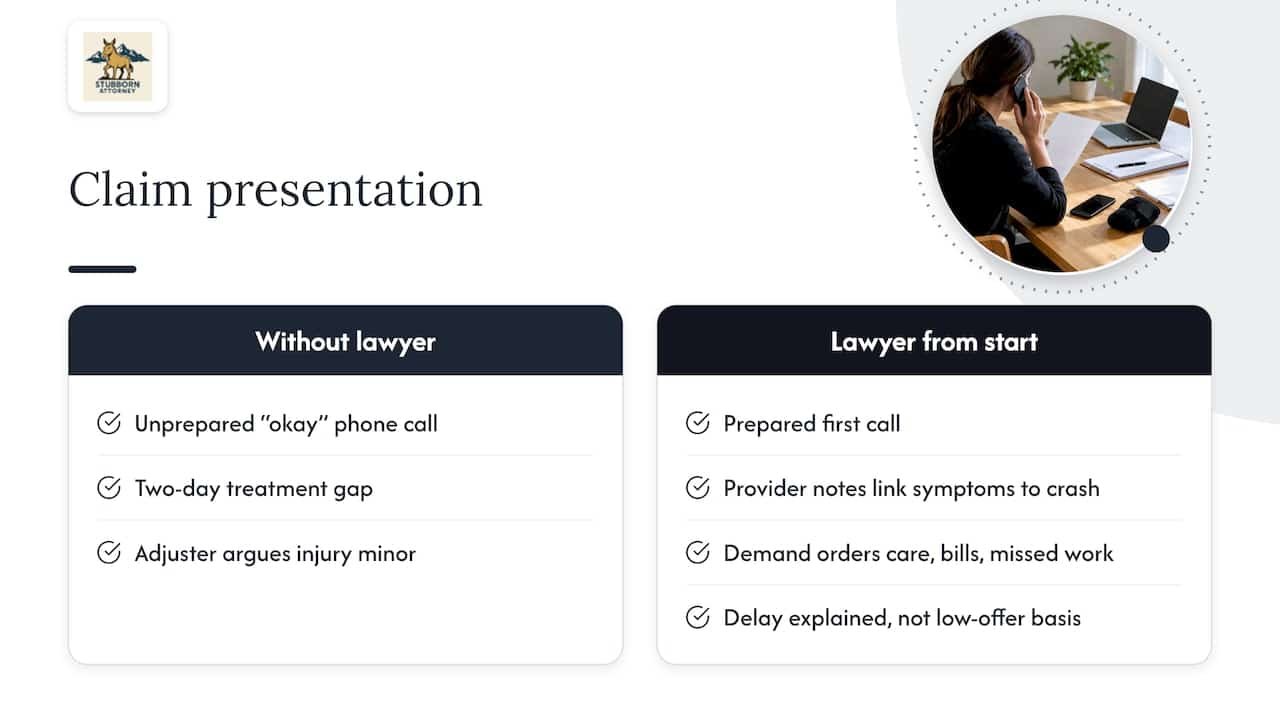
A Colorado Springs driver is rear-ended on a weekday morning. She feels sore, declines an ambulance and tells the other driver’s adjuster on the phone that she is “okay.” Two days later her neck pain worsens and she sees a doctor. Her treatment lasts several months, and the adjuster points to the first call and the two-day gap to argue the injury was minor.
With a lawyer from the start, the first call is not made without preparation. The medical timeline is documented with the provider’s notes tying her symptoms to the crash. The demand package presents the treatment, bills and missed work in the order a reviewer needs them. The gap becomes an explained delay, not a reason for a low offer.
Nothing there guarantees a result. It shows why how a claim is built and presented matters as much as the injury itself.
Our perspective
I spent time on the other side of the desk, evaluating claims for the federal government. I know the questions an adjuster asks and the reasons a file gets valued lower than it should be. I have been a lawyer for over a decade, and I use that knowledge only for injured people. That is all Malnar Injury Law does.
We chose the name StubbornAttorney because I love mules and Colorado’s mountain trails, and because a mule does not quit when the path gets steep. It is the same team and the same commitment you have always had from us. When we take your case, we do not let go.
We have settled hundreds of injury cases and recovered millions of dollars for people like you. Your case is handled directly by attorneys, not run through a case mill. We want you to heal, and we want the insurer to deal with someone who knows exactly how it evaluates a claim.
Ryan
Talk to us about your Colorado car accident
If you are dealing with an adjuster after a crash in Colorado Springs or elsewhere in Colorado, we can review your situation. We represent injured victims in car, truck, motorcycle, bicycle and pedestrian accidents, and in slip and fall, wrongful death and medical malpractice cases. You can start with our Colorado Springs car accident lawyer page or see the full range of personal injury services. We also work with clients outside the city, including through our Pueblo and Calhan location pages.
FAQ
Does a former adjuster make a better car accident lawyer?
Not automatically, but the experience is relevant. A lawyer who has evaluated claims knows what reviewers look for and how files are valued. That helps in preparing your records and negotiating. It does not guarantee a particular result, because each claim depends on its own evidence.
What percentage do personal injury lawyers take in Colorado?
The percentage is set in each lawyer’s written fee agreement, and Colorado’s contingent-fee rules require the agreement to state it precisely and address case expenses. Read the agreement for how the percentage applies and how costs are handled. With a contingency arrangement like ours, you pay no attorney fee unless there is a monetary recovery.
Can I talk to the insurance adjuster myself?
You can, and you will probably be contacted soon after the crash. Stick to basic facts, avoid guessing about your injuries and talk to a lawyer before giving a recorded statement or signing a release. Once you are represented, the insurer generally deals with your lawyer about the claim.
How long do I have to file a car accident injury claim in Colorado?
Colorado generally gives three years for a tort action for bodily injury or property damage from the operation of a motor vehicle under C.R.S. § 13-80-101(1)(n). Some claims, such as those involving a government entity or a death, have different timelines. A lawyer can confirm the deadline in your case.
Can I sue the adjuster personally?
The claim in a car accident case is normally against the at-fault driver and, where the law allows, the insurer. The adjuster is the insurer’s employee handling the file. A lawyer can tell you who the proper parties are in your situation.
Sources
- Cases of Note, Colorado General Assembly
- 1994 Colorado session law on motor-vehicle limitation periods
- Lazar v. Riggs, Colorado Supreme Court (2003)
- C.R.S. § 10-3-1116, remedies for unreasonable delay or denial of benefits
- Colorado Division of Insurance, File a Complaint
- Colorado Rules of Professional Conduct
- Colorado Rule Change 2020(31), Rules Governing Contingent Fees