

Colorado Child Injury Claims: What Parents Need to Know
If your child was hurt because someone else was careless, you have legal options in Colorado, but the rules differ from an adult’s claim. A child cannot bring a lawsuit alone, so a parent or guardian files on the child’s behalf. Any money recovered belongs to the child, and a court will often supervise how it is handled. Parents may also hold their own claim for the medical bills they paid. This guide walks through each piece in plain terms, with extra detail for car crashes, since that is where most families first meet the process.
This is general information, not advice on your case. Deadlines and approval rules turn on the facts, so talk with a Colorado personal injury attorney before you sign anything from an insurance company.
Table of Contents
- What a child injury claim is, and what it is not
- Who actually files the claim
- Who protects the money after a settlement
- What damages can cover for a child
- Child injuries in car accidents
- Proving fault when a child was hurt
- Deadlines: do not assume your child has unlimited time
- How long should you wait before settling?
- Our perspective: why parents should not go it alone
- How we can help your family
- Questions parents ask
- Sources
What a child injury claim is, and what it is not
Kids get hurt all the time, and most injuries are nobody’s legal fault. Colorado’s guide to injuries involving children notes that some injuries come from a child’s own mistakes or are pure accidents. But children can be victims of negligence just like adults. A claim exists when someone failed to use reasonable care and that failure injured your child.
In practice, the situations we see most often include:
- A crash where your child was a passenger in your car, another family’s car, or a school or carpool vehicle.
- A child struck while walking or riding a bike near a street or driveway.
- A fall on a store floor, apartment stairs or other property that was not kept reasonably safe.
- An injury caused by a defective product.
- Harm from medical care, including birth injuries.
Each of these follows different liability rules. A crash turns on driver negligence and insurance coverage. A fall at a business turns on what the property owner knew or should have known. Our guide to Colorado premises liability claims covers that second path, and our overview of personal injury compensation types shows how the pieces of a claim fit together.
Who actually files the claim
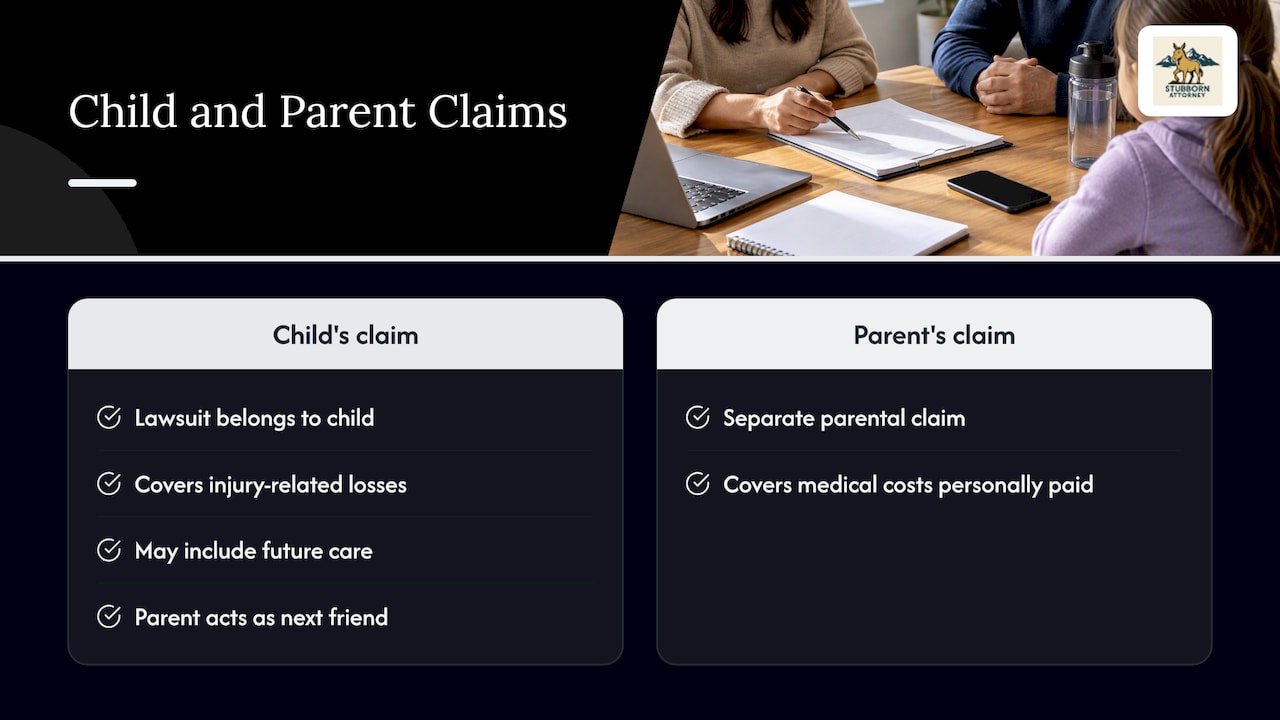
In Colorado, a child cannot legally file an injury lawsuit alone. According to the Colorado guide to child injuries, a parent or legal guardian brings the case as the child’s “next friend.” The lawsuit still belongs to the child. You are acting for your son or daughter, not for yourself.
That matters for two reasons.
First, you are the decision-maker. You choose the attorney, you approve strategy, and you decide whether to accept an offer, subject to the court oversight described below.
Second, the claim is not only the child’s. Parents can hold their own, separate claim. The same source explains that parents may have separate rights to recover medical expenses they personally paid on the child’s behalf. If you paid the emergency room deductible, the physical therapy copays and the prescriptions, those costs are part of the picture, and it is worth sorting out which claim covers which expense before anything settles.
Who protects the money after a settlement
Families are often surprised by this part. A settlement in a child’s case is legally the child’s property. It is not a family fund and it is not yours to spend. The same Colorado guide explains that these settlements often need court approval so the court can confirm the amount is in the child’s best interest, and that a conservator is frequently appointed to manage the funds.
What that looks like in practice:
- Negotiation. Your attorney and the insurer agree on a number, subject to approval.
- Court review. A judge looks at the injuries, the medical records, the proposed amount and how fees and expenses will be paid.
- Protection of the funds. The court may direct that the money be held or managed for the child instead of handed over in a lump sum.
The details vary by case size and the court involved, so ask your attorney how approval would work in your county before you agree to any figure. A good lawyer builds this step into the plan from day one. It is also another reason not to accept a quick check from an adjuster who tells you the matter can be closed with a signature today.
What damages can cover for a child
Colorado recognizes two broad categories of damages in a minor’s injury case, per the Colorado child injury guide:
- Economic losses: medical bills, including future care, and loss of future earning capacity.
- Noneconomic losses: pain, suffering and emotional stress.
Children raise questions adults do not. A broken arm that heals in ten weeks is one thing. A growth plate injury, a traumatic brain injury or a scar on a six-year-old’s face may affect school, sports, confidence and earning power for decades. Future needs have to be documented by treating physicians, not guessed at.
Colorado’s standard civil jury instruction for a minor plaintiff reflects the same logic. Colorado’s jury instruction on minor child injuries says the plaintiff has the burden of proving the nature and extent of the damages by a preponderance of the evidence. In plain terms, someone has to prove what the injury is and what it will cost your child, with records and testimony.
Colorado also limits noneconomic damages in many injury cases, and those limits have been changing. We explain how in our guides to pain and suffering claims in Colorado and the accrual date issue behind the $1.5M cap. If your child’s injuries are serious, read those before you assume any number is final.
Child injuries in car accidents
Car crashes are the situation behind most searches like this one. A child in a vehicle is exposed to someone else’s driving, and the injuries can be severe and slow to show.
Local crashes show how it happens
These events are reported news, not predictions about any case. In September 2024, a 4-year-old girl was airlifted after a three-vehicle crash in Aurora, according to FOX31 Denver. In August 2026, KRDO reported that a school cafe manager in Colorado Springs was charged with DUI and child abuse after a crash that seriously injured a 12-year-old passenger. Charges are allegations, and a criminal case is separate from a civil injury claim. But the second example shows something families should know: when the at-fault driver is also the person the child trusted, the family may face complicated insurance questions and painful decisions. Ask an attorney about every policy that could apply.
Car seat rules can affect your claim
Colorado treats child restraint violations seriously. The Colorado Department of Transportation says parents and caregivers are responsible for restraining a child properly and will be ticketed if they fail to. Safety seats should be installed and fitted according to the manufacturer’s instructions. CDOT also describes the law as a primary enforcement violation, which means an officer can stop a vehicle for it without any other reason.
Why this belongs in an injury article: an insurer may argue that a child who was not secured correctly shares fault, which raises comparative negligence. That does not automatically defeat a claim. It does mean you should be ready to show how the child was restrained, what seat was used and how it was installed.
Keep these items:
- The make, model and expiration date of the car seat or booster.
- Photos of the seat and the vehicle interior, taken before anything is cleaned or repaired.
- The seat itself, rather than throwing it away. Many insurers will replace it, but do not discard it until your attorney says so.
- The child’s height, weight and age on the crash date.
If you were the driver and you worry about your own fault, tell your attorney early. It is far easier to deal with a problem you raise than one an adjuster finds.
What to do in the first days
Our longer guide, 10 steps to strengthen an injury claim after a car accident, applies here. For a child, the short version is:
- Get your child medically evaluated, even if they seem fine. Kids may not describe pain well, and some injuries show up later. Medical records are also the backbone of the claim.
- Report the crash and get the report number. Our accident injury reporting process guide explains what to file and when.
- Photograph everything: the scene, the vehicles, visible injuries, the car seat and torn clothing.
- Write down what your child says, in their words and with the date, while it is fresh. Do not coach them.
- Keep every bill, receipt and mileage record for medical visits.
- Be careful with insurers. You can give basic facts, but do not give a recorded statement about your child’s injuries or sign a release before you understand the full extent of the injury.
- Talk with an attorney before accepting any offer.
We also keep a guide on content you need for your injury claim in Colorado with a longer list of documents.
Proving fault when a child was hurt
Proving a child’s claim uses the same core elements as any injury claim: someone owed a duty of care, breached it, and that breach caused harm. Our guides on how to prove liability in a car accident claim and car accident liability factors walk through the evidence.
Children change the evidence in a few ways:
- Young witnesses. A young child’s account may be limited. Photos, video, police reports, other adult witnesses and medical findings carry more weight.
- Medical proof of long-term effects. Pediatric specialists can speak to how an injury may affect development. Ask your child’s treating doctors whether follow-up is needed and make sure every appointment is documented.
- Shared fault questions. Insurers sometimes try to argue a child was careless. How a child’s age affects that argument is a legal question, so raise it with your attorney, not with the adjuster.
- Other people’s children. If your child was hurt as a passenger in another family’s car, the question of which insurance applies can be complicated. Our article on when your child causes a car accident covers the reverse situation.
Deadlines: do not assume your child has unlimited time
Colorado generally gives injured minors more time than adults to bring a claim, because the clock is treated differently while a person is underage. But that extra time is not a reason to wait. The parent’s own claim for medical expenses may follow a different timeline. Evidence fades, witnesses move, vehicles are repaired, and insurers press for early releases. Some claims, such as those against government entities or for medical negligence, carry their own special notice rules and shorter windows.
For a general view of how Colorado deadlines work, see our 2026 guide to key deadlines for Colorado injury claims. If medical care was involved, read about medical malpractice deadlines and caps in Colorado. Then confirm the exact date for your situation with an attorney who can look at the facts.
How long should you wait before settling?
Child injuries often need time to show their full effect. A settlement signed early may be approved on the information then available, and if your child’s recovery turns out worse than expected, it is hard to reopen. That is why a careful attorney watches for what’s called maximum medical improvement, or at least a clear picture of future care, before pushing a final number.
Some questions to ask before you accept an offer:
- Has every treating provider said what future care, if any, the child will need?
- Do the offer and the medical bills reflect the whole injury, including therapy, counseling and follow-up imaging?
- Is the offer close to the policy limits, and are there other policies (yours, a household member’s, an employer’s) that might apply?
- How would court approval and a conservator affect when and how the money is available?
- What are the attorney’s fees and case costs, and how are they handled for a minor’s settlement?
Our article on Colorado car accident settlements discusses how amounts are evaluated, and our whiplash settlement guide shows how soft-tissue injuries are treated, which can matter for teenagers in minor crashes.
Our perspective: why parents should not go it alone
We represent only injured people, and we have seen both sides of the claim. Ryan has practiced law for over a decade and was a claims adjudicator and adjuster for the federal government before that. He knows how large insurance companies and government agencies evaluate a claim, and that matters most in a child’s case.
Here is what we tell parents.
The first offer is built for speed, not for your child’s future. An adjuster looks at the bills in front of them. A parent has to think about a nine-year-old who may need care at fourteen. Those are different calculations.
Your child’s claim is not a place to be polite. Families come to us worried that pursuing a claim feels aggressive, especially when the other driver is a neighbor or a friend. The claim is usually paid by insurance, and its purpose is to cover your child’s care and losses. Being persistent is not unkind. It is the job.
Do not let money stand between your child and treatment. Our firm advertises access to medical care regardless of a client’s financial situation. Talk with us about how that works for your family.
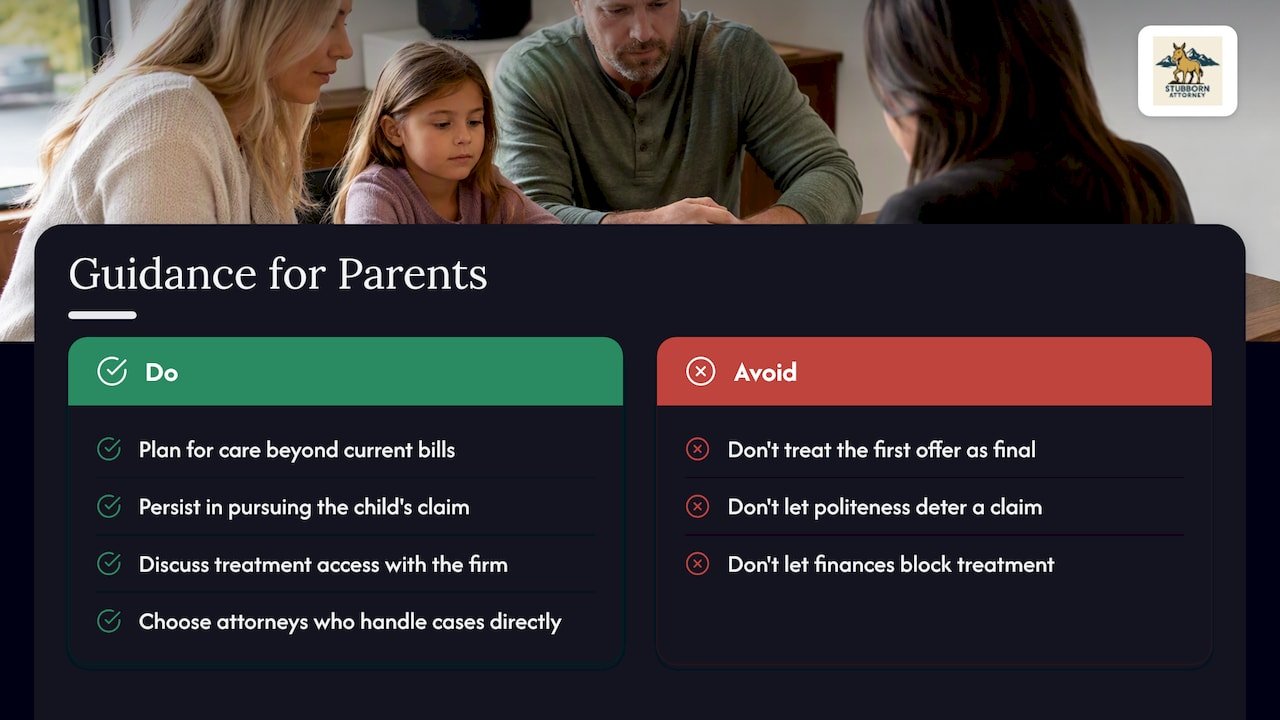
You need a lawyer who will stay with the case. We handle cases directly with attorneys instead of running them like a case mill. That is why we chose a mule as our symbol. A mule is steady and sure-footed, and it does not give up on the mountain trail. When we take a case, we do not let go.
The mule is not a gimmick. It is the standard we hold ourselves to when a family trusts us with their child’s case.
— Ryan
How we can help your family
Malnar Injury Law, now operating under the Stubbornattorney name, represents injured people in Colorado, including children hurt in car, truck, motorcycle, bicycle and pedestrian accidents, slip and fall cases, wrongful death and medical malpractice. The brand changed. The team, ownership and commitment did not. We work on a contingency fee basis, which means you pay no attorney fees unless there is a monetary recovery in the case.
If your child was hurt in a crash near Colorado Springs, start with our Colorado Springs car accident lawyer page for a free case review. You can also see the full list of services we handle. If you are still deciding whether you need a lawyer at all, read when to hire an automobile accident attorney.
Questions parents ask
Can I sue on behalf of my child in Colorado?
Yes. A child cannot file alone, so a parent or legal guardian brings the case as the child’s next friend, as explained in the Colorado child injury guide. The claim belongs to the child. You act as their representative and make decisions with your attorney.
Do I need court approval to settle my child’s case?
Often, yes. Settlements in a minor’s case commonly require court approval, and a conservator may be appointed to manage the money. Ask your attorney how this works in your county before you agree to a number, so you know when the funds will be available and who controls them.
Can I recover the medical bills I paid for my child?
Potentially. Parents may have a separate claim for medical expenses they personally paid on the child’s behalf. The child’s own claim covers things like future care, pain and emotional distress. Your attorney should sort out which expenses belong to which claim so nothing is missed or counted twice.
What if my child was not in a car seat or booster?
It does not necessarily end the claim, but it can complicate it. CDOT says Colorado’s child restraint rules are enforced as a primary violation, and an insurer may argue that improper restraint contributed to the injury. Tell your attorney exactly how your child was restrained, and keep the seat and any photos.
Does a settlement affect child support?
This question comes up often, and the answer depends on your situation, including the court orders already in place. A child’s injury settlement is the child’s property, so raise it with both your injury attorney and your family law attorney before the case resolves.
Sources
- Colorado Guide to Injuries Involving Children
- Colorado Child Passenger Safety Law, Colorado Department of Transportation
- Child airlifted to hospital with life-threatening injuries in 3-car crash in Aurora, FOX31 Denver
- School cafe manager faces DUI and child abuse charges after crash, KRDO
- Colorado civil jury instructions, Chapter 6 (Colorado Judicial Branch)