

Spinal Cord Injury Claim in Colorado: A Practical Guide
If someone else’s carelessness left you or a family member with a spinal cord injury in Colorado, you can seek compensation through an insurance claim and, if needed, a lawsuit. Three things shape that claim more than anything else: the deadline to act, how fault is assigned, and whether the full lifetime cost of the injury is counted before you settle. This guide walks through each, in plain terms, so you know what to expect and what to protect in the first weeks.
A spinal cord injury is not like most injury claims. The medical bills do not stop at discharge, and the real figure is often not knowable for a year or more. That is why the way a claim is built matters as much as the facts of the crash or fall.
Table of Contents
- What counts as a spinal cord injury claim
- The deadline: how long you have to file in Colorado
- Fault in Colorado: the 50% rule
- What compensation can cover
- Colorado’s damage caps: what is capped and what is not
- What is a spinal cord injury claim worth?
- Why you should not rush to settle
- Insurance: why the policy limits matter so much
- What to do in the first weeks
- A note on scene care and later disputes
- Our perspective: why these cases need a stubborn approach
- How an attorney builds a spinal cord injury case
- Talk with us about your claim
- Frequently asked questions
- Sources
What counts as a spinal cord injury claim
A spinal cord injury (SCI) is damage to the bundle of nerves and nerve fibers that carries signals between the brain and the body, as the National Institute of Neurological Disorders and Stroke describes it. Depending on where the damage is and how complete it is, the result can range from partial loss of sensation or strength to paralysis.
A claim exists when that injury was caused by someone else’s negligence or wrongdoing. In Colorado, the usual sources are:
- Car, truck and semi-truck crashes, including rear-end collisions, rollovers and crashes with distracted or impaired drivers.
- Motorcycle, bicycle and pedestrian collisions, where the person hurt has no protective shell.
- Falls on unsafe property, such as unrepaired stairs, icy walkways nobody treated, or poorly lit areas.
- Defective products, from vehicle components to equipment.
- Medical errors, including surgical mistakes or delayed diagnosis that turn a treatable problem into a permanent one.
For each of these, the claim has to answer the same questions: who was at fault, what did it cost you so far, and what will it cost you for the rest of your life.
If you want to see where your situation fits among injury case types, our overview of common personal injury case examples is a good starting point. For injuries this severe, our guide to what counts as a catastrophic injury in Colorado explains why the law treats them differently.
The deadline: how long you have to file in Colorado
For motor vehicle accident claims in Colorado, the statute of limitations is three years from the date the injury and its cause are known or should have been known. That sounds generous. In practice it is shorter than it feels, because a serious SCI case takes time to investigate, and filing a lawsuit is a step that has to happen before the deadline, not near it.
Two cautions apply right away:
- Government involvement can shrink the window dramatically. If a public entity is involved, for example a crash with a city vehicle or an injury tied to a poorly maintained public road, the notice deadline may be as short as 182 days. Miss it and the claim can be lost before you realize there was a clock.
- Other claim types can carry different deadlines. Falls, product claims and medical negligence cases do not all follow the three-year motor vehicle rule, and medical malpractice has its own timing rules. If your injury did not come from a car crash, confirm the deadline for your specific situation with a Colorado attorney immediately.
We cover this in more detail in our guide to Colorado spinal cord injury lawsuits and deadlines. For malpractice specifically, see our page on Colorado medical malpractice deadlines.
Fault in Colorado: the 50% rule
Colorado uses modified comparative negligence. Under this rule, you are barred from recovery if your share of fault is 50% or more. If you are less than 50% at fault, your compensation is reduced by your percentage.
A quick example. Suppose a jury finds your total damages are $4,000,000 and decides you were 20% at fault for, say, not noticing a car pulling out. Your recovery drops by 20%, to $3,200,000. If the jury put you at 50%, you would recover nothing.
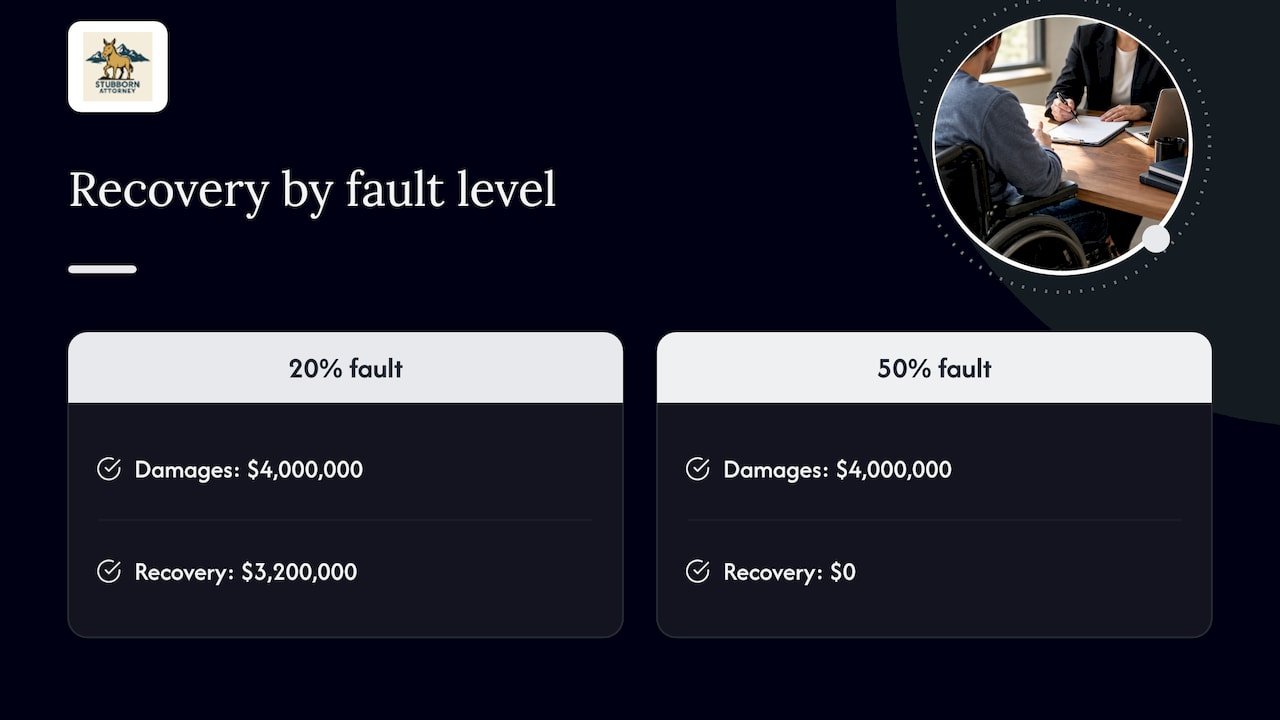
This is why insurers push so hard on small details: a pedestrian outside a crosswalk, a cyclist without lights, a driver who braked late. In an SCI case, every percentage point moves a very large number. Do not give a recorded statement to the other side’s insurer before you have talked with a lawyer, and do not guess about what you could have done differently.
Our article on the 50% rule and special verdicts in Colorado comparative negligence explains how juries are asked to assign fault.
What compensation can cover
SCI damages fall into two groups.
Economic damages
These are the measurable financial losses:
- Emergency care, surgery, hospitalization and inpatient rehabilitation
- Ongoing physical and occupational therapy
- Medications, medical equipment and wheelchairs, and their replacement over time
- Home modifications such as ramps, widened doorways and accessible bathrooms
- Vehicle modifications
- Attendant care or in-home nursing
- Lost wages and lost earning capacity over a working lifetime
For serious injuries, this category is usually the largest. Treatment for spinal cord injuries can exceed $1 million in the first year alone, according to Colorado’s insurance research cited here, and the cost of care continues for decades.
Noneconomic damages
These cover pain, suffering, loss of enjoyment of life, emotional distress and disfigurement or impairment. They are real losses with no receipt attached, and Colorado limits them.
Colorado’s damage caps: what is capped and what is not
A common misconception is that everything in a Colorado injury case is capped. It is not.
For civil actions filed on or after January 1, 2025, the cap on noneconomic damages rose from $250,000 to $1.5 million, with an inflation adjustment scheduled to begin January 1, 2028 and repeat every two years. Economic damages, meaning lifetime medical expenses, home modifications and lost earning capacity, are not subject to that cap. In a high-value SCI case, they are often the largest part of the claim.
The same law also changed other limits, including a higher wrongful death cap and rules on who may bring a wrongful death action. If your family lost someone to a spinal cord injury, read our guide to Colorado wrongful death claims, rights and damages. Medical negligence cases follow their own limits, covered on our medical malpractice page.
Because the cap depends on the filing date, a case’s timeline can affect what is available. Ask your attorney which version of the law governs your claim.
What is a spinal cord injury claim worth?
You will find websites that name a single average. Treat those numbers carefully. One published analysis puts Colorado spinal cord injury claims typically between $275,000 and $1.6 million, with severe or surgical cases reaching $11 million or more. That range is wide because no two injuries are alike, and online calculators cannot verify the facts behind their averages.
What actually drives value:
| Factor | Why it matters |
|---|---|
| Severity and level of injury | Complete versus incomplete injuries and the spinal level affect function, equipment and care needs |
| Your age | A younger person faces more years of care and more years of lost earnings |
| Earning capacity | Your work history, training and what you can no longer do |
| Available insurance | A great case can be limited by a small policy |
| Share of fault | Any fault assigned to you reduces the total |
| Quality of the life care plan | The documented, expert-built forecast of lifetime needs |
The most reliable way to value a claim is to build a detailed life care plan with medical and economic experts, rather than relying on an average. That plan is what turns “this is serious” into a number an insurer or a jury can evaluate.
Why you should not rush to settle
In spinal cord injury cases, settlement is rarely quick. The neurological outcome has to stabilize, which typically takes at least a year, and a comprehensive life care plan cannot be accurately built before then. Settling early often means significant undervaluation because the full scope of lifetime medical needs has not been calculated.
Insurers know this. An early offer can look like a lot of money when you are facing hospital bills and missed paychecks. Once you accept and sign a release, you cannot go back for more if complications, surgeries or new equipment needs appear.
Before you consider any offer, ask:
- Has my treating team told me what recovery plateau looks like?
- Has anyone priced a lifetime of care, not just this year’s bills?
- Does the offer account for replacing equipment, home changes and attendant care?
- Does it account for lost earning capacity, not just lost wages to date?
Insurance: why the policy limits matter so much
Colorado requires minimum liability auto insurance of $25,000 per person for bodily injury, $50,000 per accident, and $15,000 for property damage. Set that beside a spinal cord injury and the gap is obvious. A minimum policy can be exhausted by the first days of hospital care.
When the at-fault driver’s policy is too small, other sources may matter:
- Your own underinsured motorist (UIM) coverage, if you have it. This is why it is critical, and worth checking on your own policy today.
- Additional defendants, such as an employer when a driver was working, a vehicle owner, a company responsible for a defective part, or a property owner.
- Medical payments coverage, if your policy includes it.
Our guide to bodily injury liability in Colorado explains what that coverage does and does not pay for, and our page on financial compensation after a crash shows how different damage types fit together.
What to do in the first weeks
This is not medical advice. Your treating physicians decide your care. What follows is how to protect the claim while you focus on recovery.
- Follow your medical team’s plan and keep every appointment. Gaps in treatment are used to argue that you were not that hurt.
- Report the crash or incident. For a car crash, make sure a police report exists. For a fall, report it to the property owner or manager in writing.
- Keep records. Save bills, discharge papers, receipts, mileage to appointments, and a simple journal of daily limits and pain. Ask a family member to help.
- Preserve evidence. Photos of the scene, your vehicle and visible injuries, plus names of witnesses. Do not repair or scrap a vehicle until your attorney says the data and damage have been documented.
- Stay off social media. Photos and posts get quoted back out of context.
- Send insurers to your attorney. Do not sign medical releases broader than necessary or accept a quick check.
- Talk to a lawyer early. The early weeks are when evidence disappears and notice deadlines, especially with a government party, run out.
Our checklist, 10 steps to strengthen injury claims after a car accident, goes through the crash-specific actions in more detail.
A note on scene care and later disputes
Emergency responders often use cervical collars and backboards when they suspect a spinal injury. Clinical thinking is evolving, though. A narrative review of airway management in suspected spinal cord injury notes that manual in-line stabilization may raise the risk of failed intubation in some situations, and suggests clinicians favor the technique they are most skilled in to minimize neck movement.
Why mention it here? Because in a small number of cases, what happened in the minutes and hours after the injury can become part of the story. If you believe a delay or a mistake in diagnosis or treatment made your outcome worse, tell your attorney. That can open a separate medical negligence question, which is a different kind of case with its own rules. We do not second-guess emergency care without the records and an expert’s review, and you should not either.
Our perspective: why these cases need a stubborn approach
We handle spinal cord injuries differently from a routine fender-bender claim, because the biggest mistake is treating them as one. Insurance companies know the number that will make a frightened family say yes. We know that number is usually a fraction of what a lifetime of care costs.
Before we started representing injured people full time, I worked as a claims adjudicator for the federal government. I know how large insurers and government agencies evaluate a claim: what they look for, what they discount, and where they hope you will not push. That is the perspective we bring to every case, and it is why we focus on the evidence that supports the whole future, not only the hospital bills so far.
Our firm represents only injured people. We have been practicing for over a decade, we have settled hundreds of injury cases, and our cases are handled directly by attorneys rather than passed through a volume system. When we take a case, we do not let go. That is where the mule comes in: patient, sure-footed, and not interested in being hurried off the trail by someone who wants a quick answer.
One piece of advice we repeat to families: slow down on money, speed up on evidence. The deadline matters, but a rushed settlement can matter more.
— Ryan
How an attorney builds a spinal cord injury case
Here is what the work typically involves, so you know what you are asking for when you hire a lawyer:
- Investigation. Collecting police reports, photos, video, vehicle data, witness statements and maintenance records.
- Identifying every responsible party and every source of insurance. This is where cases with small policies are often made or broken.
- Medical documentation. Gathering records and working with treating providers on prognosis.
- Life care plan and economic analysis. Working with medical and economic experts to price future care, equipment, home changes and lost earning capacity.
- Negotiation. Presenting the full picture to insurers with the documentation to back it.
- Litigation if needed. Filing suit before the deadline and preparing for trial when an offer does not reflect the case.
For crash cases, our guide to Colorado auto accident lawyers and what victims must know explains how the process runs, and when to hire an automobile accident attorney covers timing.
Talk with us about your claim
We represent injured people in Colorado, including car, truck, semi-truck, motorcycle, bicycle and pedestrian accidents, slip and fall injuries, product liability, wrongful death and medical malpractice. Our work is on a contingency basis: you pay no attorney fee unless there is a monetary recovery in your case.
If you were hurt in Colorado Springs, see our page for personal injury representation in Colorado Springs or review all the injury cases we handle. To talk about your situation, start at stubbornattorney.com.
Frequently asked questions
How long do I have to file a spinal cord injury claim in Colorado?
For motor vehicle accidents, the deadline is generally three years from when the injury and its cause were known or should have been known. If a public entity is involved, notice may be required in as few as 182 days. Other types of claims can have different deadlines, so check your specific case with an attorney right away.
Is there a cap on spinal cord injury damages in Colorado?
Noneconomic damages such as pain and suffering are capped at $1.5 million for civil actions filed on or after January 1, 2025, with inflation adjustments starting in 2028. Economic damages, including lifetime medical costs, home modifications and lost earning capacity, are not subject to that cap. Medical malpractice and wrongful death claims have separate limits.
What if I was partly at fault?
You can still recover if you were less than 50% at fault, but your compensation is reduced by your percentage. If you are found 50% or more at fault, Colorado law bars recovery. That is why insurers focus on fault early, and why you should speak to a lawyer before giving any statement.
How long does a spinal cord injury settlement take?
Usually longer than other injury cases. The neurological outcome generally needs at least a year to stabilize before a reliable life care plan can be prepared. Settling before then risks leaving out future care you will need.
What if the at-fault driver has only minimum insurance?
Colorado’s minimum bodily injury limit is $25,000 per person, which a spinal cord injury can exhaust almost immediately. Your own underinsured motorist coverage and other responsible parties may provide additional recovery. Have your attorney review every policy that could apply.
Sources
- Average Spinal Cord Injury Settlement in Colorado, InjurySage
- InjurySage
- HB24-1472, Raise Damage Limit Tort Actions, Colorado General Assembly
- Auto Insurance, Colorado Division of Insurance
- Spinal Cord Injury, NINDS booklet
- Airway management in patients with suspected or confirmed traumatic spinal cord injury, narrative review