


Recover Colorado Diminished Value: 5 Lawyer Vetted Document First Steps
Yes, Colorado law recognizes diminished value, and you can recover it from the at-fault driver’s insurer. Order a USPAP-compliant appraisal and gather every repair invoice before you contact the insurance company. Colorado gives you three years from the crash date to file suit, but the leverage you need comes from documentation you should start collecting this week, not the week before a deadline.
Table of Contents
- What Colorado Diminished Value Means Under State Law
- How Diminished Value Is Calculated and What Proves It
- Filing a Diminished Value Claim: Step-by-Step
- Deadlines and Court Venues You Can’t Afford to Miss
- Building an Evidence File That Holds Up
- Negotiating With Insurers and Knowing When to Escalate
- Do You Owe Taxes on a Diminished Value Settlement?
- A Document-First Approach Wins More Often Than Aggressive Talk
- How Stubbornattorney Handles Diminished Value Claims
- Sources
- FAQ
What Colorado Diminished Value Means Under State Law
Diminished value is the gap between what your car was worth right before the crash and what it’s worth after it’s repaired, even with flawless bodywork. Colorado’s courts settled this decades ago: Larson v. Long (1923) and Trujillo v. Wilson (1948) both established that the proper measure of vehicle damage is the fair market value difference, plus restoration costs. A repaired frame or a stack of paint invoices doesn’t erase what a buyer will pay less for once they see it on a vehicle history report.
Colorado is a third-party diminished value state. That means you generally pursue the claim against the at-fault driver’s liability insurer, not your own policy, unless you carry specific endorsements that say otherwise. There’s no first-party statute forcing your own insurer to pay this loss automatically.
Fault still matters. Colorado’s modified comparative negligence rule (C.R.S.) A few things to keep in mind before you file:
- Confirm the other driver actually carries liability coverage. If they’re uninsured, your options shrink fast.
- The Colorado Division of Insurance (DORA) regulates insurer conduct but doesn’t force a payout. It’s a pressure valve, not a court.
- Diminished value is separate from your repair bill. Insurers sometimes act as if paying for parts and labor settles everything. It doesn’t.
How Diminished Value Is Calculated and What Proves It
The math is simple in theory: market value before the accident minus market value after repair. Proving that number is where most claims live or die.
Insurers lean on the 17c formula, a method that traces back to a Georgia class-action settlement and was never adopted as a legal standard in Colorado. It applies a damage severity multiplier and a mileage adjustment to a base value, then caps the result. In practice, 17c almost always lowballs the real loss because it ignores comparable local sales and treats every repair as roughly equal in buyer perception. You can and should push back on it with better evidence.
An independent, USPAP-compliant appraisal is usually the single most persuasive document in the file, and appraisal costs often fall within a moderate price range. A credible appraisal includes:
- Comparable sales data for your exact make, model, trim, and mileage
- Auction and dealer pricing benchmarks
- A clear explanation of methodology tied to Uniform Standards of Professional Appraisal Practice (USPAP) guidelines
- Photos and a narrative connecting the accident history to the value drop
Round out the appraisal with Kelley Blue Book (KBB) and NADA guide values pulled as of the accident date, matched to your car’s actual trim and options. Those numbers alone won’t win a claim, but stacked next to a USPAP appraisal, they show consistency an adjuster can’t easily dismiss.
Filing a Diminished Value Claim: Step-by-Step
Getting paid for diminished value in Colorado follows a predictable sequence. Skipping steps is how claims stall.
- Assemble your evidence first. Order the USPAP appraisal, pull KBB and NADA values, and request a vehicle history report from Carfax or AutoCheck showing the accident is now on record.
- Draft a demand letter. Include your VIN, the insurer’s claim number, a specific dollar figure (not a range), copies of your appraisal and repair invoices, and a response deadline, typically 14 to 21 days.
- Send it properly. Certified mail with return receipt, plus a copy through the insurer’s online claims portal, creates a paper trail that matters if the case escalates.
- Expect a counter-offer. Most adjusters open low, often citing 17c-style math. Respond in writing, point-by-point, showing why your comparable sales data is more accurate for your specific vehicle.
- Escalate if talks stall. A Colorado Division of Insurance complaint can apply regulatory pressure. For unresolved disputes, small claims court or county court becomes the next real option.
Pro Tip: Never accept the first offer verbally. Ask the adjuster to put every offer and rationale in writing. It protects you if the claim ends up in front of a judge, and it forces the insurer to commit to a number they’ll have to defend.
Deadlines and Court Venues You Can’t Afford to Miss
Colorado gives you a three-year statute of limitations from the date of the crash to file a property damage lawsuit, diminished value included. Miss that window and the claim is gone permanently, regardless of how strong your appraisal is.
There’s a sharp exception: if a government vehicle caused the accident, you generally must submit written notice within a shorter timeframe, typically around six months, far shorter than the standard three-year clock. Miss that notice period and you may lose the claim even though the three-year statute hasn’t expired yet.
Court venue depends on the dollar amount:
- Small claims court handles disputes up to a moderate dollar limit and doesn’t require an attorney, which fits many typical diminished value amounts.
- County court covers larger claims that still fall below district court thresholds.
- District court becomes necessary for higher-value disputes or when the case involves more complex liability questions.
Building an Evidence File That Holds Up
A diminished value claim rises or falls on paperwork, and insurers know most people don’t organize theirs well. Build your file in this order:
- USPAP-compliant appraisal. This is the centerpiece document and should be commissioned as early as possible.
- Pre-accident value documentation. Pull KBB and NADA figures matched precisely to your trim, mileage, and options as they stood the day of the crash.
- Complete repair invoices. Ask your shop for itemized parts lists, not just a total, and take photos before, during, and after repairs.
- Vehicle history report, police report, and every piece of insurer correspondence. Save emails, portal messages, and letters. A missing thread is a missing argument later.
For a broader look at preserving evidence right after a crash, this legal checklist walks through the basics that protect every type of claim, not just diminished value.
Negotiating With Insurers and Knowing When to Escalate
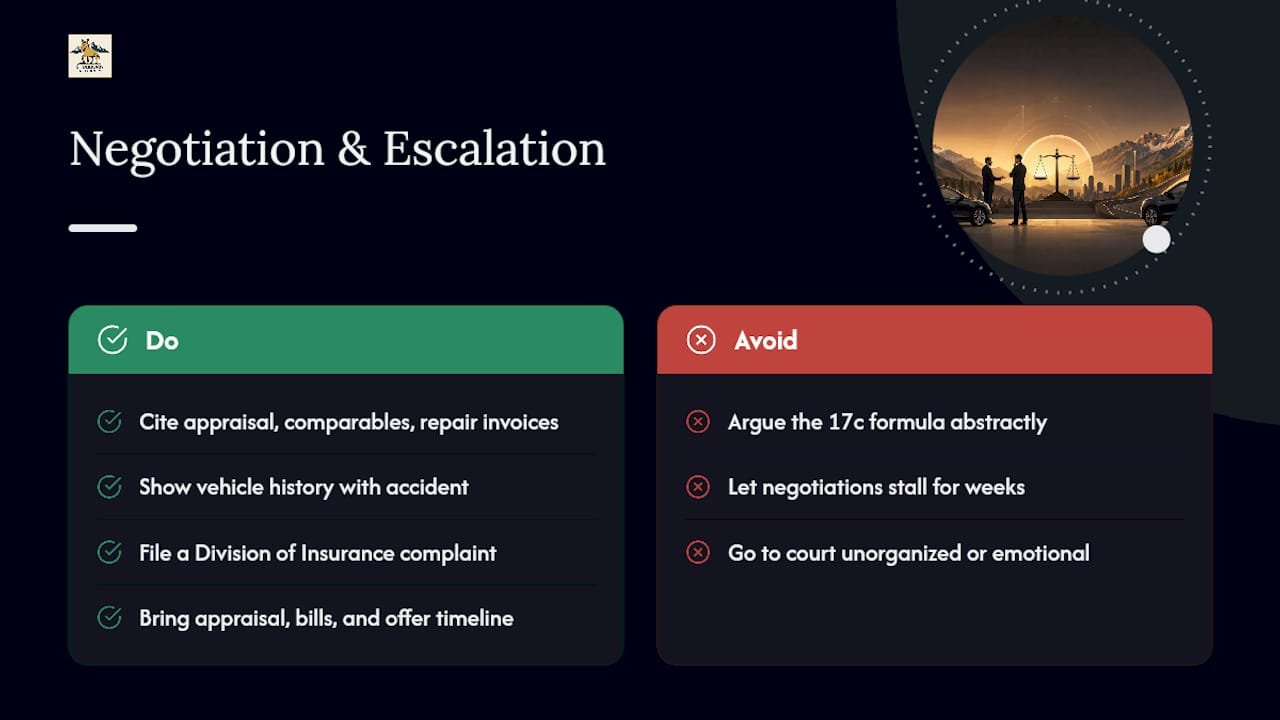
When an adjuster leans on a 17c-style number, don’t argue the formula in the abstract. Point directly at your appraisal’s comparable sales, your repair invoices, and the vehicle history report showing the accident is now permanently on record. Specificity beats philosophy in these conversations.
If negotiations stall for weeks with no real movement, a Division of Insurance complaint can trigger an inquiry into the insurer’s claims handling practices. It won’t force a settlement, but it puts the file under scrutiny the adjuster would rather avoid.
Pro Tip: If you head to small claims court, bring three things: the appraisal, the repair bills, and a printed timeline of every offer the insurer made. Judges respond to organized numbers, not frustration.
Hire an attorney when the disputed amount is large, when liability itself is contested, or when the insurer’s conduct starts looking like bad faith, repeated delays, ignored documentation, or offers that don’t move even after you’ve rebutted their formula.
Do You Owe Taxes on a Diminished Value Settlement?
In most cases, diminished value compensation in Colorado is not taxable income. The IRS generally treats payments that restore you to your pre-loss financial position as a return of capital rather than income, since you’re being compensated for a decline in an asset’s value, not paid wages or profit.
That treatment holds as long as the settlement doesn’t exceed your actual loss. If an insurer or at-fault party pays you more than your vehicle’s documented diminished value, the excess portion could potentially be taxable as income. This is uncommon in practice, since most settlements track closely to the appraised loss, but it’s worth keeping your final appraisal and settlement paperwork together in case questions come up later.
Punitive damages, if awarded in a separate legal action, are taxed differently and are generally reportable as income. Diminished value itself, though, sits in a different category since it compensates for a loss already suffered rather than punishing wrongdoing.
None of this is tax advice specific to your situation. Keep your appraisal report, repair invoices, and settlement letter together, and if your case involves an unusually large payout or overlapping injury and property damage claims, a conversation with a tax professional is worth the hour it takes.
A Document-First Approach Wins More Often Than Aggressive Talk
Most people assume a diminished value dispute comes down to who argues harder with the adjuster. It doesn’t. It comes down to who shows up with better paperwork.
Ryan Malnar spent years on the other side of claims evaluation as a federal claims adjudicator before practicing personal injury law in Colorado, and that experience shapes how these cases get built. An adjuster trained to defend a 17c number respects a USPAP appraisal and organized repair records far more than a strongly worded phone call. The leverage shifts the moment your file looks like something a judge would find credible.
That’s typically where a firm gets involved: preparing the demand letter, handling the back-and-forth with the insurer, and stepping into court if the case needs it. The mechanics matter more than the volume of the argument.
— Ryan
How Stubbornattorney Handles Diminished Value Claims
Filing a diminished value claim on your own means juggling appraisals, repair records, and an adjuster whose job is to minimize your payout. The firm reviews your appraisal and repair documentation and handles the insurer conversation on your behalf. Representation may be offered on a contingency fee basis, so clients generally do not pay upfront costs.
Bring your repair invoices, any appraisal you’ve already obtained, and your insurance correspondence to a consult, and the review moves quickly from there. If you’re weighing whether a diminished value claim is worth pursuing on your own or with representation, start with a free case evaluation to see what your specific documentation actually supports.
FAQ
What States Allow Diminished Value Claims?
Most states recognize diminished value in some form, but the rules vary widely. Colorado allows third-party claims against an at-fault driver’s insurer based on court precedent, while some states restrict recovery further or require it to go through litigation rather than direct insurer negotiation.
What Should You Not Tell Your Insurance Company?
Avoid guessing at fault percentages, speculating about injuries you’re not sure of, or giving a recorded statement before you’ve reviewed your documentation. Stick to factual details and let your appraisal and repair records do the talking on value.
What Can I Do if a Colorado Dealership Sold Me a Bad Used Car?
That’s a separate legal issue from diminished value after an accident, typically involving consumer protection or lemon law claims rather than a diminished value appraisal. A consultation can clarify which legal path applies to your specific situation.
How Much Is a Diminished Value Claim Worth?
There’s no fixed number. It depends on your vehicle’s pre-accident value, the severity of the damage, and how strong your comparable-sales appraisal is. A well-documented claim backed by a USPAP-compliant appraisal, matched KBB or NADA figures, and complete repair records consistently outperforms an insurer’s 17c-based offer.