

Colorado Ski Accident: After 13 Deaths, What Families Should Do
At least 13 people died on Colorado ski slopes during the 2024-25 season, with tree collisions and hard-impact falls the most common reported causes. If you or a loved one is hurt in a Colorado ski accident, get medical care first, then report the incident to ski patrol and preserve any evidence you can. Serious injuries and fatalities often carry legal options even when a lift ticket waiver was signed.
Table of Contents
- Recent Colorado Ski Accident Incidents You Should Know About
- What Investigators Found About Ski Accident Causes in Colorado
- Colorado’s Skier Responsibility Code and What the Law Requires
- What to Do Immediately After a Ski Accident in Colorado
- Liability, Waivers, and When You Need a Colorado Ski Accident Attorney
- Why Families Deserve a Straight Answer, Not a Runaround
- Talk to a Colorado Ski Accident Attorney Before You Talk to the Resort
- Sources
- FAQ
Recent Colorado Ski Accident Incidents You Should Know About
Colorado’s fatality count for 2024–25 marked a slight dip from prior winters but still included multiple confirmed deaths, according to a Colorado Sun survey of county coroners. That tally does not include every serious, non-fatal injury reported at resorts across the state, and it likely understates the true number of catastrophic slope injuries since many never make local news.
A few specific incidents illustrate how these accidents actually happen:
- A 44-year-old man died at Copper Mountain after crashing into a tree. He was wearing a helmet and was transported to an emergency facility, where he was pronounced dead.
- A snowboarder died at Keystone Resort after hitting the snow with force on a black-diamond run. Summit County reports described the surface as “hard and fast” that day.
- A chairlift malfunction at Vail Resort threw passengers from their seats after improperly installed lift components dating back to 2007 failed under load.
- A Castle Rock woman and mother of six was left paralyzed in a “freak” snowboarding accident at Keystone, a reminder that catastrophic outcomes happen even to experienced riders wearing protective gear.
Most of these cases trace back to intermediate or advanced runs rather than terrain parks or backcountry zones, which tells you something important: high speed on ordinary groomed terrain, not extreme features, is where the real danger concentrates.
What Investigators Found About Ski Accident Causes in Colorado
Coroner and sheriff reports on the Keystone snowboarding fatality pointed to blunt force trauma consistent with a high-speed impact on firm terrain. Summit County investigators specifically flagged the “hard and fast” snow condition that morning, the kind of surface that turns a routine fall into a life-threatening collision because it offers almost no give on impact.
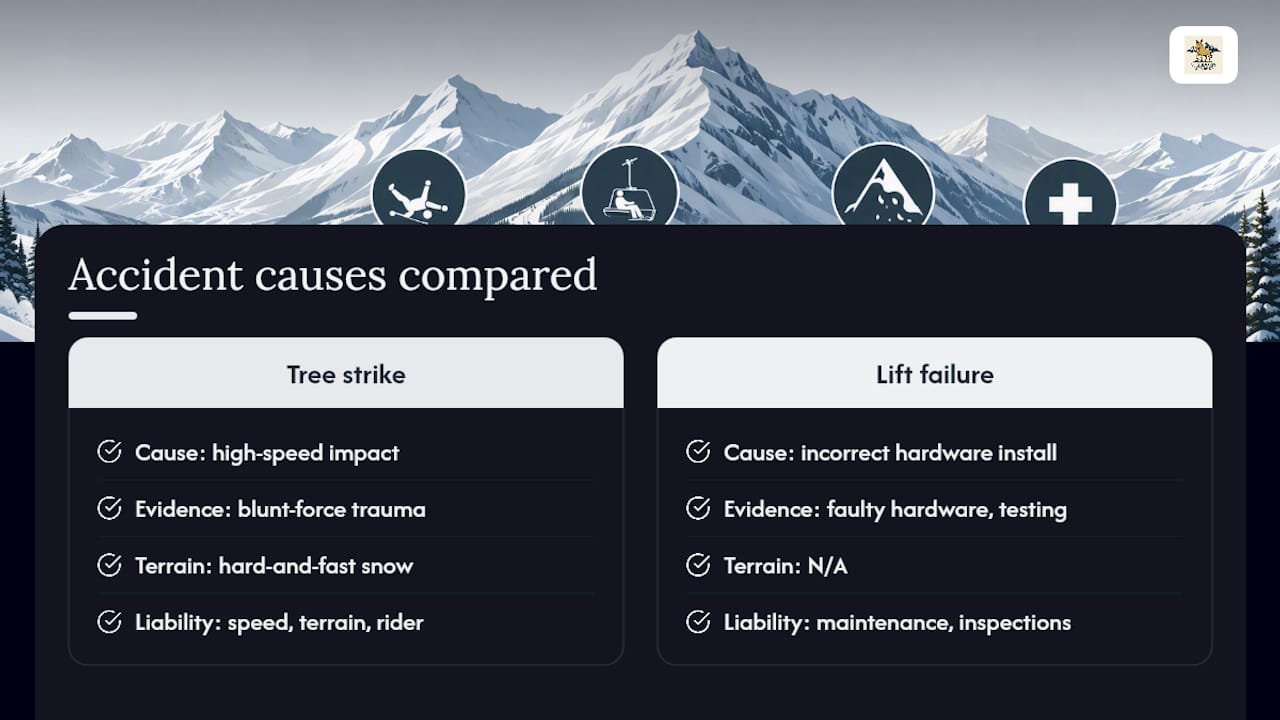
The Vail lift incident was a different animal entirely. State investigators traced the malfunction to hardware installed incorrectly in 2007, nearly two decades before it failed. The resort replaced and inspected the affected hardware and ran operational testing before returning the lift to service. That distinction matters for anyone trying to understand liability: a tree strike is usually about speed, terrain, and rider decisions, while a lift failure is about maintenance records, inspection logs, and equipment that should have been caught in a routine check.
Helmets reduce head trauma risk, but they don’t eliminate it. Investigators noted the Copper Mountain victim was wearing a helmet at the time of his fatal tree collision, and reporting on the Keystone crash flagged that helmets don’t fully protect against blunt-force injury in high-energy impacts. A helmet is essential gear. It is not armor against a 30 mile-per-hour collision with a fixed object.
Colorado’s Skier Responsibility Code and What the Law Requires
Colorado Ski Country USA maintains “Your Responsibility Code,” the industry-standard set of rules every skier and snowboarder is expected to follow. The code was updated to add duties specifically about impairment and post-collision conduct, and NSAA tracks fatality data tied to violations of these same principles through its annual fatality fact sheet.
The core duties include:
- Stay in control and be able to stop or avoid other people and objects at all times.
- Never ski or ride while impaired by alcohol or drugs.
- Exchange name and contact information with anyone involved in a collision.
- Report any collision involving injury to ski patrol or resort staff before leaving the area.
- Yield to skiers ahead of you and look uphill before merging onto a run.
Colorado’s Ski Safety Act backs several of these duties with actual legal weight, not just etiquette. Skiers who violate the code, especially the impairment and reporting rules, can face fines and in some circumstances criminal charges.
Breaking either the impairment rule or the post-collision reporting duty is now treated as a criminal matter under Colorado law, not merely a resort policy violation.
What to Do Immediately After a Ski Accident in Colorado
The minutes right after a crash shape everything that follows, including any legal claim. Move through these steps in order:
- Call ski patrol or 911 immediately if anyone is hurt, and do not move a seriously injured person unless there’s an immediate danger.
- Get medical treatment even if the injury seems minor. Adrenaline masks pain, and some head and spine injuries don’t show symptoms right away.
- Document the scene if it’s safe to do so: photos of the run, the time, snow conditions, and any equipment involved.
- Get names and contact information from witnesses before they leave the area.
- Exchange contact information with anyone else involved in the collision, as the Responsibility Code requires.
- Report the incident to ski patrol or resort staff and get an incident report number before you leave.
- Keep every record tied to the accident: medical bills, patrol reports, and photos, in one place.
Pro Tip: Ask the resort for a copy of the incident report number on the spot. Resorts sometimes take days to release full reports, and having that number in hand makes follow-up requests far faster.
If a life flight or ambulance transport was involved, note the time and destination facility. Our checklist for protecting your rights after a Colorado accident walks through documentation steps that apply just as well to slope injuries as to car crashes.
Liability, Waivers, and When You Need a Colorado Ski Accident Attorney
Most lift tickets come with a liability waiver, and many injured skiers assume that waiver ends any chance at compensation. It doesn’t always. The Colorado Supreme Court ruled that resort waivers cannot bar negligence claims tied to statutory duties, including obligations under the Passenger Tramway Safety Act governing lift operation. If a lift malfunctions because of a maintenance failure, the waiver you signed at the ticket window may not protect the resort at all.
Waivers may not preclude claims founded on violations of statutory duties, meaning a signed release does not automatically end a family’s legal options after a lift accident or a statutory safety violation.
Evidence that tends to make or break these claims includes:
- Medical records documenting the injury and treatment timeline.
- Ski patrol and resort incident reports.
- Witness statements gathered at or near the time of the accident.
- Lift maintenance and inspection logs, when a mechanical failure is suspected.
Colorado’s statute of limitations gives injured parties a limited window to file, and evidence like inspection records can disappear or get overwritten fast. That’s why early attorney involvement matters. Our ski lift accident case history covers a $12.4 million verdict that turned largely on preserved maintenance records, the same kind of evidence at stake in the Vail lift investigation.
Why Families Deserve a Straight Answer, Not a Runaround
Insurance adjusters and resort risk teams move fast after a serious accident, often before a grieving family even understands what happened. Having spent years on the other side of claims as a federal claims adjudicator, I’ve watched how quickly a company can build its defense while a family is still in a hospital waiting room. Waivers get waved around like they settle everything. They don’t, especially when statutory duties or lift maintenance are in play. If your family is facing a slope injury or a fatality, a free consultation costs nothing, and it can tell you within minutes whether you have a case worth pursuing.
— Ryan
Talk to a Colorado Ski Accident Attorney Before You Talk to the Resort
A local law firm handles Colorado personal injury cases on contingency, meaning you owe nothing unless compensation is recovered for you. That matters after a ski accident, when medical bills start arriving before you’ve even had a chance to process what happened. Bring your incident report number, medical records, and any witness contact information to your consultation, and we can tell you quickly whether a resort, a lift operator, or another party may share responsibility. Waivers rarely close every door, and the sooner maintenance records and patrol reports get preserved, the stronger your case stays. Start with a free case review with our Colorado personal injury team to find out where you stand.
Sources
- At least 13 people died on Colorado ski slopes during the 2024-25 season, marking a slight decline from recent winters
- Coroner releases name of skier who died after crash at Copper Mountain Resort
- Colorado investigation shows improperly installed ski lift parts caused accident at Vail Resort – CBS Colorado
- Your Responsibility Code | Colorado Ski Country USA
FAQ
What happened to the skier who died in Lake Chutes, Breckenridge?
Specific details from that incident are not covered in current Summit County or Colorado Sun reporting reviewed here; families seeking information on a specific Breckenridge fatality should contact the Summit County Coroner’s Office directly.
Was Natasha Richardson wearing a helmet when she fell?
Natasha Richardson was not wearing a helmet during her fall at a Quebec resort, and she died days later from an epidural hematoma that initially showed no visible symptoms.
How many people were rescued from the Colorado ski lift?
Reports on the Vail Resort lift malfunction confirmed passengers were thrown from their chair after improperly installed components failed, though an exact rescued-passenger count was not specified in state investigation findings.
Which actress was killed in a skiing accident?
Natasha Richardson, the actress known for The Parent Trap, died after a skiing fall in Quebec led to a fatal brain injury.
What should I do first after a ski collision in Colorado?
Call ski patrol or 911, get medical evaluation even for seemingly minor injuries, and exchange contact information with anyone involved, as required under Colorado’s Responsibility Code.
Can I still sue a Colorado ski resort if I signed a waiver?
Possibly. The Colorado Supreme Court has ruled that waivers cannot bar negligence claims tied to statutory duties, including certain lift-operation failures.