

How mediation works in Colorado personal injury cases
TL;DR:
- Mediation is a voluntary, structured negotiation process guided by a neutral mediator that offers Colorado injury victims more control over their case outcomes. It involves private caucuses, offers, and potential agreements, which are enforceable only when properly documented and signed. Mediation often results in flexible, non-monetary settlement terms and provides injury victims a voice to explain their human experience beyond courtroom evidence.
Most people who’ve been hurt in a car accident or injury believe mediation is just a fancy word for “settling for less.” That assumption keeps a lot of Colorado injury victims from entering the process with confidence, and it costs them. The truth is that mediation is a structured, legally recognized process that can give you more control over your outcome than a courtroom ever will. In this guide, you’ll learn exactly what mediation involves in Colorado personal injury cases, how the process unfolds step by step, what the rules say about mediator qualifications, when settlements are binding, and how to walk in prepared rather than pressured.
Table of Contents
- What is mediation in personal injury cases?
- How does the mediation process work in Colorado personal injury cases?
- Mediation rules and mediator qualifications in Colorado
- Are mediation outcomes binding or enforceable in Colorado?
- Beyond the dollars: Settlement terms and creative solutions in mediation
- Why mediation may offer more control and clarity for Colorado injury victims
- Connect with a Colorado personal injury mediation expert
- Frequently asked questions
Key Takeaways
| Point | Details |
|---|---|
| Mediation defined | Mediation is a structured negotiation process where a neutral mediator helps injury parties settle their claim outside court. |
| Colorado’s unique rules | Colorado does not certify all mediators and parties must agree on who facilitates the process. |
| Enforceable outcomes | Only written, signed, and court-approved mediation settlements are legally binding in Colorado. |
| More than money | Mediation can address many needs, including non-cash terms, creative structures, and future claims. |
| Expert guidance | Having an experienced injury lawyer leads to better mediation outcomes and protection of your rights. |
What is mediation in personal injury cases?
Now that you know mediation doesn’t mean giving up your rights, let’s define exactly how it works in Colorado injury law.
Mediation is a voluntary, structured negotiation process guided by a neutral third party called a mediator. The mediator doesn’t decide who wins or loses. Instead, they help both sides talk through the issues, identify what each party actually needs, and find common ground. Think of the mediator as a skilled guide on a difficult trail, not a judge at the top waiting to rule.
When it comes to personal injury claims in Colorado, mediation is one of three main ways a dispute can be resolved outside of a full trial. Here’s how those three paths differ:
- Mediation: Voluntary, confidential, non-binding unless a written agreement is reached. Both parties control the outcome.
- Arbitration: A neutral arbitrator hears both sides and issues a decision that is often legally binding. Less flexible than mediation.
- Courtroom litigation: A judge or jury hears evidence and decides the outcome. Public, expensive, and unpredictable.
Mediation typically enters the picture after initial negotiations between attorneys and insurance companies stall. In Colorado injury cases, mediation often happens after discovery (the formal exchange of evidence) but before a trial date is set. Courts frequently encourage or order mediation at this stage to reduce caseload and give parties a chance to resolve things on their own terms.
One of the most important things to understand is that mediation typically uses both joint presentations and private meetings, called caucuses, with the mediator moving between sides to help each evaluate their settlement options. This shuttle-style format means you’re rarely forced into a tense face-to-face confrontation with the insurance company. You have space to speak openly with your attorney in private before any offer is communicated.
Common outcomes from mediation include:
- A signed settlement agreement that closes the case
- A partial agreement on some issues while others remain open
- No agreement, with both parties proceeding toward trial
- A framework for continued private negotiations after the session
Pro Tip: Mediation is one of the few legal processes where you can negotiate for non-cash solutions, such as guaranteed future medical payments, structured payment schedules, or terms that protect your long-term care needs. Don’t assume it’s only about a single dollar amount.
How does the mediation process work in Colorado personal injury cases?
With the basics in mind, let’s look step by step at what actually happens during a mediation in a Colorado injury case.
- Scheduling and agreement on a mediator. Both parties agree on a mediator and a date. This step alone can take weeks if the parties disagree on the mediator, which is why starting early matters.
- Pre-mediation briefs. Each side typically submits a written summary of their position, including key facts, medical records, and legal arguments. This gives the mediator context before everyone enters the room.
- Opening statements or joint session. The mediation begins with opening statements from each side’s attorney. This is not a heated courtroom argument. It’s a structured summary meant to frame the issues clearly.
- Private caucuses begin. The mediator separates the parties into different rooms. This is where most of the real work happens. The mediator visits each side privately, relaying offers, asking questions, and helping each party understand the risks and strengths of their position.
- Negotiation and offer exchange. Through the mediator, offers and counter-offers are communicated. This process can take hours. A good mediator doesn’t just pass numbers back and forth. They help each side understand what the other side is really saying.
- Agreement or impasse. If both sides reach a number and terms they accept, the mediator helps draft a written agreement on the spot. If they can’t agree, the session may end without resolution, and the case can proceed to trial.
Here’s who typically attends a Colorado personal injury mediation:
- The injured party (you) and your attorney
- A representative from the insurance company, often a claims adjuster or defense attorney
- The mediator
- In some cases, expert witnesses or medical professionals may be consulted remotely
“The mediator’s role is not to decide, but to facilitate discussion and resolution.” This is the clearest way to understand what makes mediation different from any other legal proceeding. The mediator holds no power over the outcome. You do.
Understanding your rights after an injury matters deeply here, because knowing what you’re entitled to helps you evaluate every offer that comes across the table during caucuses.
Here’s a side-by-side look at how mediation compares to other resolution methods:
| Feature | Mediation | Arbitration | Litigation |
|---|---|---|---|
| Cost | Lower | Moderate | Highest |
| Speed | Faster (days to weeks) | Moderate (weeks to months) | Slowest (months to years) |
| Decision-maker | The parties themselves | Arbitrator | Judge or jury |
| Outcome binding? | Only if signed agreement | Usually binding | Binding by court order |
| Confidential? | Yes | Partially | No, public record |
| Flexibility | High | Moderate | Low |
If mediation fails, your case doesn’t disappear. It simply moves forward. No statement made in mediation can be used against you in court. That confidentiality is protected under Colorado law, which means you can speak honestly during the process without fear of those words coming back to haunt you in front of a jury.
Choosing a personal injury lawyer with mediation experience is critical here. An attorney who has sat across from insurance company representatives dozens of times knows exactly how to read an opening offer, when to hold firm, and when a creative solution is worth more than a bigger check.
Mediation rules and mediator qualifications in Colorado
Before mediation starts, you need to understand how mediators are chosen and how Colorado’s rules impact your case.
Colorado does not have a universal statewide licensing requirement for all mediators. This surprises many people. You might assume that anyone calling themselves a mediator has passed a state exam and holds a formal license. That’s not quite right here.
The Colorado Judicial Branch’s Office of Dispute Resolution (ODR) provides court-connected mediation resources and maintains a list of mediators who meet the ODR’s specific qualifications. However, the ODR does not regulate all mediators statewide. Parties in a personal injury case can also choose a private mediator, as long as both sides agree.
Here’s what separates an ODR-listed mediator from a private mediator:
| Requirement | ODR mediator | Private mediator |
|---|---|---|
| Formal training hours | Yes, required by ODR standards | Varies, no state minimum |
| Background check | Required for ODR roster | Not mandated |
| Subject matter experience | Must demonstrate relevant experience | Determined by parties |
| Selection method | Court may assign or parties choose from list | Mutual agreement between parties |
| Oversight | Colorado Judicial Branch | None, parties are responsible |
When it comes to understanding Colorado personal injury claims, the type of mediator you choose can shape the entire experience. An ODR mediator brings formal accountability. A private mediator might have deep expertise in a specific injury field, such as traumatic brain injuries or commercial vehicle accidents, which could be more valuable depending on your case.
If you’re handling a car accident claim, ask potential mediators these key questions before agreeing:
- How many personal injury mediations have you conducted in Colorado?
- What is your professional background before becoming a mediator?
- Have you handled cases involving injuries similar to mine?
- How do you typically handle an impasse?
- What are your fees, and how are they split between parties?
Both parties must mutually agree on the mediator. If you and the insurance company cannot agree, a court can appoint one. This is another reason what to look for in a lawyer matters. An experienced injury attorney will have worked with dozens of mediators and can recommend someone whose style and approach fits your case and your personality.
Are mediation outcomes binding or enforceable in Colorado?
So what if mediation results in a proposed settlement? Does that mean your case is truly resolved under Colorado law?
Not automatically. This is one of the most commonly misunderstood points about mediation. A productive mediation session does not equal a done deal until you sign a written agreement.
According to Colorado court guidance, mediation may be part of a case’s formal process, but the outcome of mediation itself is not automatically binding unless the parties reach a signed written agreement. That’s a critical distinction.
For a mediation settlement to be legally enforceable in Colorado, it generally must meet these conditions:
- The agreement must be written, not just verbal
- All parties must sign the document
- If the case is already in court, the agreement may need to be submitted and approved as a court order
- Terms must be clear, specific, and not left open to interpretation
What happens if one party signs and then refuses to follow through? The other party can take the signed agreement to court and ask a judge to enforce it. At that point, the signed document functions like a contract, and courts take breach of contract seriously. You’re not helpless if the other side tries to back out.
Here’s what you should do to protect yourself before, during, and after mediation:
- Before: Make sure your attorney has prepared a clear demand letter and reviewed all medical records, lost wages, and future care costs.
- During: Don’t sign anything in the heat of the moment. Take your time. Private caucuses exist precisely so you can consult privately with your attorney.
- After: Have your attorney review every word of any written agreement before you put pen to paper. Settlement terms can have long-reaching consequences on future medical claims.
The impact on personal injury settlement amounts from mediation is real and significant. Cases settled in mediation often resolve faster, which means you receive payment sooner and avoid ongoing legal costs.
Pro Tip: Always review the written settlement agreement with your legal counsel before signing. A single vague phrase in a release form could waive your right to future medical compensation related to the injury. Attorneys read these documents the way you’d read a trail map before a steep climb. Every detail matters.
Beyond the dollars: Settlement terms and creative solutions in mediation
Understanding the formal results is important, but mediation offers other unique benefits too.
One of the biggest advantages mediation holds over a jury trial is flexibility. A judge or jury can only award money. They cannot order future medical payments on a schedule, require behavioral changes, issue a formal acknowledgment of harm, or craft the kind of nuanced agreement that addresses your actual life situation. Mediation can do all of these things.
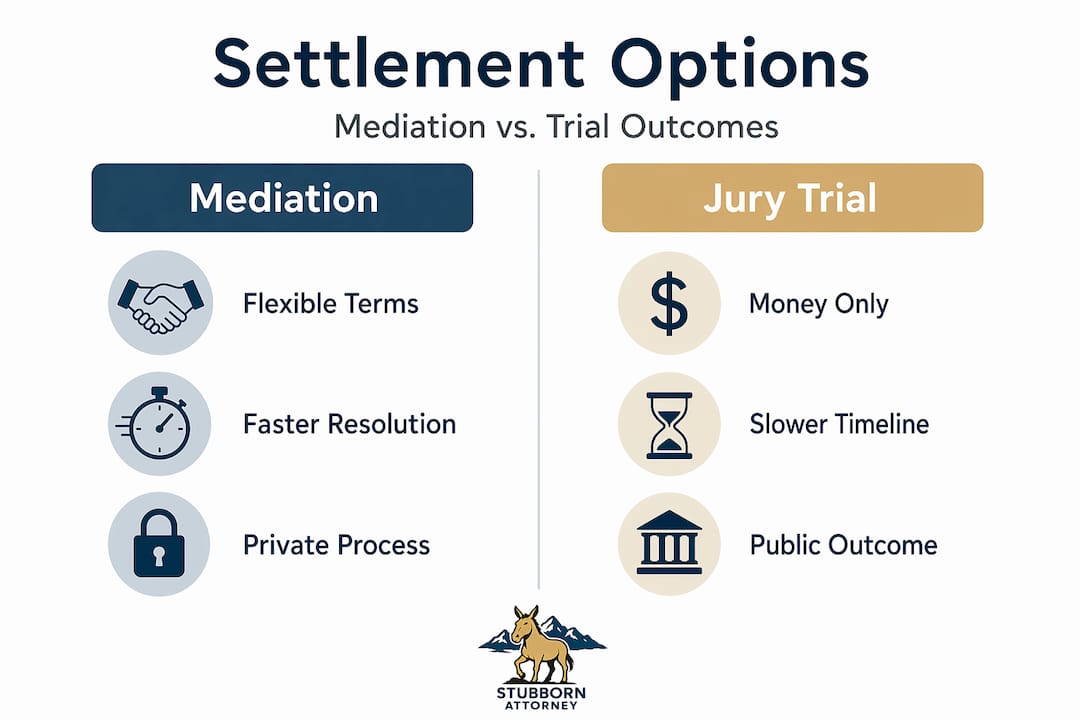
Mediation can address far more than just a cash number, including structured settlements or other settlement terms. Counsel often uses mediation to align all the components of a settlement, not just the liability dollar figure.
Non-monetary elements that can be part of a Colorado personal injury mediation agreement include:
- Structured settlements: Instead of one lump sum, payments are made over time. This can provide tax advantages and long-term financial security.
- Future medical expense arrangements: An agreement that a specific treatment or surgery will be covered, even if it occurs years from now.
- Confidentiality clauses: Both parties agree not to discuss the terms of the settlement publicly.
- Release of future claims: Carefully drafted releases that limit what future claims you are waiving, protecting you from unknowingly signing away rights to complications not yet discovered.
- Letters of acknowledgment: In some cases, parties can negotiate a formal acknowledgment of responsibility, which carries significant emotional weight for many injury victims.
Research across personal injury mediations suggests that a notable share of settlements, roughly 30 to 40 percent in many mediations, include some form of non-cash term alongside the monetary award. This isn’t a minor footnote. It reflects the reality that injury victims need more than a check. They need certainty, structure, and sometimes acknowledgment.
When thinking about factors that affect settlements, non-monetary terms can be the difference between a settlement that truly serves your recovery and one that leaves you financially exposed down the road. If you’re dealing with a serious injury that will require ongoing treatment, negotiating payment terms can be far more valuable than maximizing a one-time number.
Why mediation may offer more control and clarity for Colorado injury victims
Having explored all the technicalities and options, it’s time for a real-world perspective.
Here’s the common wisdom: mediation means you’re compromising. You’re giving up the chance to get everything you deserve in front of a jury. You’re letting the insurance company off the hook. That’s the story a lot of injury victims carry into their first conversation with an attorney.
We’ve watched this mindset cost people dearly. Not because they failed in court, but because they entered mediation with no preparation, no clear goals, and no understanding of what they actually wanted beyond a number. And numbers alone almost never tell the full story of what a serious injury does to someone’s life.
In our experience, mediation gives injury victims something a courtroom rarely can: a voice. During private caucuses, you can explain how the accident changed your daily life, what your medical journey has looked like, what you’re still afraid of about your recovery. A jury never truly hears that story. They hear evidence. Your attorney argues law. But in mediation, the human reality of your situation is front and center.
The clients who do best in mediation are the ones who walk in knowing what they need, not just what they want. There’s a difference. Wanting a large check is natural. But needing coverage for the next three years of physical therapy, or needing certainty about your child’s care if your injury affects your ability to work, those are specific, powerful negotiating positions that a skilled attorney can build a creative settlement around.
There are also cases where taking something to trial is the right call. We won’t pretend otherwise. But statistically, trials are unpredictable. Juries are human. Defense attorneys are skilled. When you enter mediation prepared, with an experienced attorney by your side and a clear picture of your goals, you often walk out with a result that fits your actual life better than any verdict could.
The real key to mediation success isn’t stubbornness for its own sake. It’s being immovable on the things that truly matter while staying creative about how to get there. That’s a philosophy we live by, both in the courtroom and on the trail.
If you’re weighing whether to pursue your case at all, understanding the reasons to pursue your injury case is the first step toward entering any resolution process with confidence.
Connect with a Colorado personal injury mediation expert
Ready to take control over your case outcome? Here’s how to get real help for your mediation.
Mediation is not something you should walk into without experienced guidance. The Colorado personal injury lawyers at Malnar Injury Law have spent years sitting across from insurance representatives, reading room dynamics, and crafting settlements that reflect what clients genuinely need. We’ve settled hundreds of injury cases and recovered millions for people across Colorado. Ryan Malnar’s background as a former federal claims adjudicator means he knows exactly how the other side evaluates your claim. Explore personal injury case examples to see what real outcomes look like, and then take the first step toward yours with a free injury case evaluation to understand your options at no risk.
Frequently asked questions
Do I have to mediate my personal injury case in Colorado?
Mediation is commonly ordered or encouraged by Colorado courts, but it is not always mandatory. Check your specific court instructions or ask your attorney whether mediation is required in your case.
What happens if mediation fails to resolve my personal injury claim?
If no agreement is reached, your case can proceed to trial or further negotiations. The mediation process using caucuses is confidential, so nothing said during mediation can be used against you at trial.
How should I prepare for a mediation session?
Work closely with your attorney to gather all medical records, document lost wages and future treatment needs, and establish a clear sense of your goals before walking into the room. Know your floor before the session begins.
Does mediation impact how much compensation I can receive?
Mediation does not cap your compensation. It can actually lead to more flexible settlement terms that address your real needs, including structured payments and future medical coverage, which a court verdict cannot always provide.
Is anything said in mediation admissible in court?
No. Mediation is confidential under Colorado law, which means statements made during the process generally cannot be introduced as evidence if your case proceeds to trial.